
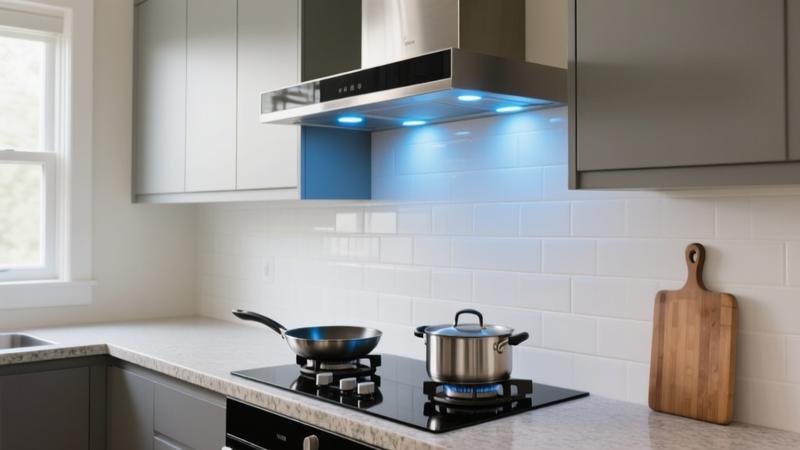
Why Indian kitchens scream for a chimney
We cook with oil, ghee and a lot of masala. That means grease-laden smoke, strong aromas and fine particulate matter. In a cramped 2-BHK, the smoke settles on cabinets, walls and even the ceiling. Breathing that air every day raises the risk of respiratory problems, especially for kids and elders. A good chimney pulls the hot, oily plume out of the room before it can cling to surfaces.
Besides health, a chimney protects paintwork and stainless steel finishes. The grease that lands on walls eventually becomes a stubborn stain that needs harsh chemicals to remove. A properly sized chimney can cut that cleaning cost by more than half.
Related: Kitchen Renovation Cost 2026 - Modular, L-Shape, U-Shape Design and Cost Guide
Types of kitchen chimneys - what fits where
- Auto-clean (Turbo) chimneys - have a built-in motor that spins a cleaning blade every 30 minutes. No manual scrubbing of the baffle. Ideal for high-usage families. Cons: higher electricity bill (about 30 W extra) and the blade can wear out in 2-3 years.
- Baffle (or filter-less) chimneys - use a series of metal plates to force the smoke to change direction, causing grease to drop into the collection tray. No replaceable filter, so cleaning is just a wash-down. Cons: slightly lower suction efficiency (5-10% loss) compared to filter models.
- Cassette (or turbo-filter) chimneys - have a detachable metal cassette that can be lifted out and rinsed. The cassette holds the grease and can be replaced every 12-18 months. Cons: extra cost for spare cassettes (Rs. 2,500-3,500 each).
- Island chimneys - mounted on the ceiling above a freestanding island. Require a duct that goes straight up and then horizontally to the outside. They look good but installation is a nightmare if the ceiling height is under 2.4 m.
- Wall-mounted (standard) chimneys - the most common type. Fixed on the wall above the cooking range, duct runs horizontally to an external vent. Easy to fit in most Indian apartments.
Suction power demystified - m3/hr numbers you can trust
People throw around "1200 m3/hr" like it's a magic number. In reality you match suction to kitchen volume and the type of cooking you do. Below is a quick reference for three typical kitchen sizes in India.
| Kitchen Size | Typical Floor Area (sq ft) | Recommended Suction (m3/hr) | Suggested Chimney Width |
|---|---|---|---|
| Small (single burner, 80-100 sq ft) | 80-100 | 800-1000 | 60 cm |
| Medium (2-3 burners, 150-200 sq ft) | 150-200 | 1200-1500 | 75 cm |
| Large (4+ burners, island, >250 sq ft) | 250-350 | 1800-2500 | 90 cm |
If you often fry pakoras or do tandoor-style cooking, bump the suction by 20-30% over the baseline. That prevents grease from building up inside the duct.
Ducted vs ductless - the real cost picture over five years
Most Indian homes go for ducted units because the exhaust goes outside. Ductless (recirculating) models use a carbon filter to trap odour and then blow the cleaned air back. They look cheap but the filter needs replacement every 6-12 months.
| Parameter | Ducted | Ductless |
|---|---|---|
| Initial cost (mid-range 75 cm model) | Rs. 12,000-15,000 | Rs. 9,000-11,000 |
| Installation labour | Rs. 3,000-4,500 (duct routing) | Rs. 1,500-2,000 (no duct) |
| Annual filter/maintenance | Rs. 800-1,200 (grease tray cleaning) | Rs. 2,500-3,500 (carbon filter) |
| 5-year total cost | Rs. 20,000-26,000 | Rs. 27,500-34,000 |
So a ducted unit costs a bit more upfront but saves you roughly Rs. 7,500 over five years. If your kitchen lacks an external wall, the ductless route may be the only option - just be ready to buy carbon filters every year.
Size matters - 60 cm, 75 cm or 90 cm
A 60 cm chimney fits a 1-burner or 2-burner gas stove. It's cheap (Rs. 8,000-10,000) but the suction is limited. A 75 cm unit covers most 3-burner setups and is the sweet spot for most Indian families. Price range Rs. 12,000-18,000 for decent models.
90 cm chimneys are meant for 4-burner gas hobs, induction clusters, or island kitchens. Expect to pay Rs. 20,000-28,000 for a reliable brand. The wider housing also means you can fit a larger filter or cassette, which translates to less frequent cleaning.
Never buy a chimney wider than the stove width. A 90 cm chimney over a 60 cm hob looks like a billboard and wastes suction power.
Installation height, duct routing and common electrician blunders
- Mount the chimney 65-75 cm above the cooking surface. Lower and the grease will splash back; higher and you lose suction efficiency.
- Keep the duct length under 3 m and avoid more than two 90-degree bends. Each bend cuts suction by about 10%.
- Use insulated metal ducting, not PVC, for outdoor runs. PVC melts if the exhaust temperature exceeds 60 °C.
- Electricians often forget to leave a 10 mm gap between the duct and the wall to accommodate thermal expansion. That causes rattling and eventual cracks.
- Some installers route the duct through a false ceiling and then down the stairwell without a proper vent cap. Result: smoke seeps back into the living area.
Filter types - what you need to clean and how often
| Filter Type | Cleaning Frequency | Replacement Cost | Typical Price (per unit) |
|---|---|---|---|
| Baffle (metal plates) | Weekly wash, deep clean monthly | None | Rs. 0 (built-in) |
| Carbon (for ductless) | Replace every 6-12 months | Rs. 2,500-3,500 | Rs. 2,500-3,500 |
| Mesh (standard filter) | Wash every 2-3 weeks | Replace every 2-3 years | Rs. 1,200-1,800 |
| Cassette (turbo-filter) | Lift out and rinse weekly | Replace cassette every 18-24 months | Rs. 2,500-3,500 |
Auto-clean chimneys still need a manual wipe of the baffle or cassette once a month; the motor only clears the surface grease, not the deep-set particles.
Maintenance schedule - keep the chimney humming
- Daily: wipe the outer steel sheet with a damp cloth. Smoke leaves a thin film that can rust if left.
- Weekly: remove the grease tray, wash with warm soapy water, dry completely.
- Monthly: deep-clean the baffle or cassette. Use a soft brush and a degreaser like "Mr. Muscle Kitchen Cleaner".
- Quarterly: inspect the duct for blockages, especially if you have a long run. A flexible brush (30 cm) works well.
- Annually: call a service tech to check the motor bearings and electrical wiring. A failing bearing can increase noise by 5-10 dB.
Top brands compared - price ranges and model highlights (2026)
| Brand | Popular Model (75 cm) | Suction (m3/hr) | Filter Type | Price (Rs.) |
|---|---|---|---|---|
| Faber | Faber Hood Evo 75 | 1400 | Turbo-cassette | 13,500-15,500 |
| Elica | Elica Splendor 75 | 1500 | Baffle | 12,000-14,000 |
| Hindware | Hindware Nova 75 | 1300 | Mesh | 10,500-12,500 |
| Glen | Glen Elite 75 | 1350 | Turbo-cassette | 13,000-15,000 |
| Bosch | Bosch DWB076E | 1550 | Baffle | 16,000-18,500 |
| Prestige | Prestige Omega 75 | 1200 | Mesh | 9,800-11,200 |
| Sunflame | Sunflame Q75 | 1250 | Turbo-cassette | 11,000-12,800 |
All listed models are CE-certified and have a warranty of at least 2 years on the motor. The price gap between Faber and Bosch is mostly due to the motor insulation and noise reduction technology - Bosch units run at 45 dB, Faber at 55 dB.
Common chimney mistakes you should avoid
- Choosing a chimney with lower suction than the cooking load. You'll see grease on the walls within weeks.
- Installing the duct too far away or using too many bends. The motor will work overtime and burn out in 1-2 years.
- Neglecting the grease tray. A full tray can cause a fire hazard - I've seen a small spark ignite the grease and smoke the whole flat.
- Using PVC duct for a high-temperature exhaust. It melts, releases toxic fumes and voids the warranty.
- Skipping the vent cap on the external wall. Rainwater can flow back into the chimney, rusting the motor.
Chimney vs exhaust fan - why they are not interchangeable
An exhaust fan simply moves air from the kitchen to the outside or to another room. It does not filter grease, so the walls still get coated. A chimney, on the other hand, captures grease in a tray or filter before the air leaves. If you only need ventilation for a small kitchenette with minimal frying, a fan of 150 m3/hr might suffice, but for any Indian cooking style you need a chimney.
FAQ
- Do I need a separate power socket? Yes. Chimneys draw 70-120 W on average; a dedicated 5 A socket avoids tripping the circuit.
- Can I use a chimney on an induction cooktop? Absolutely. The suction requirement is the same; just ensure the hood width matches the cooktop width.
- How often should I replace the carbon filter in a ductless unit? Every 9-12 months if you cook daily; more frequent if you do a lot of fried food.
- Is a stainless steel chimney better than a glass one? Stainless steel lasts longer in humid kitchens and is easier to clean. Glass looks nice but scratches quickly.
- What warranty should I look for? Minimum 2 years on motor, 1 year on filters. Some brands offer 5-year extended motor warranty at extra cost.
Related: 10 Best Kitchen Chimney in India
Related: Kitchen Chimney: Myths and FAQs
What to do when your kitchen has no external wall
Many apartments have the kitchen opening onto an internal corridor. You can still get a chimney working:
- Window duct - cut a small opening in the nearest window and fit a 150 mm duct with a weather-proof cap. Works if the window faces outside and you can lock it when not cooking.
- False-ceiling route - run the duct horizontally above the false ceiling to the nearest external wall. Use insulated aluminium ducts to avoid condensation.
- Wall extension - build a brick or steel "false wall" on the inside, then vent through it. Cost is Rs. 4,000-8,000 for materials and labour.
- Through-floor duct - in a ground-floor flat you can drop the duct through the floor slab and out the garden. Requires structural approval and a waterproof seal.
Pick the method that costs less than Rs. 12,000 and doesn't compromise the structural integrity. The cheapest is usually the window option, but make sure the window is not a fire-exit.
How Indian cooking affects chimney performance
Masala frying, tadka and deep-frying release 2-3 times more oil particles than a Western sauté. The smoke is heavier, sticks to the baffle and reduces suction by up to 30 % after just 30 minutes of continuous frying. That's why a 9,000 CMM chimney that looks over-spec for a 2-burner hob is actually the right choice for a family that does daily poori or samosa batches.
If you use a lot of ghee, the carbon filter clogs faster - change it every 4-5 months instead of the usual 12. Also, keep the flame on low to medium; a roaring flame throws larger particles that the filter can't capture, leading to greasy walls.
Cost breakdown - chimney + installation + maintenance over 5 years
| Item | Low end | Mid range | High end |
| Chimney unit | Rs. 12,000 (Faber 750 CMM) | Rs. 28,000 (Elica 1,200 CMM) | Rs. 55,000 (Hindware Island 1,500 CMM) |
| Installation labour | Rs. 3,000 | Rs. 5,500 | Rs. 9,000 (incl. False ceiling work) |
| Duct & accessories | Rs. 2,000 | Rs. 4,000 | Rs. 7,000 (insulated aluminium) |
| Filter replacements (5 years) | Rs. 4,000 (baffle only) | Rs. 8,500 (baffle + carbon) | Rs. 12,000 (premium carbon) |
| Motor service & greasing | Rs. 1,200 | Rs. 2,000 | Rs. 2,500 |
| Total (approx.) | Rs. 22,200 | Rs. 48,000 | Rs. 85,500 |
So a typical middle-class kitchen spends between Rs. 35,000 and Rs. 90,000 over five years, depending on brand, duct length and how often you replace the carbon filter. If you skimp on installation quality you will pay more in repairs later - a cheap installer can cost you an extra Rs. 5,000-10,000 in the long run.
How to read a chimney spec sheet
A spec sheet looks like a jumble of numbers. Here's what to focus on:
- CMM / motor watt - higher CMM with a motor wattage above 150 W means the unit can sustain suction for longer periods.
- Baffle vs carbon filter - baffle is washable, carbon is replaceable. Look for "dual-stage" if you want both.
- Noise dB - anything above 65 dB will be audible in a small apartment. 55-60 dB is acceptable.
- Air outlet diameter - 150 mm for < 8,000 CMM, 200 mm for > 8,000 CMM. Mismatched diameter kills performance.
Example: Elica 1,200 CMM model - 200 W motor, dual-stage filter, 60 dB, 200 mm outlet. That tells you it can handle a 90 cm hob, will be relatively quiet, and needs a 200 mm duct.