
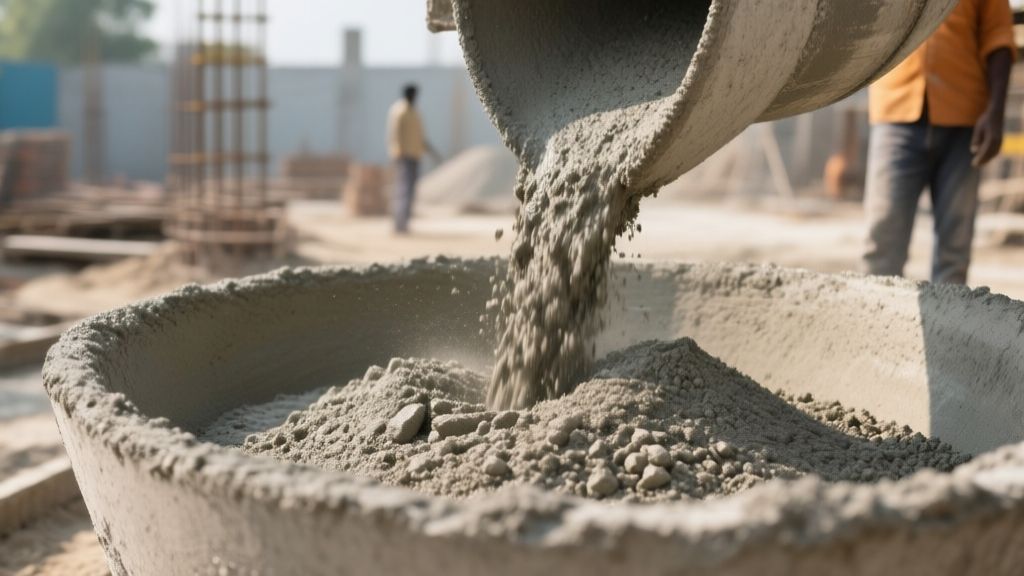
M10 Concrete Mix Ratio 2026 - Complete Guide with Proportions, Strength and Applications
Introduction
Concrete is the backbone of modern residential construction, providing the foundation, flooring, and non-structural elements that keep a building stable and durable. Among the many grades of concrete, M10 is the most basic nominal mix, often referred to as "lean concrete." In the Indian standard IS 456:2000, the designation M10 means the concrete is expected to achieve a characteristic compressive strength of 10 N/mm² after 28 days of curing.
Understanding the m10 concrete ratio is essential for contractors, site engineers, and DIY builders who need a cost-effective solution for non-load-bearing works such as plain cement concrete (PCC) beds, leveling layers, and filler walls. While higher grades like M15, M20, and M25 are required for structural slabs and columns, M10 offers a practical balance of material cost, workability, and adequate strength for applications where heavy loads are not anticipated.
In this guide we will dissect the composition of M10, compare it with other grades, provide step-by-step calculations, and share expert tips to achieve the best performance in the field. By the end of the article, you will be equipped to specify, mix, place, and cure M10 concrete confidently, ensuring that every project meets the required quality standards.
What is M10 Concrete Mix Ratio?
The notation M10 is part of the nominal mix system used widely in India and several other countries. The "M" stands for "mix," while the numeric value "10" represents the target characteristic compressive strength of 10 N/mm² (or roughly 100 kg/cm²) after a standard 28-day curing period.
- 28-day curing cycle: Concrete gains most of its strength within the first 7 days, but the 28-day benchmark is the universally accepted reference point for design and quality control. During this period, the cement hydration process continues, and the water-cement ratio, temperature, and curing method directly affect the final strength.
- Nominal vs. design mix: A nominal mix like M10 follows a fixed volume ratio (1:3:6) regardless of the specific properties of local aggregates. In contrast, a design mix is derived from laboratory trials to meet a target strength using the actual material's specific gravity, fineness modulus, and moisture content. Nominal mixes are simpler for small-scale works, while design mixes are preferred for structural elements.
- Comparison with higher grades: M15 (15 N/mm²), M20 (20 N/mm²) and M25 (25 N/mm²) are increasingly rich in cement, resulting in higher strength and durability. For example, a residential slab that will support heavy furniture or a rooftop garden typically requires at least M20. Using M10 in such scenarios can lead to excessive cracking, deflection, or even failure.
Therefore, the m10 concrete ratio is best reserved for applications where the imposed loads are light, the slab thickness is modest (generally ⤠75 mm), and cost savings are a priority.
M10 Concrete Mix Proportion: The 1:3:6 Rule
The classic nominal mix for M10 is expressed as 1 : 3 : 6 - one part cement, three parts fine aggregate (sand), and six parts coarse aggregate (gravel). This ratio is based on volume, not weight, and is designed to achieve the 10 N/mm² target when the water-cement ratio (w/c) is kept around 0.55-0.60.
Measuring by volume on site is straightforward. The most common method uses a standard wooden or steel box (often called a "gama" in Indian construction) that holds exactly 1 m³ of material. The steps are:
- Fill the box with cement and level it - this is "1 part."
- Fill the same box three times with clean, dry sand - these are the "3 parts."
- Fill the box six times with graded coarse aggregate - the "6 parts."
- Mix the dry ingredients thoroughly before adding water.
If a builder deviates to a 1:4:8 ratio (one part cement, four parts sand, eight parts aggregate), the cement content per cubic meter drops by about 20 %, resulting in a noticeable reduction in compressive strength (often to 7-8 N/mm²). This may be acceptable for a temporary fill but not for a permanent floor bed.
| Component | Nominal Parts (1:3:6) | Typical Volume (m³ per 1 m³ mix) | Typical Weight (kg per 1 m³ mix) |
|---|---|---|---|
| Cement (OPC 43) | 1 | 0.144 m³ | â 320 kg |
| Fine Aggregate (Sand) | 3 | 0.432 m³ | â 720 kg |
| Coarse Aggregate (10 mm) | 6 | 0.864 m³ | â 1 150 kg |
| Water (w/c â 0.55) | - | â 0.08 m³ | â 80 kg |
Material Specifications for M10 Concrete
Choosing the right raw materials is as important as maintaining the correct volume ratio.
- Cement: Ordinary Portland Cement (OPC) 43 grade is commonly used for M10. Portland Pozzolana Cement (PPC) can also be employed, especially where improved workability or reduced heat of hydration is desired. For M10, OPC 43 is slightly preferable because it offers a higher early strength, which speeds up form removal.
- Fine Aggregate (Sand): Sand should be clean, free from organic matter, clay, and silt. The silt content must be less than 3 % by weight. Grading should conform to IS 383:2016, with a fineness modulus of 2.3-2.8. Moisture content should be measured and accounted for during mixing.
- Coarse Aggregate: Crushed stone or hard granite with a nominal size of 10 mm is ideal for thin PCC beds. For deeper slabs (⥠150 mm) a 20 mm size may be used. Aggregates must be well-graded, angular, and free from deleterious substances. The specific gravity typically ranges from 2.6 to 2.8.
- Water: Potable or clean water is mandatory. The water-cement ratio governs workability and strength. For M10, maintain w/c between 0.55 and 0.60. Excess water reduces strength by increasing porosity and can cause shrinkage cracking.
Step-by-Step Calculation of Material Quantities
Let's calculate the material requirement for a typical site job: a 5 m × 5 m × 0.10 m (10 cm) thick plain cement concrete (PCC) floor, often used as a screed under tiles.
- Gross volume of concrete: 5 × 5 × 0.10 = 1.25 m³.
- Dry volume (accounting for bulking of sand & aggregate): Multiply by 1.54 (as per IS 10262) → 1.25 × 1.54 = 1.925 m³.
- Total parts in 1:3:6 mix: 1 + 3 + 6 = 10 parts.
- Volume of each part: Dry volume ÷ 10 = 0.1925 m³ per part.
- Cement volume: 1 × 0.1925 = 0.1925 m³ → using specific gravity 3.15, weight = 0.1925 × 3.15 × 1000 = 606 kg â 12 bags (50 kg each).
- Sand volume: 3 × 0.1925 = 0.5775 m³ → weight â 0.5775 × 2.65 × 1000 = 1 531 kg.
- Coarse aggregate volume: 6 × 0.1925 = 1.155 m³ → weight â 1.155 × 2.70 × 1000 = 3 119 kg.
- Water required (w/c = 0.58): 606 kg × 0.58 = 352 kg â 352 liters.
Summarising:
- Cement: 12 bags (â 600 kg)
- Sand: 1.53 tonnes
- Coarse Aggregate: 3.12 tonnes
- Water: 352 liters
These quantities should be adjusted for site-specific moisture in sand and aggregate. Always add a 5 % contingency for spillage and variations.
Primary Applications of M10 Concrete
M10 is predominantly used where the structural demand is minimal but a firm, level, and durable surface is required.
- Plain Cement Concrete (PCC) beds: Under tile flooring, marble, or vitrified tiles. The thin slab (75-100 mm) provides a stable base without the cost of higher-grade concrete.
- Flooring under non-structural slabs: For residential garages, patios, or garden pathways where only pedestrian or light vehicular loads are expected.
- Filler or lean concrete walls: Non-load-bearing partition walls, temporary fences, or backfill around utilities.
- Leveling and levelling courses: To correct surface irregularities before applying a finishing layer.
The key reason for selecting M10 over M20 or M25 in these scenarios is cost efficiency. Cement constitutes the most expensive component; reducing its proportion while still achieving acceptable compressive strength translates directly into lower project expenditure.
Pros, Cons, and Limitations
Pros:
- Low material cost - especially cement savings.
- Easy to mix on site with minimal equipment.
- Adequate for thin, non-structural slabs where high strength is unnecessary.
- Reduced shrinkage compared to very lean mixes (e.g., 1:5:10) because of sufficient cement content.
Cons:
- Compressive strength limited to ~10 N/mm²; not suitable for structural members.
- Higher water-cement ratio can lead to increased porosity, making the concrete more permeable.
- Susceptible to cracking if curing is inadequate or if subjected to sudden temperature changes.
Limitations: M10 should never be used for columns, beams, slabs carrying heavy loads, or in aggressive environments (e.g., marine or chemically aggressive soils) where durability is critical.
Expert Tips for Achieving Maximum Strength
- Proper curing: Immediately after finishing, keep the surface moist for at least 7 days. Ponding, wet burlap, or a fine mist spray works well. Avoid premature drying - it reduces strength by up to 30 %.
- Mixing sequence: Dry-mix cement, sand, and aggregate for 2-3 minutes to achieve uniformity. Then add 80 % of the water, mix for another minute, and finally add the remaining water to achieve the desired slump (â 75-100 mm for M10).
- Compaction: For thin PCC beds, a hand-tamped plate compactor or a vibrating screed ensures removal of air voids. Over-vibration can segregate the mix, so use controlled passes.
- Aggregate quality control: Use well-graded, clean aggregate. If the coarse aggregate contains excessive fine particles, the water demand rises, weakening the concrete.
- Admixtures (optional): A small dosage (0.5 % of cement weight) of a water-reducing admixture can lower w/c while maintaining workability, thereby increasing the final strength without adding extra cement.
Frequently Asked Questions (FAQ)
1. What does the term "m10 concrete ratio" actually mean?
It denotes a nominal mix where the target characteristic compressive strength is 10 N/mm², achieved using a volume ratio of 1 part cement : 3 parts sand : 6 parts coarse aggregate, with a water-cement ratio of about 0.55-0.60.
2. Can I use M10 concrete for a 150 mm thick floor slab?
Generally, no. A 150 mm slab will experience higher bending stresses, and the 10 N/mm² strength is insufficient. For such thickness, a minimum of M15 (or a design mix targeting ⥠15 N/mm²) is recommended.
3. How many bags of cement are required for a 10 m³ M10 mix?
Using the 1:3:6 ratio, 1 m³ of dry concrete needs about 320 kg of cement (â 6.4 bags of 50 kg). Therefore, 10 m³ will require roughly 64 bags (â 3 200 kg).
4. Is PPC suitable for M10 mixes?
Yes, PPC can be used, especially when improved workability or reduced heat of hydration is desired. However, OPC 43 generally yields higher early strength, which can be advantageous for fast-track projects.
5. What curing method gives the best strength for M10?
Ponding (covering the fresh surface with water-filled tarpaulin) or continuous mist spraying for the first 7 days provides the most consistent results. For thin beds, a wet burlap sheet works well.
6. Can I add a plasticizer to M10 concrete?
Yes. A super-plasticizer at 0.5 % of cement weight reduces the water-cement ratio without compromising workability, often raising the 28-day strength by 10-15 %.
7. How does M10 differ from ready-mix concrete?
Ready-mix concrete is typically a design mix produced under controlled plant conditions, with precise batching and quality checks. M10 is a nominal mix prepared on-site. For large projects where consistency is critical, ready-mix (see ready-mix concrete price) may be preferred.
Conclusion
Choosing the right concrete grade is a matter of balancing cost, strength, and durability. The m10 concrete ratio offers a simple, economical solution for non-structural works such as PCC beds, leveling courses, and filler walls. By adhering to the 1:3:6 proportion, observing material specifications, calculating quantities accurately, and applying proper curing and compaction techniques, contractors can achieve the expected 10 N/mm² strength reliably.
Remember: when the project demands higher loads, longer service life, or exposure to aggressive environments, graduate to a higher-grade or a design mix. Using M10 where it is not suited can lead to premature cracking, reduced lifespan, and costly repairs. For more insight into concrete fundamentals, explore our article on the difference between cement and concrete. Happy building!