OPC 43 and OPC 53 Grade Cement
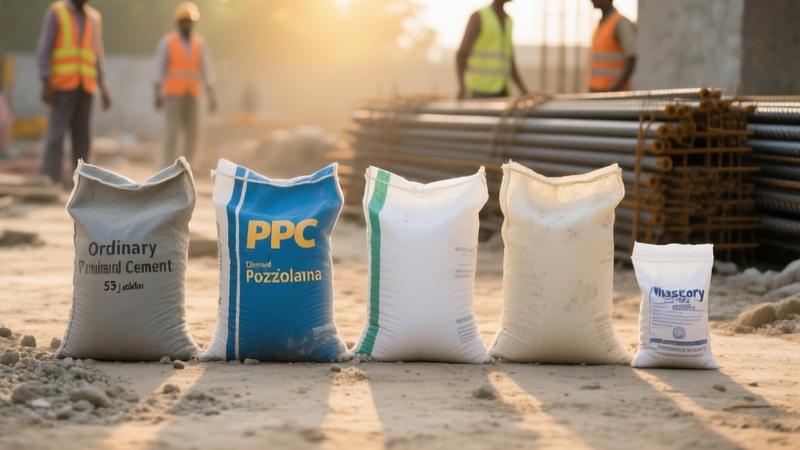
Ordinary Portland Cement (OPC) is the workhorse of Indian construction. OPC 43 is governed by IS 8112, while OPC 53 follows IS 12269. Both are made by grinding clinker with a small amount of gypsum (typically 4-5%). The difference lies in the compressive strength it must achieve at 28 days - 43 MPa for OPC 43 and 53 MPa for OPC 53.
In a typical 1,500 sq ft house, the foundation and ground floor beams demand the higher strength of OPC 53. Slab topping, plaster and non-structural walls can comfortably use OPC 43, saving a few rupees per bag. The higher grade also gives a slightly faster early strength, which helps when you need to strip formwork early.
Do not pour OPC 53 into plaster mixes that are meant for fine finish. The extra heat of hydration can cause shrinkage cracks and a rough surface. Similarly, avoid OPC 43 in high-rise piles or marine structures where aggressive exposure demands special cement types.
Brands you'll see on the market: Ultratech OPC 53, ACC OPC 43, Ambuja OPC 53, Dalmia OPC 43, Shree OPC 53, Ramco OPC 43. In 2026 a 50 kg bag of OPC 43 trades at Rs. 320-350, while OPC 53 is Rs. 340-380.
Portland Pozzolana Cement (PPC) - IS 1489
PPC blends 15-35 % pozzolanic material (fly ash, volcanic ash, or calcined clay) with OPC clinker. The pozzolan reacts with calcium hydroxide released during hydration, forming additional C-S-H gel. This gives better durability, lower heat of hydration and improved resistance to sulphates.
For residential houses in coastal Karnataka or Gujarat, where the ground water is mildly aggressive, PPC is a safe bet. It works well for slab on ground, RCC beams, and plaster where you want less cracking. The slower early strength gain (around 20 MPa at 7 days) means you should plan formwork removal after 12-14 days, not the 7-day window you enjoy with OPC 53.
Never use PPC for rapid-setting repairs or for high-rise columns that need early load bearing. The lower early strength can cause unnecessary delays.
Popular PPC brands: Ultratech PPC, ACC PPC, Ambuja PPC, Dalmia PPC, JSW PPC. Current price is Rs. 350-380 per 50 kg bag.
Portland Slag Cement (PSC) - IS 455
PSC contains 30-70 % granulated blast-furnace slag (GBFS) in place of a portion of the clinker. The slag is a latent hydraulic material; it gains strength slowly but eventually surpasses OPC in compressive strength and offers superior resistance to chloride penetration.
Use PSC for basements, underground parking, and any structure exposed to aggressive soils or seawater. It also reduces heat of hydration, making it ideal for massive footings and mat foundations where thermal cracking is a concern.
Do not rely on PSC for decorative plaster or any element that needs to be stripped within a week. The sluggish early strength will frustrate the contractor.
Brands you'll encounter: ACC PSC, Ultratech PSC, Ambuja PSC, Dalmia PSC, Birla PSC. The market price hovers around Rs. 360-400 per 50 kg bag.
Sulphate Resisting Portland Cement (SRPC) - IS 12330
SRPC is formulated with a reduced C3A content (usually < 5 %) and higher amounts of gypsum. The low C3A limits the formation of expansive ettringite when the cement meets sulphate ions.
Typical applications are foundations in black cotton soil, marine piers, and sewage treatment plant structures. If your plot is near a river or you are building a well-head, SRPC saves you from later corrosion and cracking.
Do not waste SRPC on ordinary plaster or interior walls. The extra cost (Rs. 380-420 per bag) does not translate into any benefit for non-aggressive environments.
Major brands: Ultratech SRPC, ACC SRPC, Dalmia SRPC, Shree SRPC. Prices are as noted above.
Masonry Cement - IS 3466
Masonry cement mixes OPC (usually OPC 43) with finely ground limestone, gypsum and a small amount of pozzolana. The result is a cement that gives a smooth finish and good workability for brick-mortar and plaster.
Best suited for block walls, brick-laying and interior plaster where you need a creamy mix that sets in 30-45 minutes. The added limestone improves the colour match with bricks and reduces shrinkage.
Never use masonry cement for structural concrete. Its lower compressive strength (around 25-30 MPa) makes it unsafe for beams or slabs.
Brands: ACC Masonry Cement, Dalmia Masonry, Shree Masonry. Price range Rs. 340-380 per 50 kg bag.
White Cement
White cement is OPC where the raw material mix is kept low in iron and manganese, and the kiln is run at higher temperatures to achieve a bright colour. The composition follows IS 383 (white OPC) and is often blended with white pozzolana for decorative work.
Use it for architectural finishes, terrazzo flooring, precast panels, and any place where you want a clean white look without painting. It is also the base for coloured concrete.
Do not substitute white cement for structural work unless you are prepared to pay a premium for the same strength. The price is steep - Rs. 500-560 per bag - and the colour advantage disappears under heavy loads.
Brands you'll see: Ultratech White Cement, ACC White, Dalmia White, Birla White. Prices are as mentioned.
Rapid Hardening Cement
Rapid Hardening Cement (RHC) contains a higher proportion of tricalcium silicate (C3S) and fine grinding, delivering 30 MPa strength within 7 days. It complies with IS 8112 (grade 53) but with a special processing route.
Ideal for repair works, precast elements, and projects on a tight schedule. You can strip formwork after 5-6 days, which cuts labour costs.
Do not pour RHC for large mass concrete where the heat of hydration can cause thermal cracking. The fast strength gain also means higher shrinkage risk.
Brands: Ultratech Rapid, ACC Rapid, Dalmia Rapid. Current price Rs. 380-420 per 50 kg bag.
Low Heat Cement
Low Heat Cement (LHC) replaces a portion of clinker with fly ash or slag to reduce the temperature rise during hydration. It follows IS 456 recommendations for massive structures.
Best for large foundations, dams, and thick slab pours where temperature control matters. The slower strength development is a trade-off you accept for crack-free massive pours.
Avoid LHC for small residential slabs or plaster where you need quick setting. The delayed strength will hold up the schedule.
Brands: ACC Low Heat, Dalmia Low Heat, Birla Low Heat. Price sits at Rs. 340-380 per bag.
Quick Comparison of Major Cement Types
| Cement Type | IS Code | Typical Grade | Strength (28 days) | Key Use | Not Suitable For | Price (Rs./50 kg bag, 2026) |
|---|---|---|---|---|---|---|
| OPC 43 | IS 8112 | 43 MPa | â43 MPa | Foundations, beams, slab | Plaster where low shrinkage needed | 320-350 |
| OPC 53 | IS 12269 | 53 MPa | â53 MPa | High-rise columns, heavy loads | Fine plaster, decorative work | 340-380 |
| PPC | IS 1489 | 53 MPa (effective) | â50 MPa | Coastal slabs, plaster, RCC | Rapid repairs, early stripping | 350-380 |
| PSC | IS 455 | 53 MPa (effective) | â55 MPa | Basements, marine, massive footings | Plaster, early formwork removal | 360-400 |
| SRPC | IS 12330 | 53 MPa (effective) | â55 MPa | Sulphate soils, marine piles | Non-aggressive interior work | 380-420 |
| Masonry Cement | IS 3466 | - | â30 MPa | Brick-mortar, interior plaster | Structural concrete | 340-380 |
| White Cement | IS 383 | 53 MPa (effective) | â55 MPa | Architectural finishes, terrazzo | Structural work without colour need | 500-560 |
| Rapid Hardening | IS 8112 (modified) | 53 MPa | 30 MPa @7 days | Repair, precast, fast track | Massive pours, high heat zones | 380-420 |
| Low Heat Cement | - | 53 MPa (effective) | â45 MPa | Large foundations, dams | Small slabs, plaster | 340-380 |
Practical Buying Tips
- Read the bag label. The ISI logo, followed by the grade (e.g., 53), the IS code (IS 12269), and the manufacturer's name must be printed in black ink.
- Four-digit date code. The first two digits are the year, the next two are the week of manufacture. A bag marked "2609" was made in the 9th week of 2026. Cement older than 3 months should be avoided for structural work.
- Weight check. A 50 kg bag should not be lighter than 48.5 kg. Tap the bag; a hollow sound indicates moisture loss or tampering.
- Spot counterfeit. Look for fuzzy printing, missing ISI mark, or a different shade of the brand logo. Counterfeit bags often lack the "BIS certification number" that appears after the ISI symbol.
- Store correctly. Keep bags off the ground, cover with a tarpaulin, and avoid direct rain. In monsoon-prone areas, a dry store is a must.
Related: How to Choose the Best Cement for Your Home Construction in 2026
Common Mistakes You Must Avoid
- Using OPC 53 for interior plaster. The high early strength leads to shrinkage cracks and a rough finish.
- Ignoring the ISI mark. Unmarked bags are often low-grade or mixed with fly ash beyond permissible limits.
- Storing cement in open piles during monsoon. Moisture ingress reduces the free lime content, making the cement weak.
- Using expired cement for critical columns. After 12 months the pozzolanic activity drops sharply.
- Relying solely on the float test. A bag that floats may still be counterfeit; combine with weight check and ISI verification.
More tests: Cement Quality Check at Home - 6 Simple Tests Guide 2026
Final Recommendation for a Typical 1,500 sq ft House
Lay the foundation and first-floor beams with OPC 53 (Ultratech or ACC). Use PPC for the ground-floor slab if you are near the coast, otherwise OPC 43 is fine. Choose masonry cement for brickwork mortar and interior plaster. If you plan a decorative terrazzo floor in the living room, go for white cement. Keep a bag of rapid hardening cement handy for any emergency repair.
Price-wise, a mixed bag of OPC 53 (Rs. 360 average), PPC (Rs. 365), and masonry cement (Rs. 360) will keep the total cement cost for a 1,500 sq ft house around Rs. 1.2 lac, give or take, depending on city rates.
For a quick price snapshot across brands, see Today Cement Price 2026 - All Brand Comparison. That will help you decide whether a premium brand's extra Rs. 5-10 per kg is worth it for your project.