
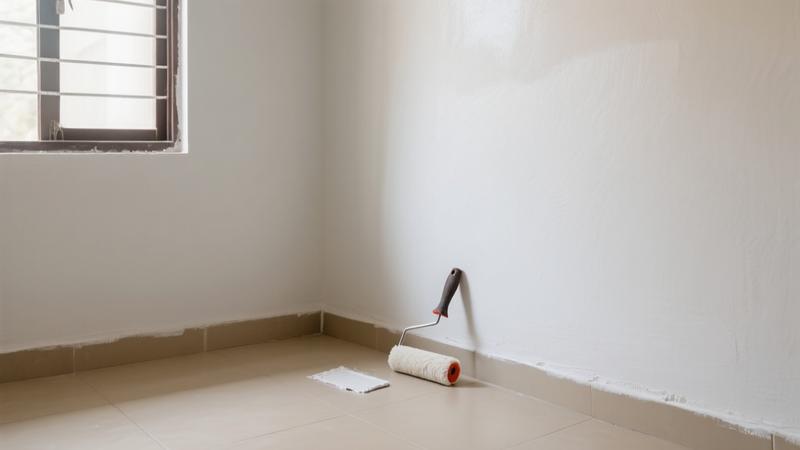
What is wall putty, POP and primer?
Wall putty, POP (Plaster of Paris) and primer sit in the same layer of the wall but they do different jobs. Wall putty is a polymer-filled filler that you spread after the plaster has set. It fills micro-holes, evens out texture and gives a paint-ready surface. POP is a gypsum-based powder you mix with water (or buy pre-mixed) and apply as the first finish coat. It builds up the wall thickness and creates a hard, smooth base. Primer is a thin, usually water-based coating that seals the substrate and improves paint adhesion. It does not fill holes; it only prepares the surface for paint.
In Indian homes the three are often mixed up. A typical sequence for a bedroom wall is: brickwork → plaster → POP (optional) → wall putty → primer → paint. Skipping any step can lead to flaking, uneven colour or cracks later.
Coverage, drying time and water mix - side by side
| Material | Coverage (per kg or litre) | Drying time (ideal) | Water mix ratio |
|---|---|---|---|
| Birla Wall Putty (25 kg pail) | ≈11 sq ft per kg (≈275 sq ft per pail) | 3-4 hrs (room temp 25 °C) | 350-400 ml water per kg putty (no sand) |
| JK Wall Putty (20 kg pail) | ≈10 sq ft per kg (≈200 sq ft per pail) | 3-5 hrs | 350 ml water per kg putty (no sand) |
| Asian Paints Wall Putty (25 kg pail) | ≈12 sq ft per kg (≈300 sq ft per pail) | 3-4 hrs | 400 ml water per kg putty (no sand) |
| POP (dry mix, 25 kg bag) | ≈1.6 sq ft per kg (≈40 sq ft per bag, 3 mm coat) | 6-8 hrs (full cure 24 hrs) | 10-12 L water per bag (ready-mix variant needs no water) |
| Pre-mixed POP (25 kg pail) | ≈20 sq ft per pail | 6-8 hrs | No water needed (ready to use) |
| Primer (1 L can) | ≈9 sq ft per litre | 1-2 hrs (touch dry) | Dilute 1:1 with water if needed |
How each material affects paint absorption
Paint absorption is the amount of paint that soaks into the wall before forming a film. High absorption means you waste paint and the finish looks patchy.
- Wall putty reduces absorption by 30-40 %. The polymer film seals pores effectively.
- POP cuts absorption by 20-30 % because the gypsum matrix is denser than raw plaster.
- Primer only lowers absorption by 10-15 % on a bare surface; on top of putty or POP the reduction is marginal.
Result: using putty first means you need roughly one coat less of emulsion paint to get the same opacity.
Smoothness and finish quality you can actually see
After sanding, the surface roughness can be measured in microns. Lower numbers mean a smoother wall and less visible brush marks.
| Material | Typical roughness after sanding | Finish quality |
|---|---|---|
| Wall putty | 1-2 µm | Ultra-smooth, ideal for matte or satin paints |
| POP | 3-4 µm | Good, but may need a second putty coat for premium finish |
| Primer only | 5-6 µm | Acceptable for textured paints, not for flat emulsion |
If you plan to use textured finishes or wall-papers, POP alone can be enough. For a sleek, modern look, putty followed by primer is the way to go.
Durability - what survives 5-10 years?
Indian homes face humidity, temperature swings and occasional wall cracks. Here's what the field data shows:
- Wall putty: 5-7 years without cracking when applied over proper plaster. Brands with acrylic binder (Birla, JK) hold up better in kitchens.
- POP: 3-5 years before minor cracks appear, especially in high-moisture zones.
- Primer: 2-3 years if you skip putty; it protects paint but does not stop underlying plaster from moving.
Combine putty + primer and you get the longest life-usually the paint stays fresh for a decade.
Cost per square foot - the numbers that matter
Below is a quick cost breakdown based on market rates in July 2026. Prices are for standard 20 kg bags or 1 L cans unless noted.
| Material | Price (Rs.) | Coverage | Cost per sq ft (Rs.) |
|---|---|---|---|
| Birla Wall Putty (25 kg) | Rs. 2,800 | ≈275 sq ft | Rs. 10.2 |
| JK Wall Putty (20 kg) | Rs. 2,500 | ≈200 sq ft | Rs. 12.5 |
| Asian Paints Wall Putty (25 kg) | Rs. 2,900 | ≈300 sq ft | Rs. 9.7 |
| POP (dry mix, 25 kg) | Rs. 1,200 | ≈20 sq ft | Rs. 60.0 |
| Pre-mixed POP (25 kg) | Rs. 1,500 | ≈20 sq ft | Rs. 75.0 |
| Primer (1 L) | Rs. 150 | ≈9 sq ft | Rs. 16.7 |
Water cost is negligible (a few rupees per sq ft). So the all-in cost for wall putty is around Rs. 10-13 per sq ft, still cheaper than POP on a coverage basis.
Brand comparison - which product gives value for money?
- Birla Wall Putty: Acrylic binder, good water resistance, works well in kitchens. Price mid-range, widely available in Tier-2 cities.
- JK Wall Putty: Slightly higher solids content, gives a harder finish. Best for high-traffic areas like hallways.
- Asian Paints Wall Putty: Lowest cost per sq ft, but the polymer film is thinner; fine for bedrooms and living rooms.
- POP (Birla POP 25 kg): Standard gypsum plaster, cheap but prone to cracking if not mixed properly.
- Primer (Nerolac Prime-Shield 1 L): Good adhesion to both putty and POP, low VOC, Rs. 165 per litre.
- Primer (Berger B-210): Slightly higher price (Rs. 180) but offers better mildew resistance for bathrooms.
All these brands are sold through local dealers; the price gap is usually Rs. 10-30 per kg for putties and Rs. 5-15 per litre for primers.
Room-wise recommendations - where to use what
- Bedroom / Living room: Two coats of wall putty, sand smooth, one coat of primer, then two coats of emulsion paint. Putty gives the sleek look you expect.
- Kitchen: Use Birla Waterproof Wall Putty (Rs. 3,200 per 25 kg) to resist steam, then Nerolac Prime-Shield primer. If you have a tiled backsplash, POP is unnecessary.
- Bathroom: Apply POP (pre-mixed) directly on plaster, let cure 24 hrs, then Berger B-210 primer (mildew-proof), finally a bathroom-grade epoxy paint. Putty is avoided because of constant moisture.
- Ceiling: POP is the preferred base because it adds a thin layer that levels out sagging plaster. Follow with a single coat of primer and two coats of matte paint.
- Exterior walls: Not covered here, but typically you skip putty, use a cement-based render, then a polymer-based exterior primer.
Related: Plastering Techniques for Indian Homes 2026 - Types, Mix Ratio and Common Mistakes
Related: POP vs Gypsum Plaster - Complete Comparison Guide for Indian Homes 2026
Step-by-step: how to apply wall putty correctly
- Clean the wall surface. Remove dust, grease and any loose plaster with a stiff brush.
- Wall putty comes ready-mix in a pail. Add 350-400 ml clean water per kg of putty (roughly 1 part water to 2.5 parts putty) and stir to a smooth, lump-free paste. Do not add sand; the polymer binder is already in the mix.
- Let the mix stand for 5-10 minutes (plastic stage).
- Using a 12 mm putty knife, apply the first coat about 1 mm thick. Work from top to bottom, overlapping strokes.
- Allow 3-4 hours to dry. Lightly sand with 120-grit paper to remove any ridges.
- Apply a second coat, this time 0.5 mm thick, to fill remaining micro-holes. Dry for another 2-3 hours.
- Final sanding with 180-grit paper gives a surface ready for primer. Wipe off dust with a damp cloth.
- Proceed to primer and paint as per room recommendation.
Common mistakes homeowners make
- Mixing too much water - the putty becomes runny, does not adhere and cracks later.
- Applying a thick coat (>2 mm) - drying stress leads to flaking.
- Adding sand or cement to wall putty - the polymer binder is pre-mixed, adding anything ruins the chemistry and the wall cracks within 1-2 years.
- Not letting the putty cure fully before sanding - you end up with uneven patches.
- Using river sand instead of M-sand or fine manufactured sand - larger particles create a gritty finish.
- Skipping primer after putty - cheap paints will soak into the putty and lose colour fastness.
Common myths about wall putty and POP
Half the advice you will hear on YouTube and from contractors is outdated. Here are the five myths that lead to the most expensive re-work:
- Myth: POP gives a smoother finish than putty. Wrong. Modern acrylic wall putty (Birla, JK, Asian Paints) gives a 1-2 micron finish; POP gives 3-4 microns. The visual difference is small, but on a high-gloss enamel you can see POP imperfections under raking light.
- Myth: Wall putty cracks after 1-2 years. Only true if you bought a cheap unbranded putty (Rs. 18-22 per kg) or applied it over damp plaster. Birla and JK branded putty lasts 6-8 years in a normal bedroom.
- Myth: POP is waterproof. POP absorbs 18-22 % water by weight. That is why bathroom walls use waterproof wall putty, not POP. POP is for dry areas only.
- Myth: Primer is optional on putty. Primer cuts paint use by 20-30 % and adds 2-3 years to the paint life. Skipping it saves Rs. 1-2 per sq ft; repainting a 1,000 sq ft wall costs Rs. 18,000-25,000 every 3-4 years instead of every 6-7 years.
- Myth: Distemper does not need primer. True for distemper, but distemper itself is a poor finish. If you are using distemper to save money, you will repaint every 2-3 years. The lifecycle cost of emulsion + primer is 30-40 % lower than distemper alone over 10 years.
How to choose the right applicator
Most homeowners hire a contractor who brings his own labour. That is fine for small repair jobs, but for a full 2BHK re-paint (1,000-1,200 sq ft wall area) you get better results by hiring a dedicated putty applicator. The difference is in the sanding. A 600-grit final sanding on a 4-inch foam pad gives a finish that a general painter will not produce, because his equipment is built for primer + paint, not for putty work.
Putty applicators charge Rs. 8-12 per sq ft for a 2-coat putty + sanding job in metros (Delhi, Mumbai, Bangalore, Hyderabad, Chennai). In Tier-2 cities the rate is Rs. 6-9 per sq ft. The total cost for a 1,000 sq ft wall area is Rs. 8,000-12,000 for labour, plus Rs. 11,000-13,000 for materials (putty + primer + sandpaper), giving Rs. 19,000-25,000 all-in before paint.
Check three things before hiring:
- The applicator should be willing to do a 1 sq ft test patch first. If he refuses, he is hiding his finish quality.
- Ask for 600-grit or 800-grit sanding on the final coat. Anything coarser shows through satin paint.
- Confirm the putty brand in writing. If the contractor says "we use whatever is in stock", expect a substandard unbranded putty that costs 40 % less but lasts 50 % as long.
FAQ
Q: How many coats of wall putty are enough?
A: Two coats for most interior walls. One coat may suffice on a perfectly smooth plaster, but a second coat guarantees uniformity.
Q: Can I use POP and wall putty together?
A: Yes. Apply POP first to level the wall, sand, then put two coats of putty for a flawless base.
Q: Is primer mandatory if I use wall putty?
A: Not absolutely, but primer ensures even paint colour and protects the putty film from solvents in the paint.
Q: What if I have a damp wall?
A: Use a waterproof wall putty (Birla or JK) and a mould-resistant primer (Berger B-210). POP should be avoided on damp surfaces.
Q: How long can I store mixed putty?
A: Mixed putty lasts about 6 hours at room temperature. If you need more time, keep it in a sealed container and add a little water before using.
Final recommendation - what to pick for a typical Indian home
If you want a wall that stays smooth for at least 8 years and you are not on a shoestring budget, go with Birla Wall Putty followed by Nerolac Prime-Shield. The cost per sq ft is around Rs. 14, which is still cheaper than POP plus extra paint. For kitchens, upgrade to the waterproof variant. Bathrooms demand POP + mildew-proof primer, not putty. Ceilings benefit from a thin POP layer before primer.
Bottom line: putty for most rooms, POP only where moisture is high, and primer everywhere you paint. That combo gives you the smoothest finish, least paint waste and the longest life without a costly re-plaster.