12mm TMT Bar Weight - The Standard Numbers
The Indian construction market has standardised the weight of thermomechanically treated (TMT) steel bars under IS 1786:2008. For a 12 mm diameter bar, the theoretical weight is 0.888 kg per metre. This figure is derived from the density of steel (â7,850 kg/m³) and the cross-sectional area of a 12 mm round bar. In practice, a 12-metre piece - the most common length supplied on site - weighs around 10.4 kg to 10.6 kg, with the exact figure depending on manufacturing tolerances and the specific grade (Fe 415, Fe 500, etc.). Understanding these numbers helps contractors and homeowners avoid over- or under-estimating material costs.
Weight Calculation Formula (D²/162.2)
The weight of any TMT bar can be quickly estimated using the simple formula prescribed by IS 1786:
Weight (kg per metre) = D² ÷ 162.2
where D is the nominal diameter in millimetres. For a 12 mm bar:
- D² = 12 × 12 = 144
- 144 ÷ 162.2 â 0.888 kg/m
This equation is reliable for the most common diameters (8 mm to 32 mm). It eliminates the need for a calculator on the site - a quick mental check can confirm whether the supplied weight matches the theoretical value.
Per Piece, Per Meter, Per Bundle - Quick Reference Table
| Diameter (mm) | Theoretical Weight (kg/m) | Weight per 12 m Piece (kg) | Typical Bundle Qty (pcs) | Bundle Weight (kg) |
|---|---|---|---|---|
| 8 | 0.395 | 4.74 | 12 | 57 - 60 |
| 10 | 0.617 | 7.40 | 12 | 88 - 92 |
| 12 | 0.888 | 10.66 | 10 - 12 | 107 - 128 |
| 16 | 1.580 | 18.96 | 10 | 190 - 200 |
| 20 | 2.466 | 29.60 | 8 | 235 - 250 |
The table above presents the 12mm TMT bar weight alongside other frequently used sizes. Note that a "bundle" is not a fixed unit; suppliers may pack 10, 12, or even 14 pieces depending on logistics. The weight range (107-128 kg) reflects this variation.
TMT Grade vs Weight (Fe 415 vs Fe 500 vs Fe 550)
While the diameter determines the theoretical weight, the grade influences the bar's tensile strength and ductility. The most common grades in residential construction are:
- Fe 415 - Minimum yield stress of 415 MPa. Suitable for low-rise housing and non-structural elements.
- Fe 500 - Minimum yield stress of 500 MPa. Preferred for slabs, beams and columns in multi-storey buildings.
- Fe 500D - Same strength as Fe 500 but with higher ductility, ideal for seismic zones.
- Fe 550 - Minimum yield stress of 550 MPa. Used in high-rise structures where higher load-bearing capacity is required.
All these grades share the same nominal weight for a given diameter because the chemical composition does not significantly alter density. However, manufacturers may apply slightly different cooling curves, resulting in a marginal weight difference (often within ±0.02 kg/m). Therefore, the grade does not affect the 12mm TMT bar weight calculation, but it does dictate where the bar can be safely used.
12mm vs Other Common Sizes (8mm, 10mm, 16mm, 20mm)
Choosing the right bar size is a balance between structural demand and cost. Here's a quick comparison:
- 8 mm - Lightest, used for light reinforcement such as plastering or non-load-bearing walls.
- 10 mm - Common for floor slabs and small beams; offers a good strength-to-weight ratio.
- 12 mm - The workhorse for residential columns, beams, and slab reinforcement. Provides sufficient strength while keeping the overall weight manageable.
- 16 mm - Required for heavily loaded beams, foundations, and columns in multi-storey structures.
- 20 mm - Reserved for massive footings, bridge decks, and high-rise column cores.
Because the weight scales with the square of the diameter, moving from 10 mm to 12 mm increases the weight by roughly 43 % (0.617 kg/m → 0.888 kg/m). This jump is reflected in the cost, but the added strength often justifies the expense in structural elements.
Practical Uses in Indian Home Construction
In a typical Indian house, 12 mm TMT bars are employed in the following ways:
- Columns - Main load-bearing columns usually receive two to three layers of 12 mm bars, tied with 8 mm stirrups.
- Beams - For 150 mm to 250 mm wide beams, a single layer of 12 mm bars (often 2-3 pieces) is standard.
- Slab Reinforcement - In 150 mm thick RCC slabs, 12 mm bars are placed at the bottom (tension zone) with 8 mm bars on the top (compression zone).
- Foundations - Strip footings and isolated footings for load-bearing walls often use 12 mm bars at 150 mm centres.
These applications align with the recommendations of the National Building Code (NBC) and the Indian Standard IS 456:2000 for concrete design. Using the correct bar size ensures compliance, reduces the risk of cracking, and improves the overall durability of the structure.
How to Verify Actual TMT Bar Weight (Buying Tips)
Even though the theoretical weight is fixed, on-site verification is essential. Follow these steps:
- Check the Manufacturer's Markings - Every TMT bar must carry a stamp indicating diameter, grade, and the manufacturer's logo. The weight per metre is often printed as "W=0.888 kg/m".
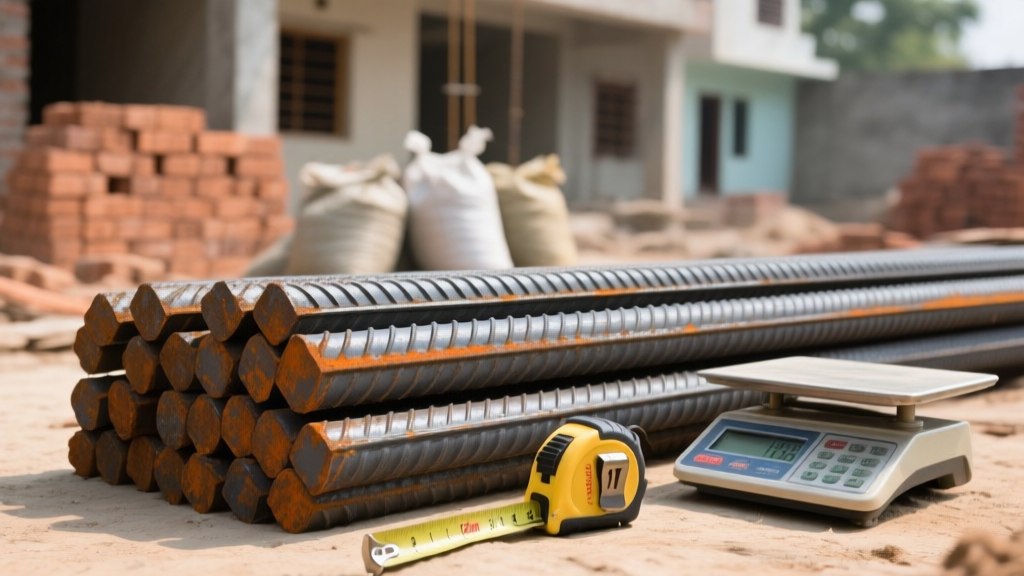
- Use a Portable Weighing Scale - For a 12 m piece, place the bar on a calibrated industrial scale. The reading should be within ±0.2 kg of the theoretical 10.66 kg.
- Sample Test - Randomly select 3-5 bars from each bundle and weigh them. If the average deviates significantly, request a replacement.
- Cross-Check with the Supplier's Invoice - The invoice should list the total weight (kg) and the number of pieces. Simple multiplication (weight per piece × number of pieces) should match the invoice total.
- Inspect for Corrosion or Damage - Rusted or bent bars may have lost material, affecting weight and strength.
These checks protect you from under-weighed or counterfeit bars, which can compromise structural integrity.
Brand-wise Specifications (Tata, JSW, SAIL)
Leading Indian manufacturers adhere closely to IS 1786, but minor variations exist:
- Tata Tiscon - Nominal weight for 12 mm is 0.888 kg/m. Their "TMT-Fe 500" grade typically records a measured weight of 10.45 kg per 12 m piece.
- JSW Neosteel - Also quotes 0.888 kg/m. Field tests show a consistent 10.50 kg per piece, with a tighter tolerance of ±0.05 kg.
- SAIL SEQR - Provides a slightly higher nominal weight of 0.892 kg/m for 12 mm, resulting in a 12 m piece weight of about 10.70 kg. The difference stems from a marginally higher steel density due to alloying elements.
All three brands meet the minimum grade requirements, but if you are particularly sensitive to weight (e.g., for transport cost calculations), note the small differences and discuss them with your supplier.
Common Weight Discrepancies and How to Avoid Them
Despite strict standards, the following issues can cause weight mismatches:
- Improper Cutting - Cutting bars at non-standard lengths without re-weighing can lead to under-weight pieces.
- Manufacturing Tolerances - A tolerance of ±0.02 kg/m is allowed. Over-large batches may occasionally exceed this limit.
- Moisture Absorption - Bars stored in humid conditions can gain a few grams of water, slightly increasing weight.
- Counterfeit Bars - Low-quality steel may have a lower density, resulting in a noticeable weight drop.
To mitigate these risks, always request a weight certification from the mill, store bars under a roof, and perform the on-site verification steps outlined earlier.
Frequently Asked Questions (FAQ)
- What is the exact weight of a 12 mm TMT bar per metre?
- The theoretical weight, as per IS 1786, is 0.888 kg per metre. In practice, the measured weight is usually between 0.86 kg and 0.90 kg per metre.
- How many 12 mm bars are there in a typical bundle?
- Suppliers generally pack 10 to 12 pieces per bundle, giving a total bundle weight of roughly 107 kg to 128 kg.
- Does the grade (Fe 415, Fe 500, Fe 550) affect the weight?
- No. The grade influences strength and ductility, not the density. Therefore, a 12 mm Fe 415 bar weighs the same as a 12 mm Fe 500 bar.
- Can I use 10 mm bars instead of 12 mm for columns?
- Only if the structural design permits it. Columns typically require the higher moment of resistance offered by 12 mm bars; substituting with 10 mm may breach safety limits.
- How can I be sure the bars I receive are genuine?
- Check the manufacturer's stamp, verify the weight with a calibrated scale, and purchase only from reputable dealers or directly from the mill.
Related Comaron Guides
For deeper insights into steel selection and market trends, explore these Comaron articles:
- Best TMT Steel Brands in India 2026 - Buyer's Guide
- Steel Rate Today India 2026 - Live TMT Prices
- TMT Bar Kaise Choose Karein - Guide 2026
Conclusion
Understanding the 12mm TMT bar weight - 0.888 kg per metre, roughly 10.5 kg per 12 m piece, and about 1 quintal per bundle - equips homeowners and contractors to plan budgets, logistics, and structural designs with confidence. By applying the D²/162.2 formula, verifying weights on site, and choosing reputable brands such as Tata, JSW, or SAIL, you can avoid costly discrepancies and ensure a safe, durable build. For a printable version of this chart and more detailed guidance, visit our full article at https://www.comaron.com/blog/12mm-tmt-bar-weight-per-piece-per-meter-2026-chart.