Introduction
Choosing the right walling material is one of the most critical decisions in Indian home construction. With rising energy costs, stricter environmental regulations, and evolving architectural trends, builders and homeowners are increasingly evaluating alternatives to traditional red bricks. Autoclaved Aerated Concrete (AAC) blocks, fly ash bricks, and conventional red bricks each promise distinct advantages in terms of strength, weight, cost, insulation, and durability. This article provides a data-driven, three-way comparison of AAC blocks, fly ash bricks, and red bricks for residential and commercial projects in 2026. By the end of this guide you will know which material aligns best with your budget, climate, and design goals. For up-to-date pricing across India, refer to the Building Materials Price List India 2026.
What Are AAC Blocks, Fly Ash Bricks, and Red Bricks?
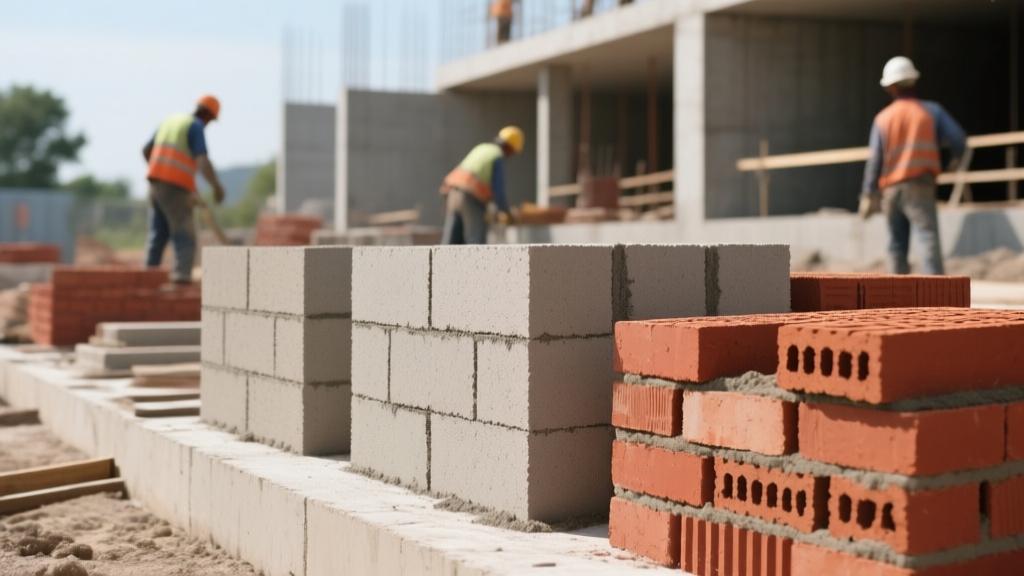
AAC Blocks are lightweight precast building elements made from a mixture of cement, lime, sand, water, and a small amount of aluminum powder. The aluminum reacts with the alkaline environment to release hydrogen gas, creating thousands of microscopic air bubbles. The resulting slurry is poured into molds, cured, and then autoclaved at high temperature (180-200 °C) and pressure (â10 bar). This autoclaving process gives AAC its characteristic porous structure, high dimensional stability, and fire resistance.
Fly Ash Bricks are manufactured by combining fly ash - a by-product of coal-fired power plants - with cement, sand, lime, and a small quantity of gypsum. The mixture is compacted under high pressure (typically 50-70 MPa) and then cured either in the open air or in a steam chamber. The result is a dense, uniform brick that utilises industrial waste, reducing landfill pressure and conserving natural clay resources.
Red Bricks are the oldest and most widely used walling material in India. They are made from natural clay that is moulded into bricks and fired in a kiln at temperatures ranging from 900 °C to 1100 °C. The high firing temperature gives red bricks their characteristic strength, durability, and reddish hue. Traditional manufacturing relies heavily on manual labour and consumes significant amounts of fuel.
Physical Properties Comparison
Understanding the core physical properties of each material is essential for structural design, thermal performance, and cost estimation. Below are typical ranges observed in the Indian market during 2026.
- Weight & Density - Weight influences handling, transportation, and dead load on foundations.
- AAC Block: 400-800 kg/m³ (lightest of the three).
- Fly Ash Brick: 1,500-1,800 kg/m³.
- Red Brick: 1,700-1,950 kg/m³.
- Compressive Strength - Determines load-bearing capacity.
- AAC Block: 3-7 N/mm² (suitable for low-rise residential walls; higher grades up to 10 N/mm² are available for mid-rise structures).
- Fly Ash Brick: 7-15 N/mm² (comparable to standard red bricks).
- Red Brick: 7-20 N/mm² (high-quality engineering bricks can exceed 30 N/mm²).
- Thermal Conductivity (λ) - Lower values indicate better insulation.
- AAC Block: 0.11-0.15 W/mK (excellent thermal insulation).
- Fly Ash Brick: 0.40-0.60 W/mK (moderate insulation).
- Red Brick: 0.50-0.70 W/mK (poorest insulation among the three).
- Water Absorption - High absorption can lead to durability issues in humid climates.
- AAC Block: <=10 % (closed-cell pores reduce capillary action).
- Fly Ash Brick: 5-15 % (depends on curing and firing process).
- Red Brick: 10-20 % (porous surface, especially in low-quality bricks).
Pros and Cons of Each Material
Below is a concise list of advantages and disadvantages to help you weigh each option against project requirements.
- AAC Blocks - Pros
- Lightweight, reducing labor and foundation load.
- Superior thermal insulation, leading to lower heating/cooling costs.
- Fire-resistant (rating up to 4 hours).
- Sound-absorbing due to porous structure.
- Easy to cut and shape on site.
- Lower compressive strength compared to conventional bricks; not ideal for high-rise load-bearing walls without reinforcement.
- Higher initial unit cost (Rs. 100-150 per block of 240 Ã 115 Ã 90 mm).
- Requires skilled mortar mix (lime-sand-cement) to achieve full bond.
- Fly Ash Bricks - Pros
- Utilises industrial waste, reducing environmental footprint.
- Higher compressive strength than AAC, suitable for load-bearing walls.
- Uniform size and shape, leading to faster laying.
- Lower water absorption than red bricks, improving durability in humid zones.
- Cost-effective (Rs. 30-45 per brick) compared to AAC.
- Thermal conductivity still higher than AAC; additional insulation may be required.
- Quality varies with the proportion of fly ash and curing practices.
- Heavier than AAC, increasing transportation load.
- Red Bricks - Pros
- Proven track record over centuries; widely accepted by building codes.
- High compressive strength, suitable for any structural application.
- Readily available across India, even in remote locations.
- Low unit cost (Rs. 25-35 per brick) and simple procurement.
- Heaviest material, raising labor and foundation costs.
- Poor thermal insulation; may require external/internal plaster or insulation layers.
- Higher water absorption can lead to efflorescence and dampness.
- Traditional firing consumes large amounts of fuel, contributing to COâ emissions.
Best Use Cases for Residential and Commercial Construction
Each material shines under specific conditions. Below we match the material to typical Indian scenarios.
- AAC Blocks - Ideal for low-rise residential houses (up to 2-3 storeys) in hot climates such as Rajasthan, Gujarat, and the Deccan plateau where thermal comfort is a priority. Also suitable for interior partition walls in commercial offices where lightweight construction and sound insulation are valued.
- Fly Ash Bricks - Perfect for mid-rise residential blocks (up to 5 storeys) and commercial structures where load-bearing walls are required but the project seeks a greener alternative to red bricks. Their moderate weight makes them suitable for seismic zones (e.g., the Himalayan foothills) when combined with proper reinforcement.
- Red Bricks - Remain the go-to choice for high-rise buildings, industrial warehouses, and heritage renovations where traditional aesthetics and maximum compressive strength are non-negotiable. They also perform well in cooler northern regions (e.g., Himachal Pradesh) where thermal insulation is less critical.
Construction Considerations
Beyond material properties, practical aspects of construction influence productivity, cost, and final finish quality.
- Laying Speed - AAC blocks are larger (typically 240 Ã 115 Ã 90 mm) and lighter, allowing a mason to place 500-600 blocks per day. Fly ash bricks, being similar in size to red bricks, yield a laying rate of 400-500 bricks per day with a skilled crew. Red bricks, due to higher weight, often see a slightly slower rate of 350-450 bricks per day.
- Mortar Requirement - AAC blocks need a richer mortar (1 part cement : 3 parts sand + lime) to fill the porous surface and achieve adequate bond strength. Fly ash and red bricks can be laid with standard cement-sand mortar (1 : 4 to 1 : 6) without lime.
- Plaster Compatibility - AAC's smooth surface reduces plaster thickness, saving material and labour. However, it may require a primer to improve adhesion. Fly ash bricks accept both cement-sand and gypsum plasters equally well. Red bricks often need a bonding agent or a skim coat to address surface irregularities.
- Joint Thickness - AAC block joints are typically 10 mm, whereas brick joints range from 10-12 mm. Consistent joint thickness improves structural integrity and reduces plaster cracking.
- Tooling and Equipment - Cutting AAC blocks requires a carbide-tipped saw or a high-speed rotary cutter. Fly ash and red bricks can be cut with a manual brick chisel or a simple angle grinder.
For interior finishing decisions such as tile selection, refer to the guide How to Choose Tiles for Your Home. The choice of walling material can affect tile adhesion and thermal movement.
Environmental Impact Comparison
Construction today is judged not only by cost and performance but also by carbon footprint and resource sustainability.
- AAC Blocks - Autoclaving consumes electricity, yet the overall embodied energy is lower because AAC uses less cement (about 30 % of that in conventional bricks) and incorporates recycled aggregates. The porous structure also reduces heating/cooling demand, translating into long-term energy savings.
- Fly Ash Bricks - By utilising fly ash, a waste product that would otherwise be stored in ash ponds, these bricks divert industrial by-products from landfills. The manufacturing process emits roughly 30 % less COâ than traditional clay brick firing. However, transportation of fly ash from power plants can add to emissions if distances are large.
- Red Bricks - The most carbon-intensive of the three due to high fuel consumption during kiln firing. Approximately 0.7-1.0 kg COâ is emitted per brick, depending on kiln efficiency. Additionally, extensive clay extraction can lead to soil degradation and loss of biodiversity.
Overall, fly ash bricks and AAC blocks are greener choices, with AAC offering the added benefit of operational energy savings.
Comparison Table: Key Specifications at a Glance
| Parameter | AAC Block | Fly Ash Brick | Red Brick |
|---|---|---|---|
| Typical Density (kg/m³) | 400-800 | 1,500-1,800 | 1,700-1,950 |
| Compressive Strength (N/mm²) | 3-7 (up to 10 for high-grade) | 7-15 | 7-20 (up to 30 for engineering bricks) |
| Thermal Conductivity (W/mK) | 0.11-0.15 | 0.40-0.60 | 0.50-0.70 |
| Water Absorption (%) | <=10 | 5-15 | 10-20 |
| Unit Cost (Rs.) | 100-150 per 240 Ã 115 Ã 90 mm block | 30-45 per brick | 25-35 per brick |
| Fire Rating (hours) | Up to 4 | 2-3 | 1-2 |
| Typical Laying Speed (units/day) | 500-600 blocks | 400-500 bricks | 350-450 bricks |
| Environmental Impact | Low - reduced cement, good insulation | Medium - utilizes fly ash waste | High - high kiln emissions |
Frequently Asked Questions (FAQ)
- Which material provides the best thermal insulation?
AAC blocks lead the pack with a thermal conductivity of 0.11-0.15 W/mK, offering up to 50 % lower heat transfer compared to fly ash and red bricks. This translates to noticeable savings on air-conditioning in hot Indian climates.
- Can AAC blocks be used for load-bearing walls in a multi-storey building?
Standard AAC grades are suitable for low-rise load-bearing walls (up to 2-3 storeys). For taller structures, AAC must be combined with reinforced concrete columns or high-grade AAC (10 N/mm²) and additional steel reinforcement.
- How does water absorption affect the durability of these materials?
Higher water absorption leads to increased risk of efflorescence, cracking, and reduced freeze-thaw resistance. Fly ash bricks and AAC blocks exhibit lower absorption than red bricks, making them more durable in humid coastal regions.
- Which walling material is the most eco-friendly?
Fly ash bricks are the most environmentally friendly in terms of raw material utilisation because they recycle industrial waste. AAC blocks also have a lower carbon footprint due to reduced cement use and superior energy performance over the building's life.
- What are the current market prices for these materials?
Pricing fluctuates with regional demand and raw-material costs. As of 2026, AAC blocks cost Rs. 100-150 per block, fly ash bricks Rs. 30-45 per brick, and red bricks Rs. 25-35 per brick. Detailed price trends are available in the Brick Price Today 2026 report.
Final Recommendation: Which Material Is Best for Your Project?
There is no one-size-fits-all answer. The optimal choice depends on budget, structural requirements, climate, and sustainability goals.
- Budget-Sensitive Residential Projects (<=2 storeys) - Fly Ash Bricks offer a good balance of strength, moderate insulation, and lower cost than AAC. Pair them with external plaster and a thin insulation layer for energy efficiency.
- Energy-Efficient Homes in Hot Climates - AAC Blocks are the clear winner due to their superior thermal performance and lightweight nature, which reduces foundation size. The higher upfront cost is offset by lower cooling bills and faster construction.
- High-Rise Commercial or Industrial Buildings - Red Bricks (or engineering clay bricks) provide the highest compressive strength and proven fire resistance. They are also widely available, ensuring uninterrupted supply for large projects.
- Projects Emphasising Sustainability - Combine Fly Ash Bricks for load-bearing walls with AAC Blocks for partitions and roof decks. This hybrid approach maximises recycled content while delivering thermal comfort.
- Seismic Zones (e.g., North-East India) - The lightweight nature of AAC reduces seismic forces, but ensure proper reinforcement. Fly ash bricks, being denser yet still lighter than red bricks, also perform well when used with adequate mortar and joint reinforcement.
In summary, evaluate your project against the criteria outlined above. Use AAC blocks where thermal comfort and speed matter most, opt for fly ash bricks when you need a greener, cost-effective solution with good strength, and rely on red bricks for maximum structural capacity and traditional aesthetics. By aligning material selection with these data-driven insights, you can achieve a durable, energy-efficient, and financially sound home construction in 2026.