
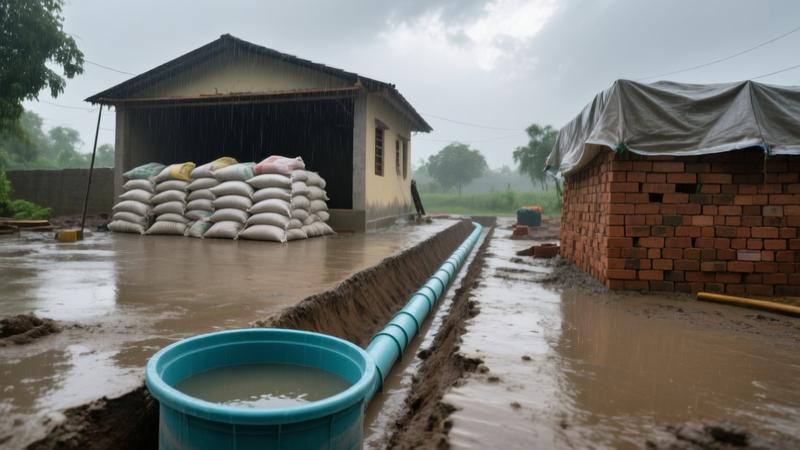
Why Monsoon Is a Real Pain for Construction
July to September brings relentless rain to Mumbai, Kerala, coastal Karnataka, Assam and even the foothills of North India. The ground stays soggy, humidity spikes above 90%, and a single downpour can wash away fresh concrete. If you ignore the weather, you'll end up with cracked walls, weak foundations and a huge bill for rework.
My 20-year stint on site taught me that the only thing that saves a project in the rains is preparation. Below are the steps that actually work, not the glossy pamphlets you see on dealer websites.
Concrete Protection - Keep the Mix From Turning Into Mud
Cover the pour immediately. Use a 1.5 mm polyethylene sheet (Rs. 12-15 per sqm) or a tarpaulin of at least 150 gsm. The sheet must extend 300 mm beyond the slab edges to prevent runoff water from seeping in.
For columns and beams, wrap the formwork with "wet cure blankets" - thick jute soaked in water and covered with plastic. This prevents rapid moisture loss and stops rainwater from creating a weak surface layer.
Concrete mix itself needs adjustment. Add 0.5 % extra cement and 5 % fly ash to improve water-tightness. Use a water-reducing admixture like Sika® Visco-Crete (Rs. 350-400 per 20 kg bag) to keep slump under control.
| Material | Cost (Rs.) | Typical Use |
|---|---|---|
| Polyethylene sheet 1.5 mm | 12-15 per sqm | Slab and footing cover |
| Tarpaulin 150 gsm | 8-10 per sqm | General protection |
| Jute wet-cure blanket | 5-7 per sqm | Columns, beams |
Do not rely on "curing compounds" alone. They evaporate quickly in high humidity and give a false sense of security.
Brick Storage - Keep the Masonry Dry
Lay the bricks on a raised platform, not directly on the ground. A 100 mm timber pallet costs Rs. 150-200 per piece and keeps moisture from wicking up.
Cover the stack with a waterproof canvas that can be rolled up when the rain stops. If you have to store bricks outdoors for more than three days, spray them with a 2 % calcium chloride solution (Rs. 450 per 25 kg bag) to reduce water absorption.
Never use bricks that have been sitting in standing water for more than 24 hrs. Their compressive strength drops by up to 15 % - a fact you'll see on the site when walls start crumbling under load.
Cement Bag Handling - Avoid the "wet bag" trap
Rainwater loves to seep through the thin paper of a cement bag. Store bags in a dry, well-ventilated shed and keep the floor sloped at least 2 % to drain any puddles.
Buy bags with "plastic-lined" inner coating - they cost about Rs. 5-7 extra per bag but save you from having to discard a whole 50 kg sack if it gets damp.
When you need to move bags, use a plastic sheet underneath the wheelbarrow. A wet bag will harden inside the bag, making it impossible to pour and leading to a weak mortar.
Plastering Risks - Rain Is the Enemy of a Smooth Finish
Plaster must be applied when relative humidity is below 80 % and there is no forecast of rain for at least 12 hrs. In Mumbai, that window usually appears after 2 am or early morning before the monsoon clouds roll in.
Use a "quick-set" plaster mix (e.g., UltraTech Plaster-Plus) that sets in 45-60 minutes. It reduces the time the surface is exposed to rain. The trade-off is a slightly higher cost - Rs. 70-80 per 20 kg bag versus Rs. 55 for ordinary plaster.
Apply a thin coat of waterproofing emulsion (e.g., Asian Paints WaterGuard, Rs. 350 per litre) after the first coat sets. This barrier prevents rainwater from soaking into the fresh plaster and causing efflorescence.
Site Drainage - The Backbone of a Rain-Proof Project
Before any concrete is poured, grade the site to a minimum slope of 2 % away from the foundation. Use 100 mm PVC drain pipes (Rs. 45 per metre) laid at 5 m intervals to collect runoff.
Install temporary "sump pits" at low points. A 200-litre plastic sump costs Rs. 1,800 and can be emptied with a pump (Rs. 3,500 for a 1 kW submersible unit). Empty the pit after every heavy shower.
Check the surrounding streets for clogged drains. If the municipal drain is blocked, arrange a private trench drain - the cost is Rs. 250-300 per metre of 150 mm dia pipe, labour excluded.
Electrical Safety - Rain and Live Wires Don't Mix
All temporary power cables must be PVC-sheathed and rated for wet conditions (minimum IP68). A 2 mm2 PVC cable costs Rs. 30 per metre; a 4 mm2 costs Rs. 45.
Grounding rods should be driven at least 2 m deep and checked for corrosion before the monsoon starts. Use galvanized rods (Rs. 150 per piece) rather than plain steel - they survive the humidity better.
Never allow the site foreman to turn on the generator without a residual-current device (RCD). A cheap RCD (Rs. 600) can prevent fatal electrocution when water splashes onto live terminals.
Seven Common Mistakes Contractors Make in the Rainy Season
- Skipping proper formwork waterproofing. They think a simple plastic sheet will do, but rain seeps through seams and ruins the concrete surface.
- Using ordinary sand for plaster. Wet sand retains water, leading to weak plaster that peels off after a few weeks.
- Leaving brick piles exposed. Moist bricks expand, causing uneven mortar joints and later cracks.
- Not adjusting mix design for extra water. Contractors often add extra water to keep workability, which reduces strength by 10-15 %.
- Delaying curing. In the monsoon they think rain will cure the concrete. It does, but it creates a porous, low-strength layer.
- Improper site drainage. Water pools around the foundation, leading to later settlement and damp walls.
- Neglecting electrical safety. Wet outlets, exposed wires and no RCDs cause frequent short circuits and accidents.
Cost Impact - How Monsoon Mistakes Eat Your Budget
Monsoon-related rework is the silent budget killer on Indian home construction projects. A typical 1,500 sq ft two-story house in Mumbai or Pune sees Rs. 50,000-1,20,000 of avoidable damage during a single bad rainy week. Here's where the money actually goes.
Concrete rework. A 100 sq ft slab pour ruined by a 30-minute unpredicted downpour costs Rs. 18,000-25,000 to break and re-pour. Add the cost of delayed schedule (3-5 days lost while you wait for weather) and the bill crosses Rs. 35,000 easily.
Brick damage. Wet bricks lose 20-30% compressive strength. A contractor who lets 5,000 bricks get rained on without tarpaulin coverage is effectively wasting Rs. 30,000-40,000 of material - you pay full price but get half-strength walls. The walls may stand but plaster will crack within 6 months.
Cement loss. 100 bags of cement ruined by moisture (lumpy or hardened) is a direct Rs. 45,000-55,000 loss. Most homeowners never notice this because the contractor quietly buys fresh cement and bills it as the original quantity. Always count bags on delivery and inspect the manufacturing date printed on each bag.
Plaster and paint failure. Plaster done during high humidity without proper curing develops hairline cracks, efflorescence (white salt patches) and paint peeling within 1-2 monsoons. Re-plastering a 1,000 sq ft wall area costs Rs. 35,000-50,000 including labor. The original plaster you already paid for is wasted.
Hidden water damage. Moisture that enters walls during construction and gets sealed under plaster causes damp patches, fungal growth and electrical issues for years. Fixing this after finishing requires breaking walls, treating with waterproofing chemicals and re-plastering - Rs. 80,000-1,50,000 for a typical two-story house.
Total monsoon-related damage on a poorly-managed project: Rs. 2,00,000 to 4,00,000. The cost of doing it right - tarpaulins, covered sheds, extra cement, weather monitoring - is Rs. 15,000-25,000. The math is obvious.
When to Pause and Resume - A Decision Framework
Indian contractors usually operate on one of two extremes - either they stop work completely for 3 months during monsoon (a 2025-era tradie practice) or they work through every weather event with zero precautions (a cost-cutting trap). Both approaches are wrong. Here's the practical call.
Pause immediately if:
- IMD or local weather forecast shows 50mm+ rain in next 24 hours
- Active concrete pour is in progress and rain is imminent - finish the pour and cover within 30 minutes, or stop and reschedule
- Wind speed crosses 40 km/h (scaffolding becomes unsafe, tarpaulins tear off)
- Lightning is reported within 5 km of the site (electrical and metal scaffolding work)
- Site is flooded and standing water won't drain within 6 hours
Resume work if:
- No rain for 12 continuous hours and surfaces are dry to touch
- Forecast shows 48-hour dry window for any plastering or painting
- Humidity has dropped below 80% RH (measured with a cheap hygrometer, Rs. 300-500)
- Foundation pits and excavations are inspected for water seepage before resuming work
Continue working through light rain if:
- Concrete is already poured and is at least 8 hours old (initial set complete)
- Brick laying is in progress and you can cover the wall with tarpaulin
- Plastering has been done at least 48 hours ago and is curing well
- The activity is internal (electrical conduits, plumbing, tile laying on dry interior walls)
Most contractors don't use a hygrometer or weather app - they just look at the sky. Invest Rs. 500 in a digital hygrometer and install a free weather app like Mausam (IMD's official app). Both pieces of information make a real difference for monsoon supervision.
Putting It All Together - A Quick Checklist for the Monsoon
| Task | When | What to Use |
|---|---|---|
| Site grading & drainage | Before excavation | 2% slope, PVC pipe, sump pits |
| Concrete pour | During light rain or after | Polyethylene sheet, wet-cure blankets, admixture |
| Brick storage | All the time | Raised pallets, waterproof canvas |
| Cement bags | All the time | Plastic-lined bags, dry shed |
| Plaster work | RH < 80% & 12 hrs dry forecast | Quick-set mix, waterproof emulsion |
| Electrical setup | Before power is applied | IP68 PVC cables, RCD, galvanized rods |
Skipping any of these steps usually ends up costing you three to five times the amount you'd spend to do it right.
Related: Concrete Curing Methods, Duration and Mistakes Indian Homeowners Make 2026
Related: Footing in House Construction 2026 - Types, Size, Reinforcement and Common Mistakes
Related: How to Choose the Best Cement for Your Home Construction in 2026