
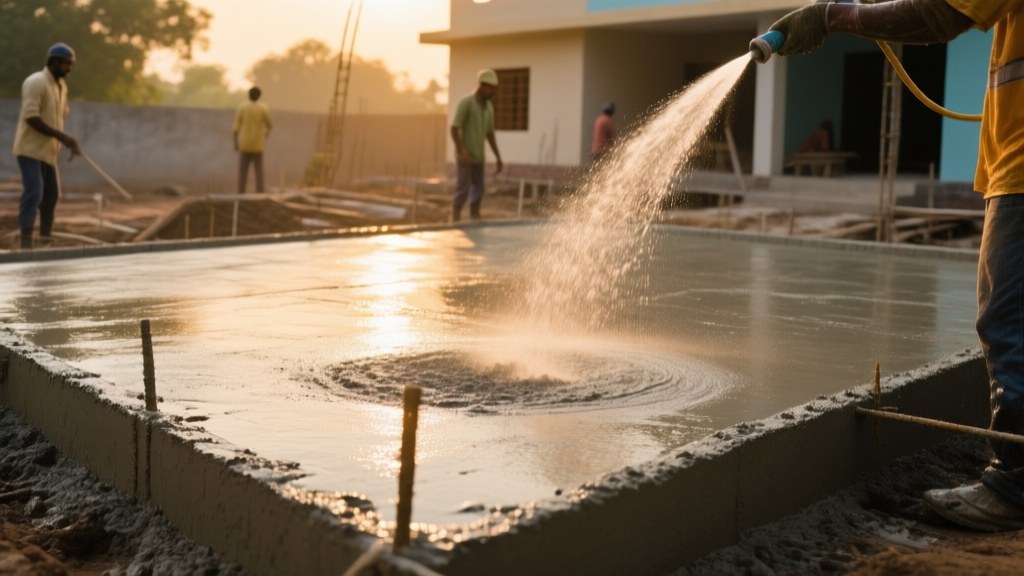
What is concrete curing and why hydration matters
Concrete is not a rock you pour and forget. It is a chemical soup of cement, aggregates, water and admixtures. When water meets cement, the tricalcium silicate (C3S) and dicalcium silicate (C2S) start reacting to form calcium silicate hydrate (C-S-H) and calcium hydroxide. C-S-H is the glue that gives concrete its strength. Roughly 30-50% of the final compressive strength appears in the first seven days, and almost all of it is tied to how well the mix stays wet.
If the water evaporates too fast, the reaction stops, leaving a porous, weak matrix. The loss of water also creates shrinkage cracks. In hot Indian summers, a slab can lose a litre of water per square metre per hour. In monsoon-soaked Kerala, excess water can dilute the mix and delay setting. The cure is simply to keep the concrete in a moist environment until the reaction slows down, typically 7-28 days depending on cement type and exposure.
For the layperson, think of concrete like a dough that needs to rest. Pull it apart too early and it falls apart; let it sit long enough and it hardens into a sturdy floor.
Related: Concrete Mix Ratio Guide for Indian Homes and How to Choose the Best Cement for Your Home for background on what goes into the mix you are curing.
Five curing methods explained with real costs
There are many ways to keep concrete wet. Below are the five we see most in Indian sites, with price breakdowns as of 2026.
- Water ponding - Dig a shallow trench or place a plastic sheet around the slab and flood it with water. Labour cost is Rs. 25-30 per sqm per day. For a 100 sqm slab, expect Rs. 2,500-3,000 daily. Water itself is cheap; municipal supply is about Rs. 10-12 per 1000 litres. Total for a 7-day cure: Rs. 18,000-22,000.
- Wet gunny/jute bags - Soak 10 kg gunny bags in water and place them over the surface. Each bag costs Rs. 40-50. You need roughly 1 bag per 1 sqm for a 1 cm thickness. For a 100 sqm slab, that's 100 bags to Rs. 4,000-5,000. Add labour Rs. 1,500-2,000 for spreading and removal. Total â Rs. 6,000-7,000 for a 7-day cure.
- Curing compounds - Liquid sealants that form a membrane. Popular brands: Sika Cure-A-Seal, Fosroc Cure-N-Seal, BASF MasterKure. Price is Rs. 150-180 per litre, and one litre covers 30-35 sqm. For 100 sqm you need 3-4 litres to Rs. 540-720. Application labour is Rs. 1,200-1,500. Total â Rs. 2,000-2,500.
- Plastic/Polyethylene membrane - Lay a thick (0.2 mm) PE sheet over the fresh concrete, seal edges with sand or tape. Sheet price Rs. 30-45 per sqm. For 100 sqm, Rs. 3,000-4,500. Labour for laying and later removal Rs. 1,200-1,500. Total â Rs. 4,200-6,000.
- Steam curing (precast only) - Pipe steam at 60-70 degC through a closed formwork. Service providers charge Rs. 1,200-1,500 per cubic metre of concrete. A typical 1 m thick, 100 sqm slab is 100 cu m to Rs. 120,000-150,000. Only feasible for precast units, not site-cast roofs.
Minimum curing duration - what the numbers say
| Structural member | OPC (Ordinary Portland Cement) | PPC (Pozzolana Portland Cement) | PSC (Portland Slag Cement) |
|---|---|---|---|
| Foundation (strip footing) | 7-10 days | 10-12 days | 12-14 days |
| Column (incl. Footings) | 14 days | 16-18 days | 18-21 days |
| Beam (plain) | 14-21 days | 16-22 days | 18-24 days |
| Slab (ground floor) | 14-21 days | 16-24 days | 18-28 days |
| Roof slab (exposed) | 21 days | 24-28 days | 28-35 days |
These are the minimum days you should keep the surface wet. Anything less and you gamble with cracks, reduced load-bearing capacity and early deterioration.
Climate-specific curing advice
India is a mixed bag. One method that works in Delhi can flop in Goa. Below are the tweaks you need for four typical zones.
Coastal humid (Kerala, Mumbai, Chennai)
High humidity (80-90%) reduces evaporation, but salt-laden sea breeze can corrode steel if you use salty water for curing. Always use fresh potable water. In monsoon months, stop water ponding once rain starts - excess water will wash out cement paste and weaken the surface. Use curing compounds or PE sheets to prevent wash-off.
Dry heat (Rajasthan, Gujarat, Delhi NCR summer)
Temperatures often hit 45-48 degC. Evaporation is brutal. Start curing within 2 hours of finishing. Use wet gunny bags plus a thin layer of curing compound to lock moisture. Shade the site with bamboo or tarpaulin; a 2-metre high shade reduces surface temperature by 10-12 degC. Increase the duration to 21 days for OPC and 28 days for PSC.
Cold hill stations (Shimla, Manali)
Night temperatures can drop below 5 degC. Concrete sets slowly; strength gain is delayed. Keep the slab covered with insulating blankets (polypropylene or straw) and maintain a temperature above 10 degC using electric heating mats (Rs. 30-40 per sqm per day). Curing compound alone won't help; you need active heat. Extend the minimum cure to 28 days for all cement types.
Monsoon-heavy zones (Assam, Odisha, parts of Karnataka)
Rainfall >200 cm per year. The biggest mistake is letting rain replace your controlled curing. When heavy rain comes, lay PE sheets over the slab immediately, then resume water ponding when rain stops. Avoid using rainwater directly; it may contain suspended soil and organic matter that affect setting.
Seven most common mistakes you'll see on site
- Pouring water on a scorching slab at noon - the water evaporates instantly, leaving a dry crust that cracks.
- Delaying the start of curing beyond 24 hours - the concrete surface already starts to dry, and you lose up to 20% of strength.
- Removing column shuttering after just 24 hours - the side walls may be okay, but the soffit needs 7-14 days of moisture before you strip.
- Using salty or chlorinated water - salt accelerates corrosion of reinforcement, especially in coastal zones.
- Walking or storing heavy objects on a slab before day 7 - even a light footstep can cause micro-cracks that grow under load.
- Skipping curing in winter - low temps stall hydration, and the slab will stay weak for weeks.
- Relying on a single layer of plastic wrap without sealing edges - water seeps out from the sides, defeating the purpose.
These blunders cost more in repairs than the extra Rs. You spend on proper curing.
Quality checks while curing
Temperature monitoring - Use a simple digital thermometer. Ideal surface temperature stays between 23-32 degC. If it climbs above 35 degC, increase water supply or provide shade.
Moisture check - Press a dry hand on the concrete; if it feels cool and slightly damp, you're good. For a more objective test, wrap a small piece of cotton gauze in plastic, leave it for 30 minutes, then weigh. If the weight gain is less than 1 % of the gauze weight, the surface is drying.
No-load time - Only after the minimum curing period (see table) should you start applying live loads or heavy equipment. For a ground-floor slab, wait at least 7 days before laying tiles; for roof slabs, wait the full 21 days before installing HVAC units.
Cost comparison for a 1,000 sq ft slab (â93 sqm)
| Method | Material cost (Rs.) | Labour cost (Rs.) | Total (Rs.) |
|---|---|---|---|
| Water ponding (7 days) | Rs. 1,200 (water) | Rs. 2,800-3,500 | Rs. 4,000-4,700 |
| Wet gunny bags | Rs. 4,800-5,600 | Rs. 1,800-2,200 | Rs. 6,600-7,800 |
| Curing compound (Sika Cure-A-Seal) | Rs. 720-840 | Rs. 1,500-1,800 | Rs. 2,220-2,640 |
| PE membrane | Rs. 3,000-4,200 | Rs. 1,200-1,500 | Rs. 4,200-5,700 |
| Steam curing (precast only) | Rs. 120,000-150,000 | Included in service | Rs. 120,000-150,000 |
For a typical house slab, the curing compound gives the best bang for the buck - you spend under Rs. 3,000 and get a reliable moisture seal.
Quick FAQ for homeowners and small builders
Can you cure concrete with seawater?
No, not for reinforced concrete. Salt accelerates rebar corrosion and weakens the cover zone. Stick to fresh potable water, especially in coastal districts.
Can you drive over a slab after 7 days of curing?
For a residential floor, yes, light foot traffic is fine after 7 days for OPC and 10-14 days for PPC. Heavy vehicles should wait at least 28 days.
Is spraying water once a day enough?
No. Once-a-day sprinkling lets the surface dry out in between, especially in summer. The slab needs to be continuously wet for the entire curing period. Three to four sprayings per day in dry heat, two per day in humid conditions.
Do you need to cure basement concrete?
Yes. Even where the slab is not exposed to sun, ambient heat and ventilation pull moisture out. Use PE sheets or curing compound.
What is the cheapest curing method?
Wet gunny bags work out cheapest for small jobs. For a 100 sqm slab, gunny bags cost Rs. 4,000-5,000. For larger slabs, a curing compound is the cheapest because a litre covers 30-35 sqm.
For more reading on concrete strength, see our guide on what affects concrete strength.
Detailed brand comparison: which curing compound to buy in 2026
Walking into a building materials shop in any Indian city, you'll find 4-5 brands of curing compound on the shelf. They look similar but the price, coverage and durability differ noticeably. Here is a no-nonsense comparison based on field use across residential projects in 2024-2026.
Sika Cure-A-Seal (acrylic-based, water-based emulsion) - Sold in 5-litre and 20-litre cans. Coverage claim: 30-35 sqm per litre on a smooth surface; expect 25-28 sqm per litre on a rough trowelled slab. Price in 2026: Rs. 165-180 per litre. Forms a clear film that breaks down in 3-4 weeks under UV. Pros: easy to spray with a hand pump, doesn't yellow, low odour. Cons: needs a second coat on porous concrete.
Fosroc Cure-N-Seal (acrylic-silicone hybrid) - 5-litre and 25-litre containers. Coverage 32-38 sqm per litre. Price: Rs. 175-200 per litre. Slightly more durable film than Sika, can last 5-6 weeks. Spray viscosity is thicker, so use a garden sprayer with a 1.5 mm nozzle. Pros: longer-lasting seal, slightly better in coastal humidity. Cons: 10-15% costlier than Sika.
BASF MasterKure 181 (wax-based, water emulsion) - 5-litre cans, sometimes sold in 25-litre drums. Coverage 35-40 sqm per litre (slightly higher because wax spreads thinner). Price: Rs. 145-160 per litre. Cheaper option, good for foundations and basement walls where aesthetics don't matter. Pros: low cost, easy spray. Cons: wax film can be slippery until it wears off, may affect later plaster bond.
Chouksey Chem Cure-Coat (indigenous brand, mid-tier) - 5-litre and 20-litre cans. Coverage 28-32 sqm per litre. Price: Rs. 110-130 per litre. Sold mostly in central and east India. Pros: lowest cost, readily available. Cons: inconsistent quality between batches, sometimes needs a second coat.
For a typical 100 sqm residential slab, the difference between Sika and Chouksey is roughly Rs. 1,200-1,500. For the small extra, Sika or Fosroc gives you a more reliable film, especially in hot, dry climates where cheap wax-based compounds can crack and peel within a week.
How to check if curing is actually working on your site
Even with the right method, you can still get it wrong. Here are three field checks any site engineer or alert homeowner can do in 5 minutes.
The thumb test (after 24 hours): Press a thumb firmly into the cured surface. If it leaves a slight imprint without the surface crumbling, hydration is progressing well. If the surface is hard as stone and feels cold, it is likely drying out.
The water-bead test: Sprinkle a few drops of water on the cured concrete. On well-cured surfaces, water spreads and soaks in slowly. On dry, under-cured surfaces, water beads up and rolls off.
The colour check: Properly cured concrete has a uniform medium-grey colour. Under-cured concrete shows light grey patches, often in straight lines along the formwork edges. These patches are signs of premature drying and likely future cracking.
Run these checks at the 1-day, 3-day and 7-day mark. Document with photos. If a section fails any check, re-saturate the area and apply a fresh coat of curing compound.
Final recommendations - what to pick and how to do it right
If you're on a tight budget and the climate is moderate (e.g., Lucknow winter-summer), go with a curing compound like Sika Cure-A-Seal or Fosroc Cure-N-Seal. One litre covers about 32 sqm, so a 100 sqm slab needs 3-4 litres. Mix the compound with water as per label, spray uniformly, and re-spray after 24 hours if the day is hot.
In hot dry zones, combine wet gunny bags with a thin coat of curing compound. The bags hold water, the compound stops it from evaporating too fast. Change the bags every 24 hours for the first three days.
For coastal projects, never use seawater. Use fresh municipal water and a PE sheet to guard against splash-out during high tides. Apply a curing compound after the sheet is in place to seal edges.
In cold hill stations, invest in insulating blankets and a low-cost electric mat (Rs. 35 per sqm per day). Pair that with a curing compound to keep the surface from freezing.
Whatever you choose, start curing within two hours of finishing, keep the surface moist for at least the minimum days in the table, and monitor temperature. Skipping any of these steps is a cheap way to invite cracks, damp patches and costly repairs later.