
Why Rainwater Harvesting Matters in India (2026 context)
India's per-capita water availability has slipped below the critical threshold of 1,700 cubic metres for the first time in recorded history. Rapid urbanisation, erratic monsoon patterns and over-extraction of groundwater have turned water scarcity from a seasonal inconvenience into a year-round crisis. The Central Ground Water Board (CGWB) now estimates that more than 60 % of Indian districts are classified as "over-exploited".
In response, the Ministry of Jal Shakti has tightened regulations under the National Water Policy 2023 and mandated rainwater harvesting (RWH) for new residential projects in 15 states. The National Building Code of India (NBC 2023) incorporates IS 456-2000 (Concrete) and IS 3370-2009 (Water-tight concrete) clauses that require designers to provide a minimum of 20 % of the roof runoff to be captured and stored.
Beyond compliance, RWH offers three tangible benefits for Indian homeowners:
- Groundwater recharge: Captured rain can be directed to recharge pits, raising the water table and reducing dependence on municipal supply.
- Utility cost reduction: Stored rainwater can be used for toilet flushing, garden irrigation, and, after proper treatment, even drinking.
- Resilience to climate shocks: A well-designed system provides a buffer during drought years and mitigates flood damage by slowing runoff.
How the System Works
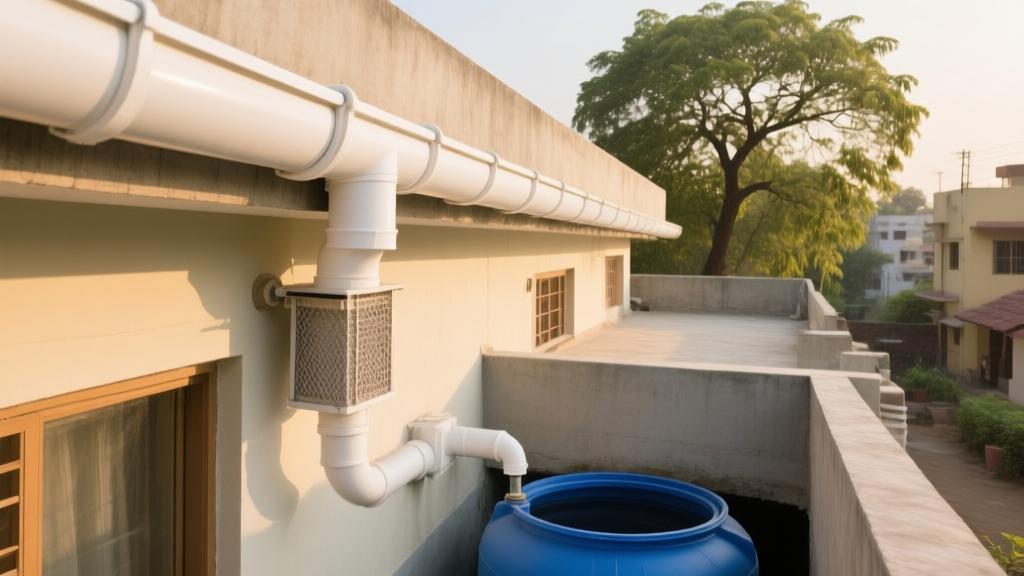
A typical RWH system follows a linear flow: catchment -> conveyance -> first-flush diversion -> filtration -> storage -> utilisation/recharge. Each stage must be sized and detailed to avoid losses and contamination.
- Catchment area: Usually the roof slab, tiled roof or balcony. The material influences the runoff coefficient (C) - for example, a concrete slab has C~0.85, while a thatched roof may be as low as 0.55.
- Gutters and downpipes: Collect runoff and transport it to the diversion unit. Proper slope (1:100) prevents stagnation.
- First-flush diverter: The first 2-5 mm of rain carries dust, bird droppings and roof debris. A diverter automatically discards this volume into a waste line.
- Pre-filter: A mesh (0.5 mm) or sand filter removes larger particles before water reaches the storage tank.
- Storage tank: Can be above-ground (RCC, ferro-cement, HDPE) or underground (concrete sump). The tank must be sealed, ventilated, and equipped with an overflow outlet.
- Recharge or distribution: Water is either pumped to household taps after treatment, or released into recharge structures (wells, pits) for groundwater augmentation.
Types of Rainwater Harvesting Systems
Storage-Based Systems
These systems focus on collecting rain for later use. They are ideal for homes with limited garden space or where groundwater levels are already high.
- Surface storage tanks: Elevated RCC or ferro-cement tanks (1 m to 3 m above ground). Provide gravity-fed pressure, useful for irrigation.
- Underground sumps: Pre-cast concrete or HDPE tanks buried below the slab. Offer protection from temperature fluctuations and reduce visual impact.
Recharge-Based Systems
When the primary goal is groundwater replenishment, the captured rain is directed to subsurface structures.
- Recharge pits: 1.5 m diameter, 2-3 m deep pits filled with graded gravel. Conform to IS 3370-2009 for water-tight concrete.
- Recharge wells: Bore-wells fitted with a sand filter column. Must meet CGWB guidelines for minimum depth (15 m) and spacing.
- Recharge trenches: Linear trenches (0.6 m wide, 1.2 m deep) filled with coarse aggregate, suitable for sloping plots.
Hybrid Systems
Hybrid designs combine storage and recharge. For example, a 5 000 L underground tank supplies household non-potable demand, while excess runoff is routed to a recharge pit. This dual approach maximises water utilisation and complies with state-level mandates that require at least 30 % of captured rain to be recharged.
Key Components of a Working System
| Component | Recommended Specification (India) | Relevant Standard / Code |
|---|---|---|
| Gutter size | 100 mm (flat roofs), 125 mm (sloped roofs) per 10 m2 roof area | IS 800-2007 (General Construction) |
| Mesh filter | 0.5 mm stainless steel or HDPE | IS 14722-1998 (Water Filters) |
| First-flush diverter | 2-5 mm capacity, PVC or HDPE housing | CGWB RWH Guidelines 2022 |
| Storage tank material | RCC (C30/37), HDPE (PE100), Ferro-cement (C20/25) | IS 456-2000, IS 3370-2009 |
| Overflow outlet | 150 mm PVC pipe with screen | IS 8043-1995 (PVC Pipes) |
Choosing the right material depends on site conditions. RCC tanks are durable in seismic zones (per IS 1893-2016), while HDPE offers corrosion resistance in coastal areas.
Sizing the System
Accurate sizing prevents under-utilisation and overflow damage. The basic formula recommended by the CGWB is:
Q = A x C x R
- Q = Annual harvestable volume (litres)
- A = Roof catchment area (m2)
- C = Runoff coefficient (dimensionless)
- R = Mean annual rainfall (mm) for the location
Below is a quick reference for major Indian cities (2025-2026 climatology):
| City | Mean Annual Rainfall (mm) | Design Rainfall (mm) for 1-in-10 year event |
|---|---|---|
| Delhi | 790 | 1 200 |
| Mumbai | 2 400 | 3 500 |
| Bengaluru | 970 | 1 400 |
| Chennai | 1 200 | 1 800 |
| Kolkata | 1 600 | 2 300 |
Example: A 150 m2 concrete roof in Bengaluru (C = 0.85, R = 970 mm) yields:
Q = 150 x 0.85 x 970 ~ 124 000 L per year ~ 340 L per day on average. For a household of four, a 5 000 L underground tank provides roughly 15 days of non-potable supply, while the remaining runoff can be directed to a recharge pit.
When designing for peak events, use the design rainfall (Rdesign) and add a safety factor of 1.25 to the tank volume to accommodate unexpected spikes.
Installation Steps
- Site survey and planning: Verify roof load capacity (refer to Concrete Mix Ratio guide
- Foundation Types guide for structural considerations) and map out gutter runs.
- Gutter alignment and slope: Install gutters with a minimum slope of 1:100 towards the downpipe. Use 2 mm thick galvanized steel or PVC gutters as per IS 800-2007.
- Downpipe sizing: Calculate pipe diameter using the formula D = sqrt(4Q/piV), where V is the design velocity (0.9 m/s). Typically, 100 mm PVC for roofs up to 200 m2.
- First-flush diverter installation: Position the diverter at the lowest point of the downpipe. Connect a waste pipe to a drainage channel away from the house.
- Filtration unit: Place a sand-media filter (150 mm depth) followed by a 0.5 mm mesh before water enters the storage tank.
- Tank placement and sealing: For underground tanks, excavate a pit with a 300 mm base of compacted sand, lay a waterproof membrane, and backfill with granular fill. Seal all manholes with lockable covers.
- Overflow management: Install a 150 mm overflow pipe with a screen leading to a soak-away pit or municipal drain, as required by local bylaws.
- Mosquito prevention: Fit fine mesh screens on all openings, and add a UV-treated water level indicator to discourage breeding.
- Commissioning: Flush the system with clean water, test for leaks, and record the first-flush volume to calibrate the diverter.
Maintenance and Water Quality
Regular upkeep ensures the harvested water remains safe for its intended use. The BIS 10500 standard (formerly IS 10500) sets the permissible limits for drinking water; while most RWH water is used for non-potable purposes, compliance is still advisable.
- First-flush discard: Clean the diverter after each rain event; a simple manual valve can be opened to release the collected waste.
- Filter cleaning: Sand filters should be back-washed every 30 days, or more frequently during dusty seasons.
- Tank inspection: Check for cracks, algae growth, and seal integrity twice a year. Use a mild chlorine solution (50 mg/L) for periodic disinfection.
- Water testing: Test for pH (6.5-8.5), total dissolved solids (TDS < 500 mg/L), and coliforms quarterly if the water is intended for drinking.
- Common contaminants: Roof paints (lead-based), bird droppings, and dust. Opt for lead-free, alkaline-resistant roofing (e.g., Mangalore tiles) to minimise leaching.
Government Regulations and Incentives
State governments have issued specific RWH mandates. Below is a snapshot of the most active jurisdictions as of 2026:
- Tamil Nadu: Mandatory RWH for all residential complexes > 500 sq ft. The Tamil Nadu Water Supply and Drainage Board offers a 30 % subsidy on tank construction.
- Maharashtra: The Maharashtra Rainwater Harvesting (Construction) Rules 2024 require a minimum 15 % of roof runoff to be stored. Municipal corporations provide a rebate on water tax for compliant homes.
- Karnataka: Under the Karnataka State Water Policy 2025, new houses must submit a certified RWH design; the state offers a low-interest loan (up to INR 2 lakhs) for tank installation.
- Rajasthan: The Rajasthan Water Conservation Act 2023 mandates recharge pits for all new constructions in arid districts.
- Delhi: The Delhi Water Supply and Sewerage Board (DWSSB) enforces a 20 % roof-runoff capture rule for apartments built after 2022.
At the national level, the Ministry of Housing and Urban Affairs provides a Green Building Incentive of up to 5 % reduction in development charges for projects that achieve a minimum of 30 % rainwater capture, as verified by a certified auditor.
Cost Snapshot
For a typical 150 m2 roof in a Tier-2 city, a complete storage-based RWH system (including 5 000 L RCC tank, gutters, diverter, and basic filtration) costs between INR 80,000 and INR 1,20,000. Hybrid systems add 20-30 % to the price due to additional recharge structures, while underground HDPE tanks can be 15 % cheaper but require careful excavation.
Common Mistakes to Avoid
- Using undersized downpipes - leads to overflow and erosion.
- Skipping the first-flush diverter - results in high turbidity and bacterial growth.
- Neglecting mosquito-proof screens - creates breeding grounds for disease vectors.
- Storing water in unsealed tanks - allows contamination and algae proliferation.
- Choosing roofing material with toxic paints - can leach heavy metals into stored water.
- Ignoring local rainfall intensity - oversizing tanks leads to stagnant water and structural load issues.
Frequently Asked Questions
- 1. Can rainwater harvested from a tiled roof be used for drinking?
- Yes, provided it is filtered, disinfected (chlorination or UV), and meets BIS 10500 standards. A two-stage filtration (sand + activated carbon) followed by UV treatment is recommended.
- 2. How often should I clean the underground tank?
- Inspect the tank annually; a thorough cleaning (draining, scrubbing, and disinfecting) is advised every 2-3 years, or sooner if water quality tests show elevated TDS or coliform levels.
- 3. Do I need a separate pump for underground storage?
- For non-potable uses (toilet flushing, garden), gravity feed is sufficient if the tank is elevated. For drinking water, a sub-mersible pump with a back-flow preventer is required.
- 4. What is the minimum roof area required for a viable system?
- While any roof can technically harvest rain, a practical minimum is 50 m2 to justify the investment, assuming a runoff coefficient of 0.8 and an average annual rainfall of 1 000 mm.
- 5. Are there any tax benefits for installing RWH?
- Yes. Several states (e.g., Tamil Nadu, Karnataka) offer property tax rebates, and the central government's Green Building Incentive provides a reduction in development charges for certified RWH compliance.
- 6. How does RWH affect my home's structural load?
- RCC tanks can add up to 0.15 kN/m2. Verify with a structural engineer and refer to the Damp Proof Course guide for guidance on load distribution and waterproofing.
Conclusion
Rainwater harvesting is no longer a niche sustainability project; it is a regulatory requirement and a practical solution to India's water challenges. By selecting the right system type, sizing components accurately, and committing to regular maintenance, homeowners can secure a reliable water source, lower utility bills, and contribute to groundwater restoration-all while staying compliant with Indian standards and government incentives.