
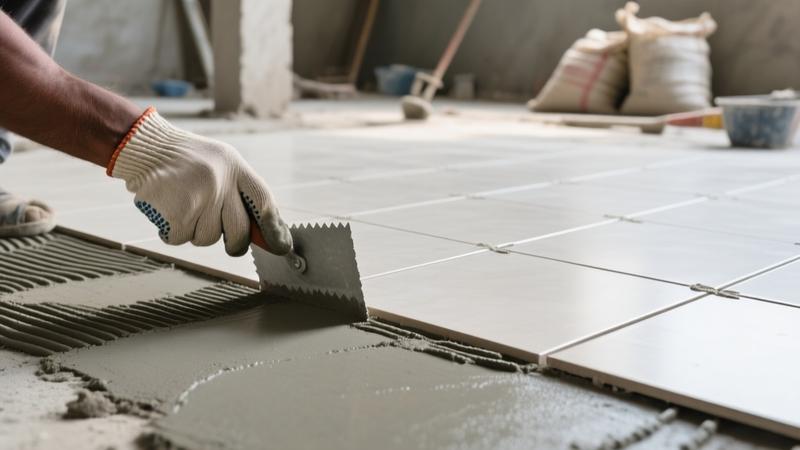
Why the choice matters for Indian homes
Floor and wall tiles are the face of any house. A weak bond shows up as cracked grout, loose tiles, or water seepage within a year. The decision between a polymer-based tile adhesive and a traditional cement-sand mortar decides whether you'll need a repair crew after a monsoon or enjoy a tile floor for a decade.
What's on the market in 2026
Tile adhesives have gone from niche products to mainstream. The big names are Sika Ceram-Plus, Dr. Fixit TileBond, and MSE's Smart-Bond. They are pre-mixed or powder-to-mix, contain polymers like acrylic or latex, and claim 30-40 per cent higher shear strength than plain cement mortar.
Cement mortars are still sold as ordinary OPC (Portland cement) mixed with river sand at a 1:4 ratio, or as modified "Cement-Sand-Latex" mixes where a small amount of liquid latex (usually 5-10 ml per litre) is added. Brands like UltraTech OPC and Ambuja are the go-to for the plain mix.
Cost comparison (per square metre)
| Item | Price Range (Rs.) | Typical Usage |
| Polymer tile adhesive (Sika, Dr. Fixit) | Rs. 120-180 per kg | Floor tiles 300-600 mm, wall tiles up to 600 mm |
| Cement-sand mortar (OPC + river sand) | Rs. 45-60 per 25 kg bag | Floor tiles >600 mm, heavy vitrified tiles |
| Modified cement-latex mortar | Rs. 70-90 per 25 kg bag | Wall tiles in wet areas (bathrooms, kitchens) |
| Labour (mix & lay) | Rs. 30-45 per sq ft | Depends on skill level, see Tile Installation Cost Per Sq Ft India 2026: Complete Guide |
If you calculate for a 100 sq m bathroom, adhesive will add roughly Rs. 12,000-18,000 to material cost, whereas cement mortar adds Rs. 4,500-6,000. The labour difference is marginal because mixing a polymer adhesive is quicker.
How you actually lay the tiles
With polymer adhesive you spread a 6-mm notched trowel, press the tile, and give it a 15-minute open-time before grouting. The bond forms as the polymer evaporates, so you can re-adjust within that window.
Cement mortar needs a 4-mm notched trowel for large floor tiles, and you must wait at least 24 hours before grouting. The mortar continues to cure for 28 days, meaning any movement in the sub-floor during that period can cause cracks.
For wall tiles in wet zones, many contractors still use a thin-set adhesive (polymer) because it resists water penetration better than plain cement mortar. Adding liquid latex to cement improves water resistance but still lags behind full polymer mixes.
Durability and performance under Indian conditions
Polymer adhesives hold up better against thermal expansion. In Delhi's summer-winter swing, a 600 mm vitrified tile on a cement mortar can lift by 0.2 mm, enough to hear a click. Adhesive limits that lift to about 0.1 mm.
Water resistance is another factor. In a bathroom where humidity stays above 80 per cent, a cement-sand mortar can absorb moisture, leading to efflorescence. Polymer adhesives are virtually impermeable, keeping the grout dry longer.
For heavy floor tiles (thickness >10 mm, weight >25 kg per sqm), a high-strength cement mortar with a 1:3 mix and added micro-silica performs as well as adhesive, provided the sub-floor is perfectly level.
Read more on tile strength in Strength of Different Tile Materials.
Common mistakes Indian builders make
- Using cheap, non-polymer "tile glue" that is just white cement mixed with water. It cracks within six months.
- Skipping the primer on glossy surfaces. Even the best adhesive will slip off polished marble or glazed tiles without a primer like Sika Primer-100.
- Mixing cement mortar with too much water to make it flow. The water-cement ratio rises above 0.6, dropping shear strength dramatically.
- Not allowing adequate curing time before grouting. Rushing leads to weak bonds and grout lifting.
- Ignoring substrate preparation. A dusty concrete slab or uneven plaster will ruin any bond, adhesive or cement.
Final recommendation for 2026 builds
If you're tiling a bathroom wall, a polymer-based adhesive (Sika Ceram-Plus or Dr. Fixit TileBond) is the safest bet - it costs a bit more but saves you from water damage and future repairs. For large floor areas with heavy vitrified tiles, a well-mixed cement-sand mortar at 1:3 ratio, compacted with a plate compactor, works fine and keeps material cost low.
For a mixed project - say, kitchen floor plus bathroom walls - use adhesive on the walls and cement mortar on the floor. That gives you the best of both worlds without blowing the budget.
Remember, the cheapest product today often becomes the most expensive repair tomorrow. Choose wisely, mix correctly, and give the mortar or adhesive the time it asks for.
Tile size and adhesive selection - the matrix that matters
Most Indian homeowners pick tiles by colour and finish, then wonder why the tile guy says "this needs a different adhesive." Tile size drives adhesive grade. The 300x300 mm ceramic tile that your father laid in 1995 with cement mortar holds fine because the small format and porous body gave the cement something to grip. Modern vitrified and porcelain tiles are different - dense, low-absorption, and large. A 600x600 mm vitrified tile on cement mortar will hollow-sound within a year. A 800x1600 mm large-format slab needs a C2TE-S1 grade adhesive (polymer-modified, slump-resistant, deformable) and a 12mm notch trowel.
Here is the practical matrix used by most Indian site engineers:
| Tile Size | Tile Type | Adhesive Grade (IS 15477 / EN 12004) | Trowel Notch |
| 300x300 mm | Ceramic (porous body) | C1 (basic cementitious) | 6mm square |
| 600x600 mm | Vitrified / Porcelain | C2 (polymer-modified) | 8-10mm square |
| 800x800 mm | Large vitrified | C2TE (slump-resistant) | 10-12mm square |
| 1200x600 mm or larger | Large-format slab | C2TE-S1 (deformable) | 12mm square + back-buttering |
| Natural stone (marble, granite) | Any size | White C2 (no grey staining) | 8-12mm |
| Mosaic / glass tile | Any size | C2TE + white colour | 4-6mm |
If your contractor is using the same grey C1 adhesive for every tile size, that is a red flag. A 50 rupees per bag upgrade to C2 saves the Rs. 50,000-80,000 cost of re-laying 200 sq ft of hollow tiles within 3 years.
Substrate preparation - the step that decides whether the tile lasts
The Indian construction site reality is that the floor or wall you are tiling is rarely ready. The screed has high spots, the plaster is dusty, the curing was rushed. Tile adhesive bonds to a clean, level, sound substrate. If the substrate fails, the tile fails - regardless of whether you used the best adhesive in India or the cheapest.
Three checks before any tile goes down:
- Surface flatness. A 2-metre straight edge should not show more than 3mm gap at any point. Out-of-level substrates force the tile-setter to build up adhesive thickness, which leads to shrinkage cracks and hollow pockets. Use self-levelling compound (weber.floor or Fosroc Nitoflor) for bad floors - Rs. 45-60 per sq ft for the material, but it saves the entire tiling job.
- Surface cleanliness. Dust, oil, curing compound, paint, or loose particles will all act as a release agent. Acid etching (dilute HCl wash followed by water rinse) or mechanical grinding may be needed for old concrete. New concrete should be cured for at least 28 days before tiling.
- Moisture content. Adhesive will not bond to a wet substrate. Check with a moisture meter (Rs. 2,500-4,000 from any hardware store) or the simpler plastic sheet test - tape a 1m x 1m polythene square on the floor for 24 hours. If condensation forms under it, the floor is too wet to tile.
For wall tiling in bathrooms, the wall must be waterproofed before tiling - not after. A cementitious waterproof coating (Dr. Fixit Raincoat, Fosroc Nitocote, or Sika TopSeal) applied in 2 coats at Rs. 35-50 per sq ft is non-negotiable. Skip this and the adhesive choice becomes irrelevant because water will eat the bond from behind within 18 months.
Adhesive brands available in India - what each is good for
The Indian market has matured. Here is what each major brand does well, based on what site engineers actually buy:
- Fosroc (Laticrete group): Nitobond series for general tiling, Tile Adhesive 220 for floor. Reliable, mid-premium pricing (Rs. 450-650 per 25 kg). Available pan-India.
- MYK Laticrete: 111, 222, 333 series covering C1, C2, and C2TE grades. Widely stocked by tile dealers. Pricing matches Fosroc.
- Ardex Endura: Premium positioning. S1 and S2 deformable grades for large format. Rs. 700-900 per 25 kg. Worth it for 800x800 mm and above.
- Dr. Fixit (Pidilite): TileBond XT and Pro. Aggressive distribution through hardware stores. Good for DIY and small projects.
- Sika: Ceram-Plus, Ceram-Standard. High-bond formulations favoured by commercial contractors.
- Weber Saint-Gobain: Weber.fix and Weber.set. Strong waterproofing range integrated with tile systems.
- BASF MasterTile: Premium range, used in commercial projects. Less common in retail.
- Kerakoll: Italian import, BioGel range. Used in high-end projects where eco-credentials matter.
For 90% of Indian homes tiling a 1,000-2,000 sq ft area, Fosroc Nitobond EP or MYK Laticrete 222 at Rs. 500-550 per 25 kg bag is the sweet spot of cost and reliability. Save the Ardex or Kerakoll for natural stone and large-format slabs.
When cement mortar is still the right call
This is a tile-adhesive article, so do not read it as anti-cement. There are specific situations where cement mortar is the correct choice and tile adhesive would be wrong:
- Outdoor pavements and driveways. Cement mortar 1:3 with 6mm aggregate handles thermal movement and load better than any tile adhesive. Adhesive here would just crack.
- Crazy paving and irregular natural stone. When the stones vary in thickness by 10-20 mm, you need the bed depth of cement mortar to make the surface level. Adhesive cannot do this in a single application.
- Heavy stone cladding on facades. Mechanical anchors plus cement mortar, not just adhesive. Building code requires it.
- Budget floor tiling where tiles will be replaced in 5-7 years. For rental properties or low-budget homes, the Rs. 8-12 per sq ft saving on adhesive makes sense if the tiles are not meant to last.
- Sub-floors that are not level. Cement mortar can be used to level and bond in one step. Tile adhesive cannot.
The mistake is using cement mortar for situations it cannot handle - vitrified wall tiles in a bathroom, large format floor tiles on a kitchen slab, or any tile installation where water resistance matters.
Quality checks after the tiles are laid
Walk the floor after 24 hours. The number of tiles that sound hollow when you tap them with a wooden mallet handle tells the story. A few hollow tiles in a 200 sq ft room is normal and acceptable (the industry tolerance is up to 5%). More than 10% hollow means the adhesive was poorly mixed, the substrate was not level, or the tiler was rushing.
For walls, push on each tile with light pressure after 48 hours. Any tile that moves or rocks needs to be re-laid. Grouting should not start until at least 24 hours after laying. Premature grouting traps moisture and prevents the adhesive from curing properly.
Finally, look at the grout lines. They should be uniform width, no tile edge sticking up above its neighbour, and no lippage. If a 1mm coin catches on a tile edge, that tile is high and will be a trip hazard. Get it lifted and re-laid before the grout hardens.