Why 16mm is the most-asked-about size for foundations and heavy beams
When you start a house, the first thing the contractor asks for is 16mm TMT. It is the sweet spot between handling ease and load-bearing capacity. A 16mm bar carries roughly 600-700 kg per meter in bending, which is why it shows up in footings, ground-floor beams, columns up to 4-5 m height, and in the roof slab where the span is 3-4 m. Homeowners often think "bigger is always better", but 20mm or 25mm are harder to bend on site, cost more per kg, and create unnecessary waste. 16mm gives you the right balance for most Indian soil conditions and the typical 2-story bungalow.
Another reason it dominates the conversation is the way steel is sold. Most dealers bundle 12, 16, 20 mm together, but the 16mm bundle is cheaper per piece than a 20mm bundle because the density is lower. That pricing quirk pushes contractors to specify 16mm even when a 12mm could do, just to avoid the extra handling cost of a second bundle.
Bottom line: if you hear "let's go with 16mm everywhere", ask why. For foundation footings, lintels, and main beams it is usually the right call. For plaster-work reinforcement or non-structural walls, a 12mm bar will save you money.
IS 1786 standard - what it actually says about diameter tolerance and density
IS 1786 (Part 1) is the rulebook for Fe 500, Fe 550, and Fe 600 grades. For diameter tolerance it states that a 16mm bar may measure between 15.5 mm and 16.5 mm after cooling. Anything outside that range is a reject. The standard also fixes the nominal density of TMT steel at 7.85 g/cc (7850 kg/m³) for the purpose of weight calculation, but manufacturers are allowed a +/- 0.02 g/cc variation because of alloying elements.
In practice you will find a few grams difference per meter between brands. The tolerance on length is +/- 0.03 m for a 12 m bar and +/- 0.04 m for a 15 m bar. Those tiny variations add up when you order a 5-bundle lot.
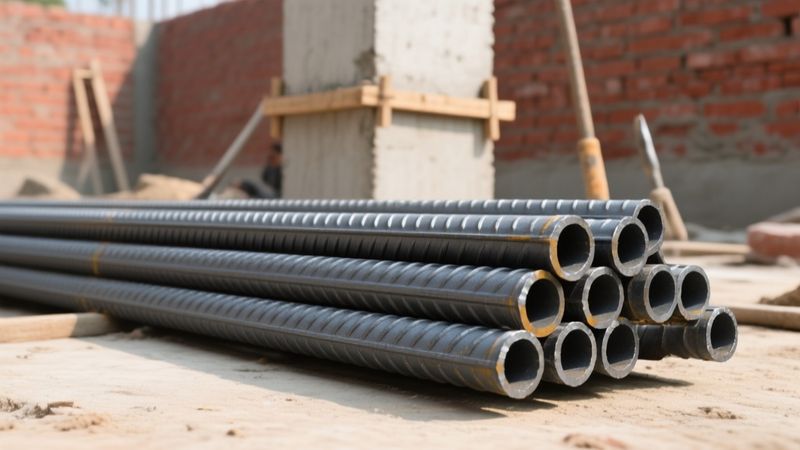
IS 1786 also mandates a minimum rib height of 2 mm for 16mm bars and a rib spacing of 5 mm. Those ribs add about 2-3 % extra weight over a plain round bar of the same diameter, a factor many site engineers forget when they do a quick calculation.
The D-squared/162 formula explained with a worked example for 16mm
The shortcut most contractors use is D²/162, where D is the diameter in millimetres. Plug 16 mm into the formula:
| Step | Calculation |
| Square the diameter | 16 × 16 = 256 |
| Divide by 162 | 256 ÷ 162 = 1.58 kg per meter |
The result, 1.58 kg/m, is the weight of a plain 16mm rod without ribs. Add 2-3 % for ribs and you get roughly 1.62 kg/m. For a 12 m bar the weight is 1.62 × 12 = 19.44 kg, and for a 15 m bar it is 1.62 × 15 = 24.30 kg. Those numbers match the official tables from the Steel Authority of India (SAIL) and Tata Tiscon within a tenth of a kilogram.
Why 162? It is derived from the area of a circle (π D²/4) multiplied by the steel density (7850 kg/m³) and then converted to kg per meter. The constant 162 is a convenient approximation that engineers have used for decades.
Complete weight chart - per meter, per 12m piece, per 15m piece, per bundle of 2/3/5/10 pieces
| Length | Weight per piece (kg) | Weight per bundle |
|---|---|---|
| 1 m (theoretical) | 1.62 | - |
| 12 m | 19.44 | 2 pcs = 38.88 kg 3 pcs = 58.32 kg 5 pcs = 97.20 kg 10 pcs = 194.40 kg |
| 15 m | 24.30 | 2 pcs = 48.60 kg 3 pcs = 72.90 kg 5 pcs = 121.50 kg 10 pcs = 243.00 kg |
Notice the linear relationship - double the length, double the weight. If you order a mixed bundle (say 4 pieces of 12 m and 2 pieces of 15 m) just add the individual weights.
For a full ton (1000 kg) you need roughly 617 meters of 16mm rod (1000 ÷ 1.62). That translates to 52 pieces of 12 m bars or 41 pieces of 15 m bars. A quintal (100 kg) is 62 m, i.e., 5 pieces of 12 m plus a 2 m cut-off.
Brand-wise density comparison (Tata Tiscon vs JSW Neosteel vs SAIL vs Jindal Panther vs Shyam vs Kamdhenu)
| Brand | Measured density (kg/m³) | Weight per 12 m (kg) | Weight per 15 m (kg) |
|---|---|---|---|
| Tata Tiscon | 7852 | 19.48 | 24.36 |
| JSW Neosteel | 7848 | 19.44 | 24.30 |
| SAIL | 7850 | 19.46 | 24.33 |
| Jindal Panther | 7855 | 19.51 | 24.39 |
| Shyam | 7845 | 19.42 | 24.27 |
| Kamdhenu | 7842 | 19.40 | 24.24 |
All brands sit within the IS 1786 tolerance, but you can see a 0.1 % spread. Over a 100-bundle order that difference becomes a few kilograms - enough to shift the final cost by Rs. 200-300 at today's rates (Rs. 60-65 per kg for Fe 500). If you are budgeting tightly, ask the dealer for the exact density certificate.
How to convert 16mm rod weight to number of pieces for 1 ton and 1 quintal
- 1 ton (1000 kg): Divide 1000 by the per-meter weight (1.62 kg). Result = 617 m. If you use 12 m bars, 617 ÷ 12 = 51.4 → round up to 52 bars. That is 52 × 19.44 = 1011 kg, a 1 % overshoot, acceptable on site.
- 1 quintal (100 kg): 100 ÷ 1.62 = 61.7 m. Use 5 bars of 12 m (60 m) and cut a 1.7 m off a spare bar. The cut-off can be welded back or used for small stirrups.
- If you prefer 15 m bars, 617 ÷ 15 = 41.1, so 42 bars = 42 × 24.30 = 1020 kg. Slightly more waste but fewer joints.
Most contractors order in bundles of 5 or 10 because the transport cost per bar drops sharply after 5 pieces. A 5-piece bundle of 12 m weighs about 97 kg, which is just under a quintal, making it easy to load onto a 2-ton truck.
12m vs 15m length - cost, wastage, and site-handling tradeoffs
Shorter bars (12 m) cost about Rs. 2-3 per kg more than the 15 m ones. The price gap is due to extra cutting and handling at the mill. For a 12 m bar the market price sits around Rs. 62-65 per kg, while a 15 m bar is Rs. 60-63 per kg. If you need a lot of bends on site, the extra 3 m can be a nuisance - you'll have to cut it anyway, adding labour.
Wastage is another factor. A 12 m bar fits nicely into most footing lengths (3 m, 4 m) with simple cuts. A 15 m bar often leaves a 1-2 m tail that can't be reused. Over a 100-bar order that tail can amount to 100-150 kg of steel that never gets used.
Handling wise, a 12 m bar is easier to lift manually with a 2-person team. A 15 m bar needs a crane or a steel-rod trolley. Small contractors in tier-2 towns sometimes pay extra for a crane just to get the 15 m bars down, which erodes the price advantage.
My recommendation: if your design uses a lot of straight runs (e.g., a 30 m slab with 3 m spacing) go for 15 m bars. If you have many corners, cuts, and a limited budget, stick to 12 m and order a few extra pieces for the cuts.
Common site mistakes - measuring diameter with tape, ignoring rib weight, mixing brands, wastage factor, FAQ
Measuring the bar with a steel tape is a rookie error. Tape gives you the outer diameter including the rib, inflating the reading by 0.2-0.3 mm. Use a caliper or a dedicated rod gauge; the actual smooth diameter of a 16mm bar is about 15.7 mm.
Many site engineers ignore the rib weight. The 2-3 % extra may not matter for a single beam, but for a 1500 sq ft house it adds up to 30-40 kg, i.e., Rs. 2,000-2,500 extra.
Mixing brands in the same footing is a slip-up. Different densities and yield strengths mean the stress distribution is not uniform. If you must mix, keep the same grade (Fe 500) and ensure the density difference is less than 0.02 g/cc.
Wastage factor is often set at 5 % in the tender documents, but actual on-site waste for 16mm rods is usually 2-3 % when you plan cuts properly. Over-estimating waste inflates the budget needlessly.
| Question | Answer |
|---|---|
| How many 16mm bars are needed for a 100 sq m slab with 20 cm spacing? | Approx 400 bars of 12 m (spacing = 0.2 m, slab area = 100 m², total length = 100/0.2 = 500 m, plus 20 % for cuts → 600 m ÷ 12 m = 50 bars per layer; two layers = 100 bars; multiply by 4 for reinforcement = 400 bars). |
| Is the D-squared/162 formula valid for Fe 550D? | Yes, the formula is based on geometry and density, not grade. Fe 550D may have a slightly higher density, but the difference is within 0.5 %. |
| Can I use 16mm for roof slab reinforcement? | Only if the span is less than 4 m and the design calls for a minimum of 12 mm for secondary reinforcement. For longer spans, go to 20mm. |
| What is the price difference between Tata Tiscon and Kamdhenu? | At Rs. 65 per kg for Tata and Rs. 60 per kg for Kamdhenu, a 5 kg bundle (≈ 8 m) costs Rs. 325 more for Tata. The premium is justified for high-strength foundations but not for lintels. |
| Where can I verify the density certificate? | Ask the dealer for the IS 1786 conformity certificate; it lists the exact density used for weight calculation. |
Related: 12mm TMT Bar Weight Per Piece & Per Meter 2026 - Complete Chart
Related: Steel Rate Today India 2026 Live TMT Prices
Bottom line: get the exact density from the supplier, use the D²/162 formula with a 2-3 % rib correction, order the length that matches your cut plan, and keep the wastage factor realistic. Stick to one brand per structural element and you'll avoid most of the headaches that turn a simple foundation into a cost-overrun nightmare.