
Why the bond matters
The bond decides how the bricks share load. A good bond spreads vertical stress, resists shear and keeps the wall from cracking when the house settles. Bad bond = weak wall, water seepage, and a lot of repair bills.
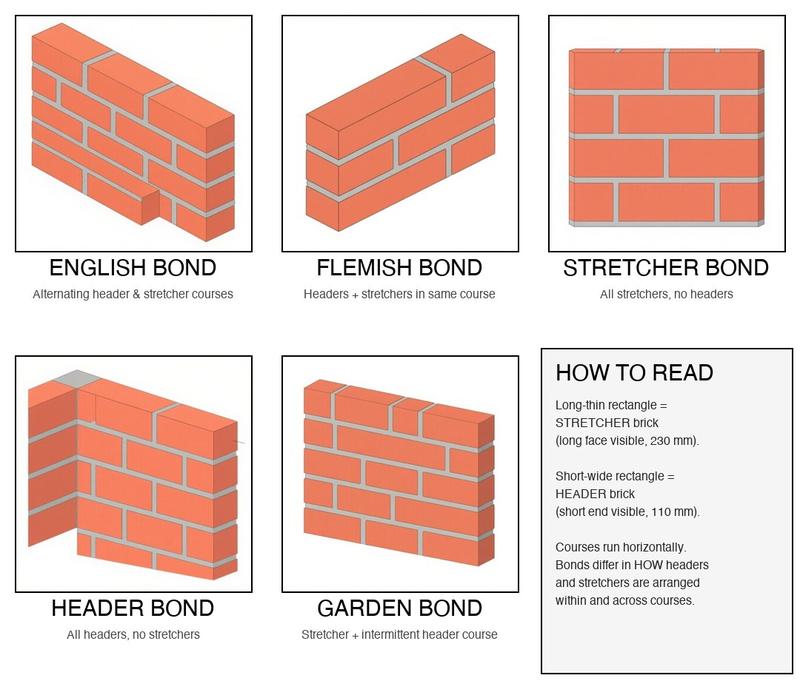
Common brick bonds used in Indian homes
| Bond | Pattern | Typical Use | Strength (approx.) |
|---|---|---|---|
| English | alternating header and stretcher every course | load-bearing walls, external facades | high |
| Flemish | header and stretcher in same course, alternating | heritage look, interior partitions | moderate |
| Stretcher | all stretchers, no headers | non-load-bearing partitions, garden walls | low-moderate |
| Header | all headers | rare, used for thick walls or decorative panels | low |
| Garden Wall | stretcher with intermittent header every 4-5 courses | boundary walls, low rise fences | low-moderate |
| 1-brick | single brick thickness (~190 mm) | partition walls, internal cladding | low |
| 1.5-brick | brick + half brick (~285 mm) | light load-bearing, semi-external | moderate |
| 2-brick | double brick (~380 mm) | main load-bearing walls, external facades | high |
Wall thickness and IS code rules
IS 2212 (Code of practice for masonry) and IS 2250 (Specification for mortar) together prescribe minimum wall thickness for different exposure classes. For a load bearing wall in a residential building (exposure class I), IS 2212 requires a minimum of 230 mm for brick masonry when using 1:4:0.5 mortar. In practice most contractors adopt the 2-brick (~380 mm) thickness to allow for plaster and finish layers while staying within the code limits.
If you are constructing a non-load-bearing partition, the code permits a minimum of 115 mm (1-brick) provided the wall does not support any permanent load. However, for walls that will carry plaster of 12 mm and a skim coat of 4 mm, the effective thickness becomes 131 mm, which still satisfies the code for interior partitions.
Common site mistake: many masons cut the brick thickness to 200 mm to save material, forgetting that the code minimum is 230 mm for load-bearing walls. This leads to excessive deflection and, in seismic zones, higher crack density. Always verify the finished thickness on site with a steel tape before laying the first course.
Mortar mix ratios you can trust
For load-bearing walls the code (IS 2250) asks for 1 : 4 : 0.5 (cement : sand : lime) by volume. That gives a compressive strength of about 7 MPa after 28 days. For garden walls or non-structural partitions 1 : 6 (cement : sand) is acceptable, but never go below 1 : 5 if you expect any load.
Typical cost in Delhi-NCR: cement Rs. 350 per 50 kg bag, sand Rs. 45 per cu ft, lime Rs. 25 per kg. A full wall of 100 sq m with 1.5-brick thickness needs roughly 12 bags of cement and 2 cu m sand - total mortar cost Rs. 5,500 to Rs. 7,000.
Load-bearing vs partition walls - when to pick which bond
- Load-bearing: use English or 2-brick wall with 1 : 4 : 0.5 mortar. Provide lintels over openings - size per Lintel in House Construction 2026.
- Partition: stretcher or Flemish bond, 1-brick thickness, 1 : 6 mortar. No need for heavy lintels; a simple steel angle or RCC lintel of 150 mm depth works.
Never treat a partition as load-bearing just because you like the look of a thick wall. The extra brick adds dead load and may cause settlement if foundation isn't sized for it.
Half brick vs full brick walls - the real cost difference
A full brick wall (190 mm) costs about Rs. 1,100 per sq m for bricks alone (Rs. 8 per brick, 125 bricks per sq m). A half-brick wall (95 mm) halves the brick count but doubles the labour for alignment, so overall you save only 20-25 percent. If you need structural strength, the half-brick trick is a waste of time.
Common masonry mistakes you must avoid
- Mixing sand of different gradation in the same batch - leads to weak joints.
- Skipping the first header course in English bond - wall loses tie-in, cracks appear.
- Using soft mud mortar for external walls - water penetrates, efflorescence follows.
- Over-tightening bricks against each other - creates stress concentrations and spalling.
- Not providing proper lintels - the most common fraud is charging Rs. 10,000 for a 150 mm concrete lintel that actually needs 200 mm depth for a 2 m opening.
Our field experience shows that 60 % of wall failures in small projects trace back to one of the above. Check each step yourself or have a trusted supervisor on site.
Choosing the right bond for your project
If you are building a two-storey house with a concrete frame, stick to English bond for all external and ground-floor load-bearing walls. Use 2-brick thickness where you expect wind pressure - especially in coastal Karnataka or Gujarat.
For a 20 x 30 ft bungalow with a central courtyard, Flemish bond on interior facades gives a heritage feel without compromising strength, as long as you keep the mortar at 1 : 4 : 0.5.
Garden walls around the property can be simple stretcher bond with 1 : 6 mortar, but remember to give a minimum 150 mm thickness and a footing of 300 mm depth.
DPC, water-proofing and bond interaction
DPC (Damp Proof Course) is usually a 12 mm thick bitumen felt or a 10 mm thick HDPE sheet placed at the top of the foundation level. The bond you choose influences how well the DPC works. In English bond the regular header courses provide a natural break that helps the DPC stay continuous. In stretcher bond, where headers appear only every fifth course, there is a higher chance of tiny gaps that allow moisture to wick up if the DPC is not overlapped correctly.
For external walls in humid zones (e.g., Kerala, coastal Tamil Nadu) combine a waterproofing membrane on the outer plaster with a well-tied DPC. Ensure the membrane overlaps the brick joints by at least 50 mm and the DPC extends beyond the wall by 150 mm on both sides. Failure to do so leads to rising damp, plaster delamination and eventually brick spalling.
Site tip: ask the masons to place a thin layer of cement-sand mortar (1 : 3) over the DPC before laying the first brick course. This creates a mechanical lock and prevents the DPC from being punctured by sharp brick edges.
Regional bond patterns across India
Different states have cultivated distinct brick laying traditions that reflect climate, local material availability and aesthetic preferences.
- Rajasthan: The "Rajasthani bond" often uses a double header pattern every third course, creating a sturdy wall that can resist high temperature swings. Builders also like to embed decorative "chunri" bricks every fifth course for visual interest.
- South India: In Karnataka and Tamil Nadu, a modified English bond called "Karnataka bond" is common. It uses a header-stretcher pair followed by two stretcher courses, which reduces the number of headers while maintaining adequate tie-in. This saves bricks in regions where clay quality is variable.
- West Bengal: The "Bengal bond" combines Flemish and English patterns. Every alternate course alternates between full header and full stretcher, giving a strong yet ornamental wall suitable for the heavy monsoon rains of the delta.
When you hire a contractor, ask which regional bond they are most comfortable with and whether it meets IS 2212 requirements for your building type. A mismatch can cause unnecessary re-work.
Cost per sq ft for each bond type 2026
| Bond | Tier-1 city (Rs./sq ft) | Tier-2 city (Rs./sq ft) | Notes |
|---|---|---|---|
| English (2-brick) | 210 | 150 | Includes brick, mortar, 2-brick thickness, standard lintel. |
| Flemish (1-brick) | 180 | 130 | Good for interior partitions and heritage look. |
| Stretcher (garden wall) | 130 | 90 | Non-load-bearing, 1-brick thickness, 1:6 mortar. |
| Header (decorative) | 200 | 140 | Used rarely, higher labour cost. |
| 1.5-brick (light load-bearing) | 190 | 135 | Suitable for semi-external walls. |
These figures assume average brick cost of Rs. 8 per brick, cement Rs. 350 per bag and include a 10 % contingency for waste. Prices rise about 12 % annually, so the 2026 numbers are already higher than 2023 rates.
Practical tip - how to verify quality before paying
Take a core sample from any wall that is at least 100 mm deep. The mortar should be hard, no sand pockets. Brick joints must be uniform, about 10 mm thick. If you see any soft, crumbly mortar, demand a re-mix - this is the same point highlighted in Common Construction Mistakes to Avoid During House Building in India 2026.
Bottom line
English bond with 2-brick thickness and proper 1 : 4 : 0.5 mortar gives the best structural safety for Indian homes. Save money only where the load is truly minimal - garden walls, interior partitions - and use stretcher or Flemish bond with thinner walls. Keep an eye on mortar quality, lintel sizing, and never let a cheap brick replace a proper bond. If you follow these basics, your house will stand firm for the next 30 years.
Pre-mason checklist (print and give to contractor)
- Confirm wall thickness as per IS 2212 (230 mm for load-bearing, 115 mm for partitions).
- Verify mortar mix: 1 : 4 : 0.5 for load-bearing, 1 : 6 for non-structural.
- Check bond pattern matches approved drawing (English, Flemish, etc.).
- Inspect first header course in English bond - must be present.
- Ensure DPC is placed at foundation level and overlaps bricks by 50 mm.
- Confirm lintel size and reinforcement as per Lintel in House Construction 2026.
- Take a mortar core sample from the first 2 courses - hardness and uniformity.
- Ask for a written cost breakdown per sq ft for each bond type.
- Record any deviation on site diary with date, time and responsible foreman.
- Final sign-off only after visual inspection of joint thickness (10 mm) and brick alignment.