
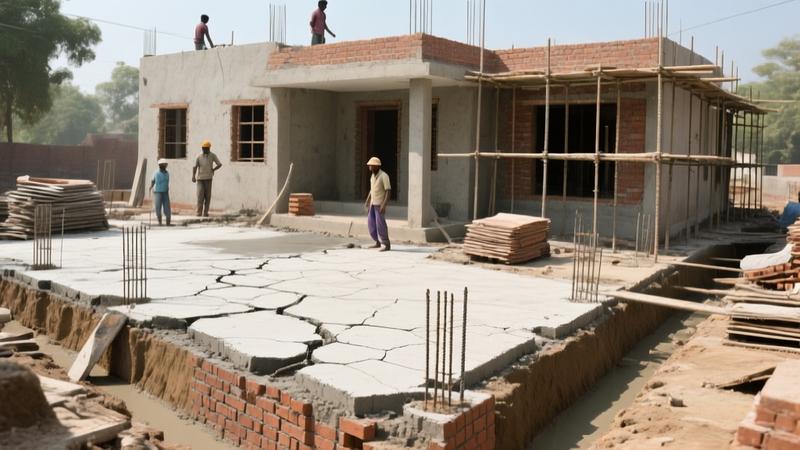
Common Construction Mistakes to Avoid During House Building in India 2026
After 500+ projects, I've seen the same avoidable errors pop up year after year. Most of them cost a few thousand rupees if you do them right the first time, but explode into lakhs when you have to fix them later. Below are the 12 blunders that bite most Indian homeowners and small builders today.
1. Skipping Soil Test
Every foundation starts with the ground. A simple Indian Standard IS 2720-1 soil investigation costs Rs. 4,000-6,000 per borehole. Many first-time owners think they can guess the soil type and save a few bucks. The result is either a settlement crack later or a whole foundation redesign. Moreover, the soil test report is often a mandatory attachment for the local municipal building permit, so skipping it can cause unexpected legal delays.
| Do it right now | Rs. 5,000 per borehole (3-5 boreholes for a 150 sq m plot) |
| Fix later | Rs. 80,000-1,20,000 for underpinning, extra concrete, and labor |
Besides money, a delayed soil test can stall approvals. You'll also waste time re-excavating if the soil is later found to be collapsible. Take the test early; it's a tiny investment for peace of mind and keeps the construction schedule on track.
2. Shallow Footings
Footings that are only 300 mm deep in a zone with 6-7 % clay content will crack when monsoon water swells the soil. The Footing in House Construction 2026 guide explains that minimum depth should be 450-600 mm depending on soil bearing capacity. In addition, deeper footings provide better resistance against differential settlement caused by nearby tree roots or future road widening.
| Do it right now | Rs. 2,500-3,500 per sq m extra excavation & concrete |
| Fix later | Rs. 1,00,000-1,50,000 for underpinning and settlement repair |
If you cut corners, expect uneven floors, door jams, and a need to pour a new plinth beam later. The extra digging cost now is nothing compared to a cracked foundation repair, and it also avoids future disputes with neighbours over foundation movement.
3. Wrong Concrete Grade
Using M15 for a load-bearing slab or a column is a classic mistake. The IS 456 code mandates at least M20 for residential slabs, M25 for columns with more than 2.5 m height. Contractors love the cheaper cement-sand-aggregate mix, but the loss of strength shows up as flexural cracks within months. Additionally, the lower grade concrete absorbs more moisture, which can accelerate corrosion of embedded steel in humid climates.
| Do it right now | Rs. 300-350 per cu m extra for M25 over M15 |
| Fix later | Rs. 1,20,000-2,00,000 for slab strengthening or full replacement |
Switching to the correct grade at the pour stage costs a few thousand; correcting it after cracking can double the budget. Remember that the mix design should be approved by a qualified site engineer to avoid on-site improvisations.
4. Bad Sand for Plaster
River sand with high silt content (more than 5 %) creates a weak plaster that peels off when painted. The right sand should pass the "wet hand test" - no gritty feel. Using cheap "construction sand" from a local dump saves Rs. 500-800 per bag but leads to re-plastering. Moreover, poor-grade sand retains moisture, encouraging mould growth behind the plaster in monsoon-prone regions.
| Do it right now | Rs. 1,200-1,500 per cu m of quality sand |
| Fix later | Rs. 30,000-50,000 for removal, new plaster, and paint |
Bad plaster also invites damp patches on walls, especially in humid coastal cities. A small extra spend on sand avoids a big rework later and keeps the interior finish looking fresh for years.
5. Wrong Rebar Diameter
Many contractors use 8 mm bars for a 3-storey house's column instead of the required 12 mm. The saving is about Rs. 30 per kg, but the column's load-carrying capacity drops by 20-30 %. The result is a cracked column under live load, which may also cause excessive deflection in floor slabs above. Using the correct diameter also improves ductility, an essential factor during seismic events common in many Indian zones.
| Do it right now | Rs. 70-80 per kg for 12 mm TMT (Tata Tiscon) vs 8 mm |
| Fix later | Rs. 1,50,000-2,20,000 for column jacketing or replacement |
Choosing the correct diameter at the bar-bending stage saves you a massive structural retrofit later and also keeps the reinforcement schedule within the limits set by IS 456 for spacing and concrete cover.
6. Bar Bending Schedule (BBS) Errors
Skipping a proper BBS leads to over-bending, under-bending, or missing hooks. A typical mistake is omitting the 45-degree hook on a lintel bar, which reduces its moment resistance. The Bar Bending Schedule (BBS) for House Construction 2026 guide shows a sample schedule and common pitfalls. Moreover, an accurate BBS helps the site supervisor verify that the steel delivered matches the design, preventing costly shortages.
| Do it right now | Rs. 2,000-3,000 for a professional BBS drawing |
| Fix later | Rs. 80,000-1,10,000 for structural retro-fit and re-bar replacement |
Getting the BBS right the first time avoids costly re-bending on site and prevents weak points that only show up after a few months of service. It also speeds up the site audit because the engineer can cross-check quantities instantly.
7. Inadequate Curing
Many owners think "just sprinkle water once" is enough. Proper curing requires maintaining 70-80 % moisture for 7-14 days for M25 concrete. Skipping this step reduces strength by up to 15 % and leads to surface cracks. The Concrete Curing Methods article details how curing blankets, ponding, or membrane curing can be chosen based on climate, and the Monsoon Construction Guide stresses extra caution during heavy rains.
| Do it right now | Rs. 800-1,200 per 100 sq m for curing blankets or water-sprinkling system |
| Fix later | Rs. 60,000-1,00,000 for crack repair, epoxy injection, and resurfacing |
Spend a day or two on proper curing and you'll avoid a month of crack repairs later. Remember to protect the curing surface from direct sunlight and wind, especially in hot summer months, to retain moisture.
8. Wrong Plaster Mix
Using a 1:3:8 (cement:sand:lime) mix for external walls is a mistake; the correct ratio for Indian climates is 1:4:0.5 (cement:sand:lime) with a water-cement ratio of 0.45-0.5. The cheap mix looks smooth but peels off when exposed to rain. Additionally, an over-rich cement mix can cause shrinkage cracks, while the right proportion offers better adhesion to brickwork and improves fire-rating of the wall.
| Do it right now | Rs. 250-300 per sq ft extra for correct mix |
| Fix later | Rs. 35,000-55,000 for re-plaster and repaint |
Getting the mix right the first time also improves fire resistance and reduces paint consumption. A quality plaster also acts as a barrier against insects and helps maintain indoor humidity levels.
9. No Waterproofing
Skipping a waterproof membrane under the roof slab or in the bathroom floor is a classic cost-cutting move. A 2 mm bitumen sheet costs Rs. 45-55 per sq ft, while a liquid polymer membrane runs Rs. 120-150 per sq ft. Not applying any waterproofing can lead to roof leaks within a season. In high-rainfall zones, a liquid membrane also seals around roof penetrations better than bitumen, reducing future maintenance.
| Do it right now | Rs. 1,00,000-1,40,000 for full house waterproofing (1500 sq ft) |
| Fix later | Rs. 2,00,000-3,50,000 for leak repair, plaster removal, and re-waterproofing |
Water ingress not only damages plaster but also promotes mould, which costs health and money. A well-executed waterproofing system also adds resale value because future buyers appreciate a dry, problem-free roof.
10. No Damp-Proof Course (DPC)
Many low-budget projects omit the DPC in the plinth. A 1 mm HDPE sheet costs Rs. 30-40 per sq ft. Without it, capillary rise pulls moisture up the walls, causing salty efflorescence and paint failure. Moreover, the absence of a DPC accelerates the corrosion of steel ties in the plaster, especially in coastal cities where chloride ions are abundant.
| Do it right now | Rs. 12,000-15,000 for 400 sq ft DPC |
| Fix later | Rs. 40,000-70,000 for wall drying, DPC insertion, and re-painting |
A proper DPC is a one-time installation; retrofitting means breaking the plinth, which is a nightmare. Ensure the DPC overlaps correctly at corners and is protected by a moisture-resistant membrane during back-filling.
11. Wrong Conduit Placement
Running electrical conduits inside plastered walls without proper sleeves leads to future short circuits when you need to add sockets. A typical mistake is placing a 2.5 mm conduit at 15 mm from the wall surface; the code (IS 3043) asks for at least 25 mm clearance. Fixing it later means chipping out plaster and re-plastering. In addition, poorly placed conduits make fire-stop installation difficult, compromising safety.
| Do it right now | Rs. 800-1,200 per 10 m conduit with proper sleeves |
| Fix later | Rs. 25,000-35,000 for wall opening, re-plaster, and finishing |
Plan the conduit map during the bar-bending stage and keep a spare conduit loop for future upgrades. A clear layout also helps the electrician finish the wiring without having to cut through finished plaster.
12. Contractor Fake Bills
Some contractors submit inflated material bills or charge for "extra work" that never happened. A fake brick bill can add Rs. 1,00,000 to the total. The only defence is a proper audit: compare the contractor's invoice with a purchase receipt and a site verification checklist. Engaging a third-party quantity surveyor for periodic checks can catch discrepancies early, saving you from a nasty legal battle.
| Do it right now | Rs. 5,000-8,000 for a third-party verification service |
| Fix later | Rs. 1,00,000-2,50,000 lost to over-billing and legal hassle |
Never settle the final payment until you have inspected every item. A little paperwork now saves you a big headache later, and it also gives you leverage if you need to claim warranty work from the contractor.
FAQ
- How many boreholes are enough for a 200 sq m plot? Usually 4-5 evenly spaced holes give a reliable average bearing capacity, and the lab report can be submitted directly with the building plan.
- Can I use M20 concrete for a ground floor slab? Yes, if the live load is under 2 kN/m² and the slab thickness is at least 150 mm, but always verify with the structural engineer's design.
- Is liquid waterproofing better than bitumen? Liquid membranes bond better to irregular surfaces and are quicker to apply, but they cost 2-3 times more. Choose based on budget, roof slope, and expected rainfall intensity.
- What is the minimum size for a DPC? A 1 mm HDPE sheet covering the entire plinth width with a 300 mm overlap on each side is standard, and it should be placed above the damp proof course level before back-filling.
- How often should I inspect the work before paying? At every major stage: excavation, footing, column pour, slab, plaster, and finishing. A written punch-list after each stage helps avoid surprise charges later.
Take these points seriously, spend a modest amount now, and you'll dodge the massive repair bills that haunt most Indian homeowners.