
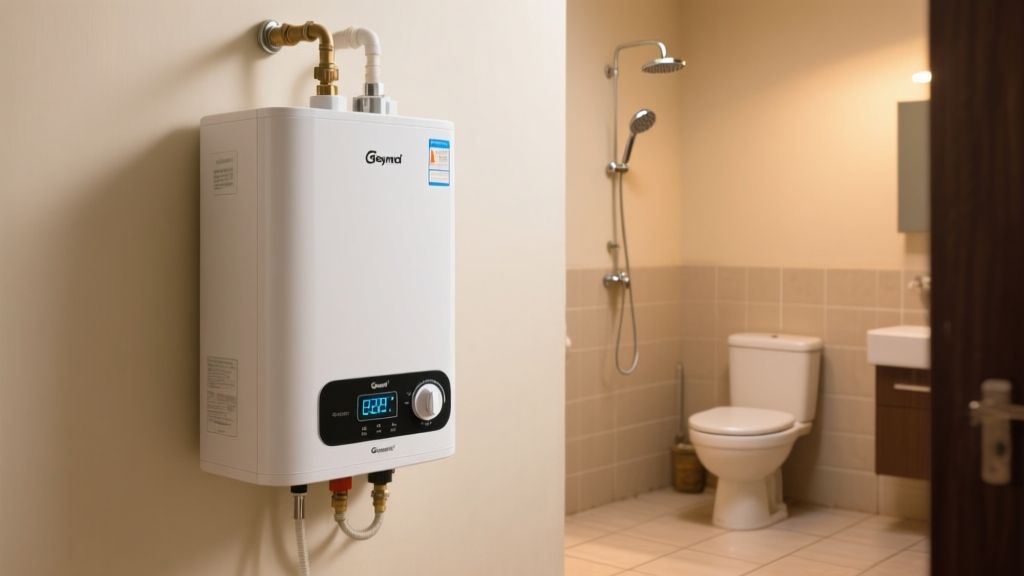
Instant (Tankless) Electric Geysers
Instant electric geysers heat water on demand, so there is no storage tank. A 2 kW unit can deliver 6-8 litres per minute at 40 °C rise, enough for a single shower or kitchen tap. The biggest advantage is the lack of standby loss - you only pay for the kilowatt-hours you actually use.
Popular models in 2026 include the AO Smith HSE-VS-2-A (2 kW, Rs. 4,800) and the V-Guard VGD-2 (2 kW, Rs. 3,900). Both have a 3-year warranty and a safety cut-off at 90 °C. Installation needs a dedicated 15 A circuit and a heat-resistant wall mount.
These units fit well in apartments where space is at a premium. The downside is a drop in flow if multiple outlets are opened simultaneously - a 2 kW geyser will struggle if you try to run a bath and a washing machine together.
Best for: small families, renters, and anyone who wants zero tank maintenance.
Storage (Tank) Electric Geysers
Storage geysers keep a reservoir of hot water ready for use. The classic 15-litre electric tank is the most common size for a two-bedroom flat. A 2 kW element raises the temperature of 15 litres from 15 °C to 60 °C in about 45 minutes.
Brands like Racold (R-15-V, Rs. 5,200) and Bajaj (RC-15, Rs. 4,500) dominate the market. They come with a glass-lined inner tank to resist corrosion, a thermostat with +/- 2 °C accuracy, and a double-circuit safety valve.
Energy loss through the tank walls is the main cost driver. A well-insulated 15-litre unit loses roughly 0.3 kWh per day, translating to about Rs. 130 per year at the current tariff of Rs. 8 per kWh. If you upgrade to a 30-litre model, loss roughly doubles.
Installation is simple - a wall-mounted bracket or floor stand, plus a 6 mm copper pipe for inlet and outlet. Regularly check the anode rod (if present) and clean the thermostat contacts to avoid premature failure.
Best for: families that need a burst of hot water for bathing, cooking, and washing in quick succession.
LPG / Natural Gas Geysers
Gas geysers use a small burner to heat water as it passes through a heat exchanger. A 6 kW gas unit can supply 12-15 litres per minute at a 40 °C rise, easily handling two showers at once.
In Delhi-NCR, the Havells Geyser-NG-6 (6 kW, Rs. 7,800) and the Racold Gas-6 kW (Rs. 7,200) are widely available. Both accept LPG cylinders and, where pipelines exist, natural gas. They have a built-in flame-failure safety device and a pressure-relief valve.
Operating cost is tied to gas price - at Rs. 90 per kg of LPG, a 6 kW unit consumes about 0.5 kg per hour of continuous use, costing roughly Rs. 45 per hour. Compared with a 2 kW electric geyser (which would cost Rs. 16 per hour at Rs. 8/kWh), gas wins only if you have high daily hot-water demand.
Ventilation is mandatory; a flue or vent pipe must be installed to exhaust combustion gases. In high-humidity regions, condensation can corrode the heat exchanger, so stainless-steel models (e.g., Bajaj S-6, Rs. 9,000) are worth the extra cash.
Best for: large families, villas with a dedicated gas line, and builders who want to market a "continuous hot-water" promise.
Solar Thermal Water Heaters
Solar collectors convert sunlight into heat, which is transferred to a water tank via a heat-transfer fluid. The most common flat-plate collector in India is the 2 m² aluminium-coated panel costing around Rs. 4,500 per panel.
A typical 200-litre solar water heater (SW-200, Rs. 18,000) includes two 2 m² panels, a 200-litre insulated tank, and a backup electric element of 1 kW. In Delhi-NCR, annual solar gain averages 1,200 kWh, enough to pre-heat water for a family of four, cutting electric consumption by 40-50 %.
Installation requires a roof with at least 30° tilt and unobstructed south-west exposure. The system must be flushed annually to prevent scaling, especially in hard-water areas like Rajasthan.
Initial outlay is high - a 300-litre system with three panels can run Rs. 28,000-30,000. However, the payback period is usually 4-5 years, given the reduced electricity bill and the 30-year lifespan of the collectors.
Best for: eco-conscious homeowners, new constructions with large roof space, and regions with high solar insolation.
Heat Pump Water Heaters
Heat-pump water heaters (HPWH) extract heat from ambient air and raise water temperature using a compressor. A 1 kW heat-pump can deliver 15 litres per minute at 45 °C rise, using only 0.3 kW of electricity - an efficiency (COP) of about 3.5.
In 2026 the Panasonic DH-WH-1 (Rs. 22,000) and the Daikin DH-WH-1 (Rs. 24,500) are the few models sold in India. They come with a 200-litre insulated tank and a built-in inverter to adapt to fluctuating grid voltage.
The biggest limitation is ambient temperature. Below 10 °C the COP drops to 2.0, and the unit may need a supplemental electric element. In most Indian cities, the average winter night temperature stays above 15 °C, so the system works efficiently year-round.
Installation needs a well-ventilated space - a utility cupboard or a balcony. Noise level is around 45 dB, comparable to a normal conversation.
Best for: owners of energy-efficient homes who can afford the higher upfront cost and want low operating bills.
Immersion Rods (Direct Heating)
Immersion rods are the simplest way to heat water: a metal coil inserted directly into a storage tank. A 2 kW rod raises a 15-litre tank from cold to hot in 30 minutes, consuming about 0.6 kWh per heating cycle.
Most Indian manufacturers (e.g., Philips, Havells) sell 2 kW rods for Rs. 650-800. They are sold as accessories for RCC water tanks, metallic or concrete, and can be fitted by a handyman.
Because the heating element is exposed to water, mineral deposits shorten its life. In hard-water zones, replace the rod every 2-3 years, or install a water softener.
Safety is a concern - a missing grounding wire can cause electric shock. Always use a double-pole circuit breaker and keep the rod away from the tank's top surface to avoid boiling and pressure buildup.
Best for: budget-conscious builders, temporary water-heating solutions, and rural homes where electricity is the only fuel.
Hybrid (Electric + Solar) Water Heaters
Hybrid units combine a solar collector with an electric backup element in a single tank. The solar side pre-heats water during the day, while the electric element (usually 1 kW) tops up the temperature to the set point.
Brands like V-Guard (Solar-Hybrid-250, Rs. 21,000) and Racold (Solar-Hybrid-300, Rs. 24,500) dominate the segment. A 250-litre hybrid can supply a family of five with 60 litres of hot water per day, with only 30 % of the heating coming from electricity.
Installation mirrors that of a pure solar system - roof-mounted panels, a controller, and a vented tank. The controller switches automatically between solar and electric based on solar gain and tank temperature.
Annual electricity savings are roughly Rs. 5,000-7,000 in Delhi-NCR, assuming a tariff of Rs. 8 per kWh and an average solar contribution of 60 %. Payback is typically 5-6 years.
Best for: middle-income homeowners who want a reliable hot-water supply without the hassle of a separate solar tank.
Quick Comparison of Key Parameters
| Type | Typical Capacity | Power Rating | Installation Cost (Rs.) | Annual Operating Cost (Rs.) |
|---|---|---|---|---|
| Instant Electric | 6-8 L/min | 2 kW | 3,500-5,000 | ~500 |
| Storage Electric | 15-30 L | 2 kW | 4,000-6,500 | ~1,200 |
| Gas (LPG/NG) | 12-15 L/min | 6 kW | 7,000-9,000 | ~2,200 |
| Solar Thermal | 200-300 L | 1 kW backup | 18,000-30,000 | ~250 |
| Heat Pump | 200 L | 1 kW (compressor) | 22,000-25,000 | ~360 |
| Immersion Rod | 15-30 L (tank size) | 2 kW | 800-1,200 | ~960 |
| Hybrid (Solar+Elec) | 250-300 L | 1 kW backup | 21,000-25,000 | ~500 |
Operating Cost Breakdown (Assuming 150 hot-water days/year)
| Type | Electricity (kWh) | Gas (kg) | Annual Cost (Rs.) |
|---|---|---|---|
| Instant Electric | 62 (2 kW×1 hr×31 days) | 0 | ~500 |
| Storage Electric | 150 (standby + usage) | 0 | ~1,200 |
| Gas Geyser | 30 (backup) | 90 (0.5 kg×180 hrs) | ~2,200 |
| Solar Thermal | 30 (electric backup) | 0 | ~800 |
| Heat Pump | 45 (0.3 kW×150 hrs) | 0 | ~360 |
| Immersion Rod | 120 (2 kW×60 hrs) | 0 | ~960 |
| Hybrid | 60 (electric top-up) | 0 | ~1,000 |
Choosing the Right Heater for Your Project
- Space constraints: Instant electric or immersion rods need only a wall bracket; storage tanks require floor space.
- Water demand: A family of six with two bathrooms benefits from a 6 kW gas geyser or a 200-litre solar system.
- Budget: Immersion rods are the cheapest upfront; heat pumps have the lowest running cost.
- Energy source availability: If LPG is already installed, a gas geyser adds little extra cost. Where the grid is unreliable, solar or heat-pump options provide more resilience.
- Maintenance willingness: Solar collectors need periodic cleaning; electric storage tanks need occasional thermostat checks.
Installation Tips You Can't Ignore
Never trust a plumber who skips the pressure-test. A proper test with a pressure gauge should show 1.5-2 bar on the inlet and 0.5-0.8 bar on the outlet. For gas geysers, a certified gas fitter must fit the regulator and check for leaks with a soap-solution test.
All electric units must be connected to a dedicated circuit with a double-pole breaker of at least 16 A. Use copper MC-wire of 2.5 mm² for the feeder; aluminium wire is a fire hazard.
For solar and hybrid systems, mount the collector with a tilt angle equal to your latitude plus 10°. In Delhi (28°N) a 38° tilt gives maximum winter performance.
Maintenance Checklist (Yearly)
- Flush storage tanks to remove sediment - 10 litres of clean water per 100 litres of tank capacity.
- Inspect the anode rod in electric storage tanks; replace if more than 30 % worn.
- Clean solar collector glass with a soft cloth and mild detergent; avoid abrasive cleaners.
- Check gas geyser flame for a steady blue colour; yellow tips indicate incomplete combustion.
- Test heat-pump refrigerant pressure; low pressure may need professional service.
- Replace immersion rods showing visible scaling or reduced heating time.
Real-World Example: A 3-Bedroom Villa in Gurgaon
The homeowner installed a 6 kW gas geyser in the master bathroom, a 15-litre electric storage geyser in the kitchen, and a 250-litre solar-hybrid system for the rest of the house. Initial spend was Rs. 68,000 (gas + electric + hybrid). Annual electricity bill dropped from Rs. 12,000 to Rs. 5,500, while LPG consumption fell from 30 kg to 12 kg. Payback is projected in 4-5 years.
This mix shows that combining technologies can balance cost, space, and reliability. The gas geyser handles peak demand, the electric tank covers quick needs, and the solar-hybrid supplies the bulk of daily hot water.
Bottom Line
There is no one-size-fits-all water heater. Instant electric units win on space and zero standby loss, but they can't feed multiple taps at once. Storage electric geysers are cheap and simple but waste heat. Gas geysers give high flow at the cost of ventilation and fuel price volatility. Solar thermal and hybrid systems cut electricity bills dramatically if you have roof space. Heat-pump heaters offer the lowest operating cost where ambient temperature stays above 15 °C. Immersion rods stay the cheapest upfront but need frequent replacement in hard-water areas.
Pick the combination that matches your household size, budget, and energy-source availability. A little planning now saves you headaches and money later.
Related: Types of Plumbing Pipes for Indian Homes 2026 and Types of Doors for Indian Homes 2026