Thermo-Mechanically Treated (TMT) steel bars have become the backbone of modern construction in India, offering a blend of strength, ductility and corrosion resistance that plain mild steel cannot match. Builders, architects and homeowners increasingly rely on TMT bars to meet the stringent demands of high-rise structures, coastal projects and seismic zones. This guide explains the complete manufacturing process, the Indian quality standards, how to verify authenticity and why TMT bars are the preferred choice for earthquake resistant construction in 2026.
1. What is TMT and How It Differs From Conventional Reinforcement Bars
The term TMT stands for Thermo-Mechanically Treated, a process that combines controlled heating, rapid cooling and tempering to produce a steel bar with a tough outer surface and a ductile core. The outer layer, known as the martensitic rim, gains high tensile strength, while the inner core retains a ferrite-pearlite structure that provides flexibility during loading. This dual structure is achieved without any additional alloying elements, making TMT bars both economical and high performing.
Conventional reinforcement bars, often called mild steel or plain bars, are produced by simple hot rolling and cooling in air. They have a uniform microstructure, typically ferrite-pearlite, which gives them low yield strength (around 250 MPa) and limited ductility. As a result, plain bars are prone to sudden failure under high stress and are less resistant to corrosion in aggressive environments.
Because of the thermomechanical treatment, TMT bars offer a minimum yield stress of 415 MPa for Fe415 grade and can exceed 550 MPa for higher grades, while maintaining elongation values above 12 percent. The hardened surface improves resistance to cracking, and the ductile core allows the bar to bend slightly without breaking, a property that is essential during seismic events. Additionally, the controlled surface hardness reduces the likelihood of rust formation, extending the service life of structures.
2. Step-by-Step Manufacturing Process of TMT Bars
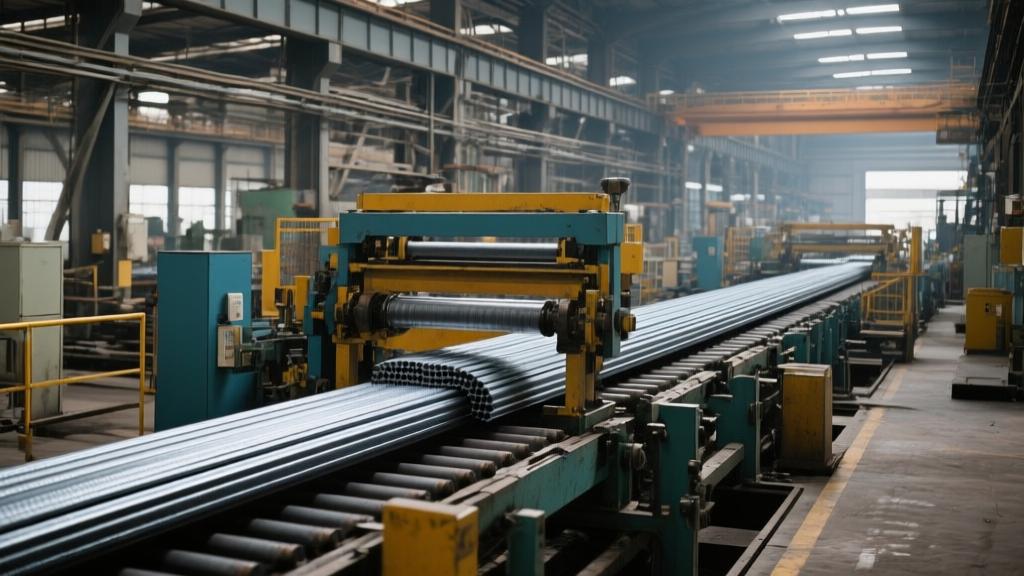
The manufacturing of TMT bars takes place in a dedicated steel rolling mill equipped with furnaces, rolling stands, quenching systems and tempering chambers. Each stage is carefully monitored to ensure that the final product meets the specifications laid down in IS 1786:2008. The process can be broken down into five distinct steps, each contributing to the unique microstructure of the bar.
The main stages are:
- Billet heating
- Hot rolling
- Water quenching (rapid cooling)
- Self-tempering (controlled heat transfer)
- Atmospheric cooling (final tempering)
Billet heating begins with high-quality carbon steel billets that are fed into a furnace pre-heated to a temperature of 900°C to 950°C. At this temperature the steel becomes fully austenitic, a phase that is essential for the subsequent transformation into martensite during quenching. The residence time in the furnace is carefully controlled, typically ranging from 30 to 45 minutes, to achieve a uniform temperature throughout the billet.
After heating, the billet moves to the rolling mill where it passes through a series of rollers that gradually reduce its cross-section to the desired diameter, usually between 6 mm and 32 mm for reinforcement applications. The hot rolling process takes place at temperatures above the austenitizing point, allowing the steel to deform easily while maintaining its austenitic structure. The reduction ratio and rolling speed are calibrated to produce a smooth surface and accurate dimensional tolerances.
Immediately after the final roll, the bar is subjected to a high-pressure water jet that cools the outer surface at a rate of approximately 200°C per second. This rapid cooling transforms the outer layer into martensite, a hard and brittle phase that provides the high tensile strength required for reinforcement. The core of the bar remains relatively hot, retaining a softer ferrite-pearlite microstructure that ensures ductility.
Self-tempering, also known as "tempering by heat transfer," occurs when the hot core transfers heat to the cold martensitic rim. This controlled heat flow reduces the hardness of the outer layer by converting martensite partly into tempered martensite and bainite, while preserving a high strength level. The result is a graded structure where the surface hardness is balanced by core flexibility, a hallmark of TMT technology.
The final stage is atmospheric cooling, where the bar is allowed to cool down to room temperature in still air. This step completes the tempering process, stabilizes the microstructure and eliminates residual stresses that could lead to cracking. After cooling, the bars are subjected to straightening, cutting to length and final inspection before they are dispatched to the market.
3. TMT Bar Grades Available in India and Their Mechanical Properties
Indian manufacturers produce TMT bars in several grades that are identified by a numerical code such as Fe415, Fe500, Fe500D, Fe550 and Fe550D. The "Fe" prefix indicates that the bar is made of iron-based steel, while the number denotes the minimum yield stress in megapascals (MPa). The "D" suffix stands for "ductile", meaning that the bar has been engineered for higher elongation and better energy absorption during seismic loading.
Fe415 is the entry-level grade, offering a minimum yield stress of 415 MPa and an elongation of at least 12 percent. It is commonly used in residential buildings, low-rise commercial structures and in areas where the seismic demand is moderate. The typical market price for Fe415 bars in 2026 ranges from Rs. 45 to Rs. 50 per kilogram, depending on the diameter and the supplier.
Fe500 raises the yield stress to 500 MPa while maintaining a similar elongation of 12 to 14 percent. This grade is suitable for medium-rise apartments, commercial complexes and infrastructure projects such as bridges and flyovers. Prices for Fe500 bars have risen slightly due to higher steel content, and they now trade between Rs. 48 and Rs. 55 per kilogram.
Fe500D retains the 500 MPa yield strength but improves ductility to 15 percent or higher, meeting the requirements of the "D" classification. The enhanced ductility makes Fe500D the preferred choice for structures located in high seismic zones, as it can undergo larger deformations without fracturing. The market price for Fe500D is marginally higher, ranging from Rs. 52 to Rs. 58 per kilogram.
Fe550 offers a minimum yield stress of 550 MPa and elongation of 12 to 14 percent, delivering the highest strength among the standard grades. It is used in high-rise towers, heavy-load foundations and pre-stressed concrete elements where maximum load-carrying capacity is essential. The price for Fe550 bars typically falls between Rs. 55 and Rs. 62 per kilogram.
Fe550D combines the 550 MPa yield strength with a ductility of 15 percent or more, providing both high strength and superior seismic performance. This grade is increasingly specified for critical infrastructure such as hospitals, schools and government buildings in earthquake-prone regions. The price range for Fe550D bars is Rs. 60 to Rs. 68 per kilogram, reflecting the additional processing required to achieve the ductile microstructure.
Related: Fe415 vs Fe500D vs Fe550 comparison
4. Indian Standard IS 1786:2008 and Certification Marks
IS 1786:2008 is the Indian standard that governs the requirements for high-strength deformed steel bars and wires for concrete reinforcement. The standard specifies the chemical composition, mechanical properties, dimensions, tolerances and testing procedures for each grade of TMT bar. Compliance with IS 1786 ensures that the bar will perform reliably under the loads and environmental conditions defined by Indian building codes.
According to IS 1786, Fe415 and Fe500 grades must contain carbon (C) between 0.15 and 0.20 percent, while the higher grades Fe550 and Fe550D allow carbon up to 0.25 percent. Manganese (Mn) is limited to 0.80 percent, and the presence of elements such as silicon, sulfur and phosphorus is also tightly controlled to prevent brittleness. These compositional limits are verified through chemical analysis in accredited laboratories.
Manufacturers who meet the standard can affix the ISI mark, a steel mark and a hall-mark on each bar. The ISI mark is a three-digit code that identifies the testing agency, while the steel mark indicates the grade and the manufacturer's registration number. Some producers also display a "BIS" logo to show that the product is certified by the Bureau of Indian Standards.
Builders can verify the authenticity of a bar by checking the mark against the BIS database, which is accessible online through the official portal. The database provides details such as the manufacturer's name, grade, batch number and the date of certification. Regular verification helps prevent the use of sub-standard or counterfeit bars in construction projects.
5. Quality Testing Methods for TMT Bars
Quality testing is a critical step that confirms whether a TMT bar meets the mechanical and chemical requirements set by IS 1786. Tests are performed at various stages of production, from raw material inspection to final product certification. The most common tests include tensile testing, bend testing, impact testing and chemical analysis.
The tensile test measures the bar's ability to withstand pulling forces until it fractures. A specimen of standard length is subjected to a gradually increasing load in a universal testing machine, and the yield stress, ultimate tensile strength and elongation are recorded. The results must meet or exceed the minimum values specified for the bar's grade.
Bend testing assesses ductility by bending a bar over a specified radius without causing cracks or excessive deformation. For Fe415 and Fe500 grades, the bar is bent to a radius of 25 mm, while higher grades are tested at a 30 mm radius. Successful bend tests indicate that the bar can accommodate stresses induced by concrete shrinkage or seismic movements.
The impact test, also known as the Charpy V-Notch test, evaluates the bar's toughness by measuring the energy absorbed when a notched specimen is struck by a pendulum. A higher impact energy value reflects better resistance to sudden loading, which is essential for earthquake-resistant design. D-grade bars typically exhibit impact energies 30 percent higher than their non-D counterparts.
Chemical analysis is performed using spectrometric techniques such as Optical Emission Spectroscopy (OES) to verify the elemental composition of the steel. The test confirms that carbon, manganese, silicon and other alloying elements fall within the limits prescribed by IS 1786. Consistent chemical composition ensures that the mechanical properties are reproducible across batches.
6. How to Identify Genuine TMT Bars and Avoid Counterfeits
Counterfeit TMT bars have become a serious concern in the Indian market, especially in remote construction sites where supervision is limited. Fake bars often mimic the appearance of genuine products but lack the required strength, ductility and corrosion resistance, leading to premature failure of structures. Recognizing the signs of authenticity can save builders from costly repairs and legal liabilities.
Authentic bars carry clear, legible markings that include the grade (e.g., Fe500D), the manufacturer's name, the ISI code and the steel mark. The font size, spacing and embossing depth are uniform, and the marks are positioned at a standard distance from the bar ends. Faded, smudged or misspelled markings are red flags that the bar may be counterfeit.
While all steel bars are magnetic, the intensity of magnetism can indicate carbon content. Genuine TMT bars have a moderate magnetic pull due to their low carbon content, whereas counterfeit high-carbon bars exhibit a stronger magnetic attraction. A simple spark test can also differentiate the two: genuine TMT produces fewer, finer sparks compared to the bright, abundant sparks of inferior carbon steel.
The density of steel is approximately 7.85 g/cm³, and the weight per meter can be calculated from the bar's diameter using the formula W = 0.006165 à D² (where D is diameter in mm). Builders can compare the measured weight of a sample with the theoretical weight; a significant deviation (more than 5 percent) suggests adulteration or use of lower grade steel.
Every batch of TMT bars should be accompanied by a test certificate issued by an ISI-approved laboratory. The certificate lists the batch number, grade, mechanical test results and the date of issue. By cross-checking the batch number on the bar with the details on the BIS portal, buyers can confirm that the product is genuine.
Related: Identify fake TMT bars
7. Storage, Handling and On-Site Best Practices
Proper storage of TMT bars protects them from moisture, mechanical damage and corrosion, which can degrade their performance before they are even placed in concrete. Bars should be kept in a dry, well-ventilated area, preferably under a waterproof tarpaulin or a shed that shields them from rain.
Bars must be stored on a raised platform or wooden planks to prevent direct contact with the ground, which can cause rust at the points of contact. Stacking should be done in uniform layers with a maximum height of 2.5 meters to avoid excessive pressure on lower bars. Each stack should be labeled with grade, diameter and date of receipt for easy identification.
During handling, workers should use proper lifting equipment such as cranes, forklifts or steel bar carriers to avoid bending or twisting the bars. When bars need to be cut on site, a clean, sharp cutting tool should be used to prevent micro-cracks at the cut ends. After cutting, the exposed ends must be protected with a rust-preventive coating or wrapped in a plastic sheet.
During transportation from the mill to the site, bars should be loaded in a way that distributes weight evenly across the vehicle's axles. They should be secured with steel straps or wooden blocks to prevent shifting that could cause damage. Avoid exposing the load to salt water, especially in coastal regions, as it accelerates corrosion.
8. Why TMT Bars Are Preferred for Earthquake-Resistant Construction in India
Earthquakes generate dynamic loads that cause rapid reversals in stress, demanding that reinforcement steel absorb and dissipate energy without breaking. The ductile core of TMT bars allows them to elongate significantly, thereby reducing the risk of sudden fracture during seismic shaking.
High yield strength grades such as Fe500D and Fe550D provide the necessary stiffness to resist lateral forces while still offering the elongation required for energy absorption. This combination of strength and ductility aligns with the performance criteria set out in IS 1893 (Part 1) - the Indian code for earthquake resistant design.
D-grade bars are specifically engineered to have a minimum elongation of 15 percent, which is 20 to 30 percent higher than standard grades. This increased elongation translates into higher seismic damping capacity, allowing structures to sway safely rather than collapse under extreme ground motion.
The Indian National Building Code (NBC) and IS 456 require the use of high-strength, ductile reinforcement in seismic zones, and they explicitly reference TMT bars that meet IS 1786. Using TMT bars simplifies compliance with these codes and reduces the need for additional seismic detailing measures.
Related: earthquake-resistant construction
9. Comparison of TMT Grades - Applications and Approximate Pricing (2026)
The table below summarizes the key mechanical properties, typical applications and market price range for the most common TMT grades used in Indian construction. Builders can use this information to select the appropriate grade based on structural requirements, seismic zone and budget.
| Grade | Yield Strength (MPa) | Elongation (%) | Typical Applications | Approx Price (Rs./kg) |
|---|---|---|---|---|
| Fe415 | 415 | 12 - 14 | Residential houses, low-rise apartments, non-seismic zones | 45 - 50 |
| Fe500 | 500 | 12 - 14 | Medium-rise commercial buildings, bridges, parking structures | 48 - 55 |
| Fe500D | 500 | 15+ | High-seismic zones, hospitals, schools, industrial facilities | 52 - 58 |
| Fe550 | 550 | 12 - 14 | High-rise towers, heavy-load foundations, pre-stressed elements | 55 - 62 |
| Fe550D | 550 | 15+ | Critical infrastructure in seismic zones, nuclear plants, airport terminals | 60 - 68 |
As shown, the D-grades (Fe500D and Fe550D) command a premium price because of the additional tempering steps required to achieve superior ductility. However, the long-term benefits of enhanced seismic performance and reduced risk of structural failure often outweigh the modest cost increase. Selecting the right grade at the design stage can lead to significant savings in both construction time and life-cycle maintenance.
Related: TATA vs JSW vs SAIL comparison
10. Environmental Aspects of TMT Bar Manufacturing
The primary raw material for TMT bars is carbon steel scrap and virgin iron ore, both of which have environmental footprints associated with mining and processing. Modern plants increasingly rely on recycled steel scrap, which reduces the need for virgin ore and cuts COâ emissions by up to 30 percent.
The heating and rolling stages consume large amounts of energy, typically sourced from coal, natural gas or electricity. Advanced furnaces equipped with waste-heat recovery systems can reclaim up to 20 percent of the heat generated, improving overall energy efficiency and lowering the plant's carbon intensity.
During production, by-products such as slag, scale and dust are generated. These materials are either sold to cement manufacturers as clinker additives or processed in air-pollution control equipment like bag filters and electrostatic precipitators to meet the Central Pollution Control Board (CPCB) standards.
At the end of a building's life cycle, TMT bars can be reclaimed and melted down for reuse, completing a circular loop that minimizes waste. The high recyclability of steel, combined with the fact that TMT bars retain their mechanical properties after recycling, makes them an environmentally responsible choice for sustainable construction.
Some leading Indian steel producers have set targets to reduce greenhouse gas emissions by 25 percent by 2030 through measures such as shifting to renewable energy, adopting low-carbon steelmaking technologies and optimizing logistics to cut transportation emissions. These initiatives align with the Indian government's commitment to the Paris Agreement and enhance the overall sustainability profile of TMT bars.