Introduction
In India, cement is the cornerstone of every building, from a modest single-storey house to a towering skyscraper. Selecting the right cement grade is not just a matter of cost; it directly influences the structural strength, durability, and long-term maintenance of the project. A mismatched grade can lead to premature cracking, reduced load-bearing capacity, and increased susceptibility to chemical attacks, especially in aggressive environments such as coastal areas or industrial zones. Therefore, understanding the specific properties of each cement grade and aligning them with the demands of your construction work is essential for safety, compliance with BIS standards, and overall project success.
This guide provides a step-by-step, SEO-optimized overview of the most common cement grades available in India-OPC 33, OPC 43, OPC 53, Portland Pozzolana Cement (PPC) and Portland Slag Cement (PSC). It explains their composition, performance characteristics, typical applications, and how to make an informed decision based on regional availability, brand reputation, and BIS standards (IS 269 for OPC, IS 1489 for PPC and PSC). By the end of this article, Indian homeowners and small-scale builders will have a clear roadmap to choose the right cement grade for any construction project in 2026.
What Are Cement Grades?
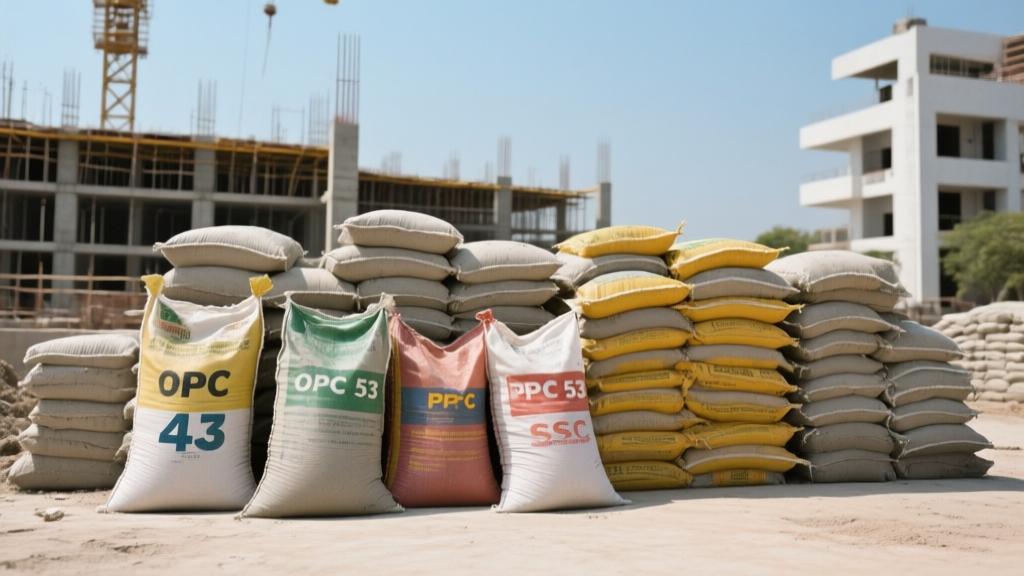
Portland cement, the most widely used binder in India, is classified into grades based on its minimum compressive strength after 28 days of curing. The grade number roughly corresponds to the strength in megapascal (MPa). The primary grades you will encounter are:
- OPC 33 - Minimum 28-day compressive strength of 33 MPa. This is the lowest grade of ordinary Portland cement and is suitable for non-structural works such as plastering, rendering, and dry-point masonry where high load bearing is not required.
- OPC 43 - Minimum 28-day compressive strength of 43 MPa. It is the most commonly used grade for residential construction, including foundations, slabs, beams, and columns under moderate loads.
- OPC 53 - Minimum 28-day compressive strength of 53 MPa. This high-strength grade is preferred for high-rise buildings, heavy-load structures, bridges, and precast elements where superior load-bearing capacity is essential.
- PPC (Portland Pozzolana Cement) - A blend of OPC and pozzolanic materials such as fly ash, volcanic ash, or calcined clay. The pozzolanic component reacts with calcium hydroxide to form additional cementitious compounds, enhancing durability and resistance to sulphates. PPC is typically available in grades equivalent to OPC 33, 43, and 53, but the most common commercial grade is PPC 43.
- PSC (Portland Slag Cement) - A composite of OPC and ground granulated blast-furnace slag (GGBS). The slag improves long-term strength, reduces heat of hydration, and provides excellent resistance to sulphate attack and chloride penetration. PSC is usually marketed as PSC 33, PSC 43, or PSC 53, with PSC 43 being the most popular for reinforced concrete work.
All these grades must conform to the Bureau of Indian Standards. OPC grades follow IS 269, while PPC and PSC adhere to IS 1489. Compliance with these standards ensures consistent quality, appropriate fineness, and reliable performance across different manufacturers.
Detailed Comparison of Common Cement Grades
| Cement Grade | Minimum 28-Day Compressive Strength (MPa) | Typical Applications | Fineness (m²/kg) | Sulphate Resistance | Setting Time (hrs) | BIS Standard |
|---|---|---|---|---|---|---|
| OPC 33 | 33 | Plastering, non-structural walls, dry point masonry | 300-350 | Moderate | 1.5-2.5 | IS 269 |
| OPC 43 | 43 | Residential foundations, slabs, beams, columns, general construction | 300-350 | Moderate | 1.5-2.5 | IS 269 |
| OPC 53 | 53 | High-rise frames, heavy-load columns, bridges, precast elements | 300-350 | High | 1.5-2.0 | IS 269 |
| PPC (43) | 43 | Marine structures, sewage tanks, aggressive soils, plastering where durability is needed | 300-350 | High | 2.0-3.0 | IS 1489 |
| PSC (43) | 43 | Reinforced concrete, industrial floors, structures exposed to sulphates or chlorides | 300-350 | Very High | 2.0-3.0 | IS 1489 |
Which Cement Grade Suits Which Application?
- Foundations and Footings - For typical residential footings on stable soil, OPC 43 provides adequate strength. In areas with high water tables, expansive soils, or sulphate-rich ground, PPC 43 or PSC 43 is recommended for added durability.
- Columns and Beams - High-load columns in multi-storey buildings benefit from OPC 53 or PSC 43, which deliver higher early strength and better resistance to cracking under sustained loads.
- Slabs and Ground Floors - OPC 43 is suitable for most ground-level slabs. For industrial or commercial floors that experience heavy traffic, OPC 53 or PSC 43 ensures superior wear resistance.
- Plastering and Rendering - OPC 33 is sufficient for interior plaster where structural load is minimal. For exterior plaster in humid or coastal regions, PPC 43 provides better resistance to moisture penetration.
- Roofing and Damp-Proofing - PPC 43 and PSC 43 are ideal for roofing concrete and waterproofing membranes because of their lower heat of hydration and higher sulphate resistance.
- Marine and Sewage Structures - Environments exposed to chlorides and sulphates demand the superior durability of PPC 43 or PSC 43. These grades significantly reduce the risk of corrosion in reinforcement.
- Precast Elements - OPC 53 offers rapid strength gain, which shortens formwork removal time and improves production efficiency for precast panels and blocks.
OPC vs PPC - Detailed Comparison
| Parameter | OPC | PPC |
|---|---|---|
| Composition | Pure Portland clinker, gypsum | OPC + pozzolanic material (fly ash, volcanic ash, calcined clay) |
| Strength Development | High early strength (especially OPC 53) | Slower early strength, but comparable or higher long-term strength |
| Durability | Good, but susceptible to sulphate attack in aggressive soils | Enhanced durability; pozzolanic reaction reduces permeability and improves resistance to sulphates and chlorides |
| Sulphate Resistance | Moderate (grade dependent) | High - pozzolanic material consumes calcium hydroxide, limiting sulphate attack |
| Heat of Hydration | Relatively high, especially for OPC 53 | Lower, which reduces thermal cracking in massive pours |
| Workability | Standard; may require admixtures for high-rise work | Generally better due to finer particles and improved lubrication |
| Cost | Usually marginally lower than PPC | Slightly higher, but offset by reduced maintenance in aggressive environments |
Common Mistakes Homeowners Make When Choosing Cement
- Assuming the cheapest bag is the best value without checking the BIS mark or grade stamp.
- Using OPC 33 for structural elements such as columns or footings, which can compromise load-bearing capacity.
- Ignoring the environmental exposure; for example, selecting OPC 43 for a coastal house where sulphate resistance is critical.
- Purchasing cement in bulk without verifying storage conditions; cement exposed to moisture can lose its hydraulic properties.
- Relying solely on brand reputation without confirming the specific grade and compliance with IS 269 or IS 1489.
How to Verify Cement Quality
Before finalizing your purchase, always inspect the packaging for the official BIS logo, grade stamp, and manufacturing date. Check the batch number and verify it on the manufacturer's website or through the BIS portal. A simple field test such as the "initial and final set time" test can give you a quick indication of cement quality. For a step-by-step guide on testing cement at home, refer to How to Check Cement Quality at Home. Additionally, you may request the manufacturer's test report that confirms compliance with IS 269 (for OPC) or IS 1489 (for PPC/PSC).
Regional Availability and Brand Recommendations
India's cement market is dominated by a few national manufacturers, each offering a full range of grades. In the northern states, brands such as ACC, UltraTech and Ambuja have extensive distribution networks, making OPC 43 and OPC 53 readily available. In the western and central regions, Dalmia and Shree Cement provide competitive pricing for PPC and PSC, especially in areas with high industrial activity where durability is a priority. In the coastal south, Ramco and Birla Cement are known for producing PPC with superior sulphate resistance, which is essential for projects near the sea.
When selecting a brand, look for the following indicators of quality:
- Clear grade marking (e.g., "OPC 53" or "PPC 43") on the bag.
- Batch number and manufacturing date printed in a legible font.
- Presence of the BIS certification mark and a valid IS code reference.
- Positive feedback from local contractors and builders who have used the product in similar projects.
Typical price ranges for a 50 kg bag in 2026 are Rs. 300-350 for OPC 33, Rs. 350-400 for OPC 43, Rs. 380-440 for OPC 53, and Rs. 380-460 for PPC or PSC. Prices can vary based on location, transportation costs, and bulk purchase discounts.
Decision Matrix for Selecting the Right Cement Grade
| Project Type | Recommended Cement Grade(s) |
|---|---|
| Residential Foundation (plain concrete, 150-200 mm thick) | OPC 43 for normal soil; PPC 43 or PSC 43 for sulphate-rich or expansive soil |
| Multi-Storey Columns (reinforced concrete) | OPC 53 or PSC 43 for high early strength and durability |
| Ground-Level Slab (residential) | OPC 43; use PPC 43 for aggressive groundwater conditions |
| Plastering (interior & exterior) | OPC 33 for interior; PPC 43 for exterior in humid climates |
| Roofing Concrete & Damp-Proofing | PPC 43 or PSC 43 for low heat of hydration and high sulphate resistance |
| Marine or Sewage Structures | PPC 43 or PSC 43 (both offer excellent resistance to chlorides and sulphates) |
| Precast Panels & Blocks | OPC 53 for rapid strength gain and efficient formwork removal |
FAQ
- Question: Can I use OPC 33 for a two-storey house foundation?
Answer: No. OPC 33 is intended for non-structural work. For a two-storey house, OPC 43 or higher is required to safely support the loads imposed by the superstructure. - Question: How does the presence of fly ash affect the strength of PPC?
Answer: Fly ash reacts slowly with calcium hydroxide, so early strength may be lower than OPC. However, the long-term strength (after 90 days) often matches or exceeds that of OPC, while offering better durability. - Question: Is PSC more expensive than OPC?
Answer: PSC is generally priced slightly higher than OPC of the same grade because of the added slag content. The extra cost is usually justified by improved resistance to sulphates, reduced heat of hydration, and lower maintenance over the life of the structure. - Question: What BIS standard should I look for on the cement bag?
Answer: For ordinary Portland cement, the bag must carry the IS 269 mark. For PPC and PSC, the required standard is IS 1489. Both standards ensure the cement meets minimum strength, fineness, and quality criteria. - Question: How does cement grade affect the calculation of steel reinforcement?
Answer: Higher-grade cement (e.g., OPC 53 or PSC 43) provides greater compressive strength, which can reduce the required area of steel for a given design. For detailed reinforcement sizing, refer to How to Calculate Steel Requirement for House Construction.
Conclusion
Choosing the right cement grade is a critical decision that influences the safety, durability, and cost-effectiveness of any construction project in India. By understanding the differences between OPC 33, OPC 43, OPC 53, PPC and PSC, and by matching each grade to the specific demands of foundations, columns, slabs, plastering, and aggressive environments, homeowners can ensure compliance with BIS standards (IS 269 and IS 1489) and avoid common pitfalls. Always verify the cement's BIS certification, consider regional availability, and select reputable brands that consistently meet quality benchmarks. With the decision matrix and practical advice provided in this guide, you are now equipped to make an informed choice that will stand the test of time and deliver lasting value for your construction project in 2026.