
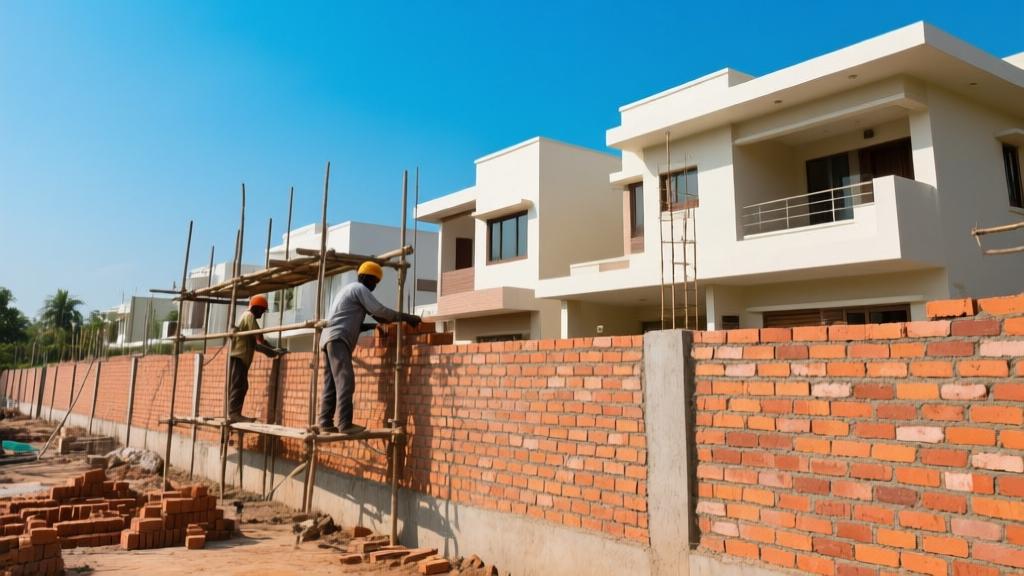
Introduction
A boundary wall is one of the first and most important investments in any residential or commercial property in India. It defines your property line, provides security, enhances privacy, and adds to the overall aesthetic appeal of your building. With property prices rising across Indian cities, understanding the true cost of building a boundary wall helps you budget accurately and avoid unexpected expenses during construction.
In 2026, boundary wall costs in India vary significantly based on the type of wall, material quality, height, and location. A simple brick wall can cost as little as Rs. 250 per running foot, while an elaborate RCC or wrought iron fence can exceed Rs. 800 per running foot. This comprehensive guide breaks down every cost component so you can make informed decisions for your project.
Boundary Wall Cost Per Running Foot 2026
The following table shows the average cost per running foot for different types of boundary walls in India during 2026. These rates include both material and labor costs for a standard 4.5-foot to 6-foot high wall.
| Boundary Wall Type | Cost Per Running Foot (Rs.) | Best For |
| Brick Wall (9 inch) | Rs. 350 - 500 | Residential compounds, high security |
| Brick Wall (4.5 inch) | Rs. 250 - 400 | Budget residential, temporary walls |
| Concrete Block Wall | Rs. 300 - 450 | Quick construction, commercial sites |
| RCC Wall | Rs. 500 - 700 | High security, permanent structures |
| Wrought Iron Fence | Rs. 400 - 800 | Modern aesthetics, visibility |
| Stone Wall | Rs. 450 - 650 | Rural properties, natural look |
| Chain Link Fence | Rs. 150 - 300 | Sports fields, industrial areas |
| Barbed Wire Fence | Rs. 100 - 200 | Agricultural land, budget option |
Note: These rates are for a standard wall height of 4.5 to 6 feet. Taller walls will cost proportionally more. Rates may vary by 15-20% depending on your city and local material availability.
Types of Boundary Walls Explained
Choosing the right type of boundary wall depends on your budget, security requirements, aesthetic preferences, and local climate conditions. Here is a detailed look at each type:
Brick Walls
Brick walls are the most popular choice for residential boundary walls in India. A 9-inch brick wall provides excellent strength and durability, making it ideal for long-term use. A 4.5-inch wall is suitable for budget-conscious homeowners or temporary demarcation. Fly ash bricks are increasingly preferred over red clay bricks due to their uniform size, better strength, and eco-friendly manufacturing process.
Concrete Block Walls
Concrete blocks (also known as cement blocks or AAC blocks) offer faster construction than traditional brick walls. They are lightweight, have good thermal insulation properties, and require less mortar. This makes them a cost-effective option for commercial properties and large residential compounds where speed of construction matters.
RCC (Reinforced Cement Concrete) Walls
RCC walls are the strongest type of boundary wall available. They use steel reinforcement bars embedded in concrete, providing exceptional resistance to impact, weathering, and attempted breaches. These are commonly used for high-security properties, industrial facilities, and government buildings. The higher cost is justified by their virtually permanent nature and low maintenance requirements.
Wrought Iron Fences
Wrought iron fences combine security with aesthetics. They allow visibility while providing a physical barrier, making them popular for modern residential properties and gated communities. The cost varies widely based on the design complexity, with simple straight-bar designs being more affordable and ornamental patterns costing significantly more. Regular painting every 2-3 years is required to prevent rust.
Stone Walls
Stone walls are traditional in many parts of India, especially in rural and hilly regions. They use locally available stones bound with cement mortar. Stone walls have a natural, rustic appearance and are extremely durable. The cost depends heavily on the type of stone used and the availability of skilled masons in your area.
Detailed Cost Breakdown
Understanding how the total cost is distributed helps you identify where you can save without compromising quality. Here is the typical breakdown for a standard 9-inch brick boundary wall:
Material Costs (Approximately 60-65% of Total)
- Bricks: Rs. 8-12 per brick (fly ash) or Rs. 6-10 per brick (red clay). A 9-inch wall requires approximately 134 bricks per cubic meter.
- Cement: Rs. 380-450 per 50kg bag. Approximately 3-4 bags per cubic meter of masonry.
- Sand: Rs. 180-250 per cubic meter for river sand, Rs. 150-200 for manufactured sand (M-Sand).
- Steel (for RCC): Rs. 55-65 per kg for TMT bars. Required for RCC walls and lintels.
- Aggregate: Rs. 200-300 per cubic meter for 10mm and 20mm stone aggregate.
Labor Costs (Approximately 30-35% of Total)
- Masonry work: Rs. 80-150 per square foot depending on location and wall complexity.
- Plastering: Rs. 50-100 per square foot for single-side or double-side plastering.
- Foundation work: Rs. 100-200 per running foot for a standard strip foundation.
- Skilled mason daily wage: Rs. 600-1,000 per day.
- Helper daily wage: Rs. 400-600 per day.
For a more detailed breakdown of labor costs across different construction activities, see our guide on Construction Labor Cost Per Sq Ft India 2026.
Foundation Costs
The foundation is critical for boundary wall stability. A typical strip foundation for a 6-foot high brick wall requires:
- Width: 2-3 feet
- Depth: 3-4 feet below ground level
- Cost: Rs. 100-200 per running foot (included in total wall cost above)
In areas with soft soil or high water tables, a deeper or wider foundation may be needed, increasing costs by 20-30%.
Factors That Affect Boundary Wall Cost
Several factors influence the final cost of your boundary wall. Understanding these helps you plan and budget more effectively:
Wall Height
Wall height is the single biggest factor affecting cost. A standard residential boundary wall is 4.5 to 6 feet high. Every additional foot of height increases material and labor costs by approximately 15-20%. Walls taller than 8 feet may require additional structural support, further increasing costs.
Location and City
Material and labor costs vary significantly across Indian cities. Metro cities like Mumbai and Delhi have higher labor rates but better material availability. Tier-2 cities may have lower labor costs but higher transportation costs for materials. Rural areas often have the lowest overall costs due to cheap labor and locally sourced materials.
Material Quality and Brand
Using premium brands for cement (UltraTech, ACC, Ambuja) adds 5-10% to material costs compared to regional brands. Similarly, IS-certified TMT bars from reputed manufacturers cost more than local steel but provide better strength and corrosion resistance. For a comprehensive overview of building material prices, refer to our Building Materials Price List India 2026.
Design and Finishing
A plain cement-plastered wall is the most economical finish. Adding paint, tiles, decorative caps, or ornamental ironwork can increase costs by 25-50%. White-washing is the cheapest finishing option at Rs. 10-20 per square foot, while exterior-grade paint costs Rs. 25-50 per square foot.
Soil Conditions
Rocky soil requires less excavation but may need specialized foundation techniques. Soft or waterlogged soil requires deeper foundations and possibly pile foundations, significantly increasing costs. Always get a soil test done before starting construction to avoid surprises.
Boundary Wall Cost by City
Here is how boundary wall costs compare across major Indian cities in 2026. Rates shown are for a standard 6-foot high, 9-inch brick wall with plastering:
| City | Cost Per Running Foot (Rs.) | Key Factor |
| Mumbai | Rs. 450 - 650 | Highest labor and land costs |
| Delhi NCR | Rs. 400 - 550 | High labor rates, good material availability |
| Bangalore | Rs. 380 - 520 | Moderate costs, growing demand |
| Chennai | Rs. 350 - 500 | Competitive pricing, local manufacturing |
| Hyderabad | Rs. 350 - 480 | Balanced material and labor costs |
| Kolkata | Rs. 300 - 450 | Lower labor costs |
| Pune | Rs. 380 - 520 | Similar to Bangalore |
| Jaipur | Rs. 320 - 450 | Locally available stone reduces cost |
How to Reduce Boundary Wall Cost
Building a boundary wall does not have to break the bank. Here are practical strategies to reduce costs without compromising on quality and safety:
1. Choose the Right Wall Thickness
A 4.5-inch wall is sufficient for most residential properties where security is not the primary concern. Reserve 9-inch walls for areas with higher security needs. This single decision can reduce material costs by 30-40%.
2. Use Locally Available Materials
Transportation costs can add 15-25% to material prices. Source bricks, sand, and aggregate from local suppliers within 50 km of your site. Fly ash bricks are widely available near thermal power plants and are often cheaper than red clay bricks.
3. Optimize Wall Height
A 4.5-foot wall meets most municipal requirements for residential properties. Adding barbed wire or thorny plants on top provides additional security without the cost of building a taller wall. Check your local building bylaws for minimum and maximum height requirements.
4. DIY Where Possible
Tasks like site clearing, material handling, and basic plastering can be done by unskilled helpers at a fraction of the cost of skilled masons. Hire a skilled mason for critical work like foundation laying and bricklaying, and use helpers for supportive tasks.
5. Buy Materials in Bulk
Purchasing cement, bricks, and sand in bulk quantities (for the entire wall project at once) typically saves 5-10% compared to buying in smaller batches. Coordinate with your contractor to estimate total material requirements accurately before ordering.
6. Consider Alternative Materials
Concrete blocks and AAC blocks can be faster and cheaper than traditional brick masonry in some cases. Chain link fencing is the most economical option for large agricultural or industrial properties where aesthetics are not a priority.
7. Time Your Construction
Avoid building during the monsoon season (June-September) when material costs rise and work progress slows. The best time for boundary wall construction in most of India is October to March, when weather conditions are favorable and contractors are more available.
Boundary Wall vs Compound Wall: What is the Difference?
The terms "boundary wall" and "compound wall" are often used interchangeably, but there is a subtle difference:
- Boundary Wall: A wall that marks the legal boundary of a property. It is usually simpler in design and primarily serves to define property lines and provide basic security.
- Compound Wall: A wall that encloses an entire compound or courtyard, which may include multiple buildings or structures. Compound walls are typically more elaborate, with gates, guard rooms, and decorative elements.
From a cost perspective, the construction methods and materials are similar. The main difference is that compound walls often include additional features like gates (Rs. 15,000-50,000), guard rooms (Rs. 50,000-2,00,000), and decorative elements that increase the overall project cost.
Maintenance Cost of Boundary Walls
A well-built boundary wall requires minimal maintenance, but regular upkeep extends its life and keeps it looking good. Here are typical maintenance costs:
- White-washing: Rs. 10-20 per square foot, done once or twice a year. For a 100-foot wall at 6 feet high, this costs approximately Rs. 6,000-12,000 per year.
- Exterior paint: Rs. 25-50 per square foot, done every 3-5 years. More expensive upfront but longer-lasting than white-washing.
- Repair of cracks: Rs. 500-2,000 per incident depending on severity. Hairline cracks can be sealed with cement-based sealant.
- Wrought iron fence painting: Rs. 30-60 per square foot, needed every 2-3 years to prevent rust.
- Gate maintenance: Rs. 1,000-3,000 annually for lubrication, hinge repair, and painting.
For plastering-specific maintenance and repair costs, see our guide on Plastering Cost Per Sq Ft India 2026.
Frequently Asked Questions
What is the average cost of a boundary wall per running foot in India?
The average cost of a standard 9-inch brick boundary wall in India ranges from Rs. 350 to Rs. 500 per running foot for a height of 4.5 to 6 feet. This includes material costs (bricks, cement, sand, steel for lintels) and labor charges for masonry and plastering. Simpler options like chain link fencing cost as low as Rs. 150 per foot, while premium RCC walls can cost up to Rs. 700 per foot.
How much does a boundary wall cost for a 100-foot property?
For a 100-foot property boundary, the total cost depends on the wall type. A standard 9-inch brick wall would cost approximately Rs. 35,000 to Rs. 50,000. A wrought iron fence would cost Rs. 40,000 to Rs. 80,000. An RCC wall would cost Rs. 50,000 to Rs. 70,000. These estimates include foundation, masonry, and basic plastering but exclude gate and decorative finishing costs.
Is a 4.5-inch or 9-inch wall better for residential properties?
For most residential properties, a 9-inch wall is recommended for better stability, security, and longevity. A 4.5-inch wall is adequate for temporary demarcation or in low-crime areas where security is not a major concern. The 9-inch wall costs approximately 30-40% more but provides significantly better structural integrity and resistance to impact. If budget is a constraint, consider a 4.5-inch wall with a concrete foundation and periodic plastering reinforcement.
Do I need permission to build a boundary wall in India?
In most Indian cities, building a boundary wall within your property line does not require special permission from municipal authorities. However, some cities have regulations regarding wall height (typically maximum 6-8 feet for residential), setback requirements from the road, and design guidelines in planned colonies or gated communities. Always check with your local municipal corporation or society before starting construction. Building a wall that encroaches on public land or a neighbor's property is illegal and can result in demolition orders and fines.
Conclusion
Building a boundary wall is a significant investment that protects your property, enhances privacy, and adds to your home's curb appeal. In 2026, you can expect to pay between Rs. 250 and Rs. 700 per running foot depending on the type, height, and location. A standard 9-inch brick wall with plastering offers the best balance of cost, durability, and aesthetics for most Indian homeowners.
The key to staying within budget is careful planning: choose the right wall type for your needs, source materials locally, time your construction for favorable weather, and get multiple quotes from contractors. With proper construction and regular maintenance, a well-built boundary wall can last 25-30 years or more.
For more construction cost guides and building material information, explore our other articles on Comaron. Whether you are building a new home or renovating an existing property, we provide practical, up-to-date information to help you make informed decisions and save money on your construction projects.