
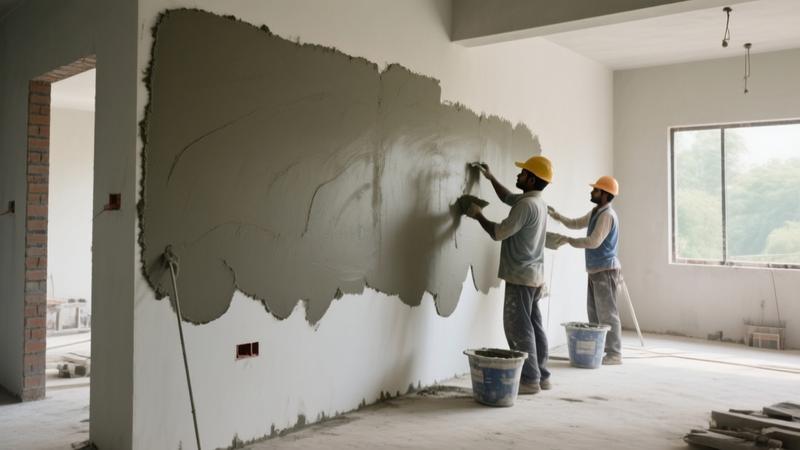
Introduction
Plastering is one of the most important finishing activities in residential and commercial construction. It not only provides a smooth, uniform surface for paint or wall finishes, but also adds strength, fire resistance and protection against moisture. In 2026 the Indian construction market continues to show strong demand for high-quality plaster work, driven by rapid urbanisation, affordable housing schemes and increasing consumer expectations. Understanding the plastering cost per square foot is essential for homeowners, builders and developers who want to budget accurately, compare quotes and avoid hidden expenses.
This article presents a detailed, up-to-date guide on plastering costs across India in 2026. We cover the major types of plaster, cost breakdowns for different thicknesses, city-wise price variations, the factors that influence the final bill and practical tips to save money without compromising quality. All rates are expressed in Indian rupees (Rs.) per square foot and reflect realistic market conditions as of mid-2026.
Types of Plastering
Cement Plaster
Cement plaster is the most widely used plaster in Indian construction. It is a mixture of ordinary Portland cement, sand (usually 1:4 to 1:6 cement-to-sand ratio) and water. The mix can be applied on both brick masonry and concrete walls. Cement plaster offers good compressive strength, excellent adhesion and resistance to moisture, making it suitable for external walls, wet areas and high-traffic zones.
Gypsum Plaster
Gypsum plaster, also known as plaster of Paris, is a dry-mix product that contains gypsum powder, fine sand and additives. It is lightweight, sets quickly and provides a very smooth finish, which is why it is preferred for interior walls and ceilings. Gypsum plaster is less suitable for damp areas because gypsum is hygroscopic and can degrade when exposed to moisture over time.
Mud Plaster
Mud plaster, also called earthen plaster, uses locally available soil, sand, lime and sometimes natural fibers. It is an eco-friendly option with low embodied energy. Mud plaster is common in rural construction and heritage restoration projects where breathability and compatibility with traditional materials are required. However, it offers limited strength and durability compared to cement or gypsum based systems.
Fibre Reinforced Plaster
Fibre reinforced plaster incorporates synthetic or natural fibers (such as polypropylene, glass or jute) into the cement or gypsum matrix. The fibers improve tensile strength, reduce cracking and enhance impact resistance. This type of plaster is increasingly used in high-rise residential projects, commercial offices and areas where vibration or settlement is a concern. The cost is higher due to the additional material and processing steps.
Cement Plaster Cost Per Sq Ft
Cement plaster remains the most cost-effective solution for most Indian construction projects. In 2026 the typical market rate for cement plaster ranges from Rs. 15 to Rs. 25 per square foot, depending on thickness, quality of cement, sand grade and local labour rates. Below is a detailed breakdown for two common thicknesses - 12 mm and 15 mm - which are widely specified for interior and exterior walls.
12 mm Cement Plaster
- Material cost: Rs. 5-7 per sq ft. This includes cement (approximately 2.5 kg per sq ft), sand (about 7 kg per sq ft) and admixtures if any.
- Labor cost: Rs. 8-12 per sq ft. Labor includes surface preparation, mixing, application and finishing.
- Total cost: Rs. 13-19 per sq ft. In premium markets or high-end residential projects the total can approach Rs. 20 per sq ft.
15 mm Cement Plaster
- Material cost: Rs. 6-9 per sq ft. The extra thickness requires about 3.2 kg of cement and 9 kg of sand per sq ft.
- Labor cost: Rs. 10-14 per sq ft. Additional labor time is needed for mixing a larger volume and applying a uniform coat.
- Total cost: Rs. 16-23 per sq ft. Premium finishes with polished or textured surfaces may exceed Rs. 25 per sq ft.
These rates assume a standard brick or concrete wall with minimal surface defects. For walls with extensive cracking, unevenness or high moisture content, preparation work such as cleaning, priming or waterproofing can add Rs. 2-5 per sq ft to the final bill.
For a deeper dive into labour rates that influence these calculations, refer to our construction labor cost guide.
Gypsum Plaster Cost Per Sq Ft
Gypsum plaster is the preferred choice for interior wall finishing where a high degree of smoothness is required. In 2026 the cost for gypsum plaster typically ranges from Rs. 20 to Rs. 35 per square foot. The variation depends on the type of gypsum board, inclusion of additives, thickness and the finish quality (plain, skimmed or decorative).
Standard 12 mm Gypsum Plaster
- Material cost: Rs. 8-12 per sq ft. This covers gypsum powder, fine sand and additives.
- Labor cost: Rs. 10-15 per sq ft. Gypsum plaster sets quickly, so skilled labour is required to achieve a uniform finish.
- Total cost: Rs. 18-27 per sq ft.
Standard 15 mm Gypsum Plaster
- Material cost: Rs. 10-14 per sq ft.
- Labor cost: Rs. 12-18 per sq ft.
- Total cost: Rs. 22-32 per sq ft.
Gypsum plaster is less suitable for exterior walls or areas exposed to high humidity. For such applications, a moisture-resistant gypsum mix can be used, which adds an extra Rs. 3-5 per sq ft to the material cost.
For more information on the pricing of gypsum and other building materials, see the building materials price list.
Factors Affecting Plastering Cost
While the base rates give a good starting point, several factors can cause the final cost to deviate from the quoted price. Understanding these variables helps you negotiate better and plan for contingencies.
- Material quality: High-grade cement (e.g., 53 grade) and washed, well-graded sand increase material cost but improve durability and finish.
- Location: Metropolitan cities like Mumbai and Delhi have higher labour wages and material transportation costs compared to tier-2 or tier-3 cities.
- Surface condition: Rough, uneven or damp surfaces require additional preparation work such as cleaning, priming, or applying a waterproofing coat.
- Contractor rates: Established contractors with a reputation for quality may charge a premium, while newer firms might offer lower rates but with variable workmanship.
- Project size: Larger projects often benefit from economies of scale, reducing the per-square-foot cost for both materials and labour.
- Access and height: Plastering high-rise buildings or areas with restricted access may require scaffolding, safety equipment and additional labour, raising costs by 5-10%.
Plastering Cost by City
Below is a city-wise snapshot of typical plastering rates for cement plaster (12 mm) and gypsum plaster (12 mm) as of 2026. These figures are averages derived from multiple contractor quotes and market surveys.
| City | Cement Plaster (12 mm) Rs. per sq ft | Gypsum Plaster (12 mm) Rs. per sq ft |
|---|---|---|
| Mumbai | 22-26 | 28-35 |
| Delhi | 20-24 | 26-33 |
| Bangalore | 18-22 | 24-30 |
| Chennai | 19-23 | 25-32 |
| Hyderabad | 18-22 | 24-31 |
| Pune | 19-23 | 25-32 |
| Kolkata | 17-21 | 23-29 |
| Jaipur | 16-20 | 22-28 |
Note that the above rates include basic surface preparation. Any special treatment such as waterproofing, anti-crack mesh or decorative finishes will add to the quoted price.
Material vs Labor Cost Breakdown
Understanding how the total cost is split between material and labour helps you evaluate contractor quotes more objectively. The typical percentage distribution for cement plaster (
How to Calculate Plastering Cost for Your Project
Estimating plastering cost accurately helps you avoid surprise expenses and keeps the project on budget. Follow the step-by-step method below to arrive at a realistic figure.
- Measure the total wall area. Multiply the length and height of each wall to get its area in square feet. Add the areas of all walls together.
- Deduct openings. Subtract the combined area of doors, windows, and any other voids. Use the formula:
Total plasterable area = (Sum of wall areas) - (Sum of opening areas) - Identify the plaster type and rate. Choose cement plaster, gypsum plaster or a mix, then apply the prevailing market rate per sq ft for that finish.
- Add ceiling plaster if required. Measure ceiling area separately and multiply by the ceiling plaster rate.
- Include wastage and contingency. Add 8-12% of the calculated material cost to cover breakage, spillage and unforeseen adjustments.
- Calculate labor cost. Labor is usually quoted per sq ft. Multiply the plasterable area by the labor rate.
- Sum up all components. The final estimate is:
Total cost = (Plasterable wall area × plaster rate) + (Ceiling area × ceiling rate) + (Labor cost) + (Wastage & contingency)
How to Measure Wall Area (Subtracting Doors and Windows)
1. List each wall. Write down the length and height for every wall segment.
2. Calculate individual wall area. Multiply length by height (e.g., a 12-ft long wall with 9-ft height gives 108 sq ft).
3. Sum all wall areas. Add the results from step 2.
4. Measure openings. For each door or window, multiply width by height. Typical interior door: 3 ft × 7 ft = 21 sq ft. A window: 4 ft × 5 ft = 20 sq ft.
5. Subtract openings. Total opening area is deducted from the summed wall area to obtain the plasterable surface.
Example: Calculate for a 3BHK House with 1200 sq ft of Wall Area
Assumptions:
- Total wall area (including openings) = 1,200 sq ft
- Doors = 4 (21 sq ft each) → 84 sq ft
- Windows = 8 (20 sq ft each) → 160 sq ft
- Ceiling area = 1,000 sq ft
- Cement plaster rate = Rs. 45 per sq ft
- Ceiling plaster rate = Rs. 35 per sq ft
- Labor rate = Rs. 30 per sq ft
- Wastage & contingency = 10 %
Calculations:
- Plasterable wall area = 1,200 - (84 + 160) = 956 sq ft
- Plaster cost (walls) = 956 × Rs. 45 = Rs. 43,020
- Ceiling plaster cost = 1,000 × Rs. 35 = Rs. 35,000
- Labor cost (walls + ceiling) = (956 + 1,000) × Rs. 30 = Rs. 58,680
- Subtotal = Rs. 43,020 + Rs. 35,000 + Rs. 58,680 = Rs. 136,700
- Wastage & contingency (10 %) = Rs. 13,670
- Total estimated cost = Rs. 150,370
This example shows how a systematic approach yields a transparent budget for a typical 3BHK home.
Plastering Cost for Different Wall Types
Different substrates require distinct preparation, material mix and labor intensity. Below are the average 2026 rates for the most common wall types in India.
| Wall Type | Typical Plaster Rate (Rs. per sq ft) | Notes |
|---|---|---|
| Brick masonry (solid brick) | Rs. 40-50 | Requires a 12 mm cement-sand mix for good adhesion. |
| RCC (reinforced cement concrete) walls | Rs. 45-55 | Surface is smoother; a thinner 10 mm mix is sufficient but priming is essential. |
| AAC block (autoclaved aerated concrete) | Rs. 35-45 | Lightweight; a 10 mm cement-sand mix with a bonding agent works well. |
| Ceiling plaster (concrete or steel deck) | Rs. 30-40 | Often done with a fine gypsum finish; lower labor cost as work is horizontal. |
These rates include material, labor and basic surface preparation. Additional finishes such as texture or waterproofing will raise the price.
Common Plastering Defects and Repair Costs
Even with careful work, defects can appear over time. Knowing the typical repair cost per square foot helps you budget for maintenance.
- Cracking
- Hairline cracks (surface level, < 0.5 mm width) - repair cost: Rs. 5-7 per sq ft. Usually fixed by re-skinning and re-plastering the affected area.
- Structural cracks (wider than 0.5 mm, deep) - repair cost: Rs. 15-20 per sq ft. Requires removal of loose plaster, reinforcement (mesh or steel rods), and re-application of a stronger mix.
- Efflorescence (white salt deposits) - caused by moisture migration. Repair cost: Rs. 8-10 per sq ft. Involves cleaning, applying a breathable primer, and re-plastering with a low-soluble cement mix.
- Dampness and moisture issues - leads to soft plaster and mold. Repair cost: Rs. 10-12 per sq ft. Requires damp proofing treatment, removal of affected plaster, and re-application with a moisture-resistant additive.
- Blistering and peeling - usually due to poor surface preparation or excessive water. Repair cost: Rs. 6-9 per sq ft. Involves scraping off the blistered layer, re-priming, and re-plastering.
Early detection and timely repair can prevent larger, more expensive remediation later.
Tips to Save Money on Plastering Work
Following these practical suggestions can reduce your overall plastering expense without compromising quality.
- Buy materials in bulk. Purchasing cement, sand and additives in 50 kg or larger bags can cut material cost by 5-10 % compared to small-packet purchases.
- Plan work during the off-season. Monsoon and peak summer months see higher labor rates. Scheduling plastering in the cooler, dry months of October-December often yields a 10 % labor discount.
- Choose a contractor with a fixed-price package. Fixed-price contracts lock in rates for material and labor, protecting you from price hikes during the project. This can save up to 8 % versus daily-rate hiring.
- Opt for labor-only if you have a reliable foreman. When you can source quality cement and sand yourself, hiring only skilled labor reduces overall cost by roughly 12-15 %.
- Use premixed ready-mix plaster where feasible. Premixed bags reduce waste by 5-7 % and speed up application, lowering labor hours.
- Combine plastering with other finishes. Align plastering with painting or ceiling work to minimise mobilization and equipment setup, saving 5-8 % on overall project overhead.
- Source local sand and aggregates. Transport charges can add 5 % to material cost. Using sand from a nearby quarry or riverbed (subject to quality checks) cuts this expense.
- Implement strict quality checks. Inspect each coat before proceeding to the next. Early detection of unevenness or premature cracking avoids costly re-work, potentially saving 10 % of the total plastering budget.
For related cost saving ideas on finishing, see our interior paint cost guide.
FAQ: Plastering Cost Per Sq Ft India 2026
- What is the average cost of plastering per sq ft in India 2026?
- The average ranges from Rs. 35 to Rs. 55 per sq ft, depending on wall type, plaster material (cement vs gypsum) and location. Brick walls typically fall near Rs. 40-50, while RCC walls can be a little higher.
- Is gypsum plaster better than cement plaster?
- Gypsum plaster offers a smoother finish, quicker curing and lower shrinkage, making it ideal for interior walls and ceilings. However, it is less resistant to moisture compared to cement plaster, so for external or damp areas cement plaster remains the preferred choice.
- How long does plastering take for a 3BHK house?
- For a standard 3BHK with approximately 1,200 sq ft of wall area, a skilled crew can complete plastering in 7-10 working days, including surface preparation, two coats of plaster and curing time. Ceiling work adds another 2-3 days.
- Can I plaster over existing paint?
- Yes, but the painted surface must be clean, free of grease and loosely attached paint removed. Applying a bonding primer before plastering ensures proper adhesion and reduces the risk of delamination.
- What is the expected lifespan of cement plaster?
- When applied correctly and maintained, cement plaster can last 10-15 years on interior walls and up to 20 years on well-protected exterior surfaces. Regular inspection and timely repair of cracks or moisture issues can extend its service life.