
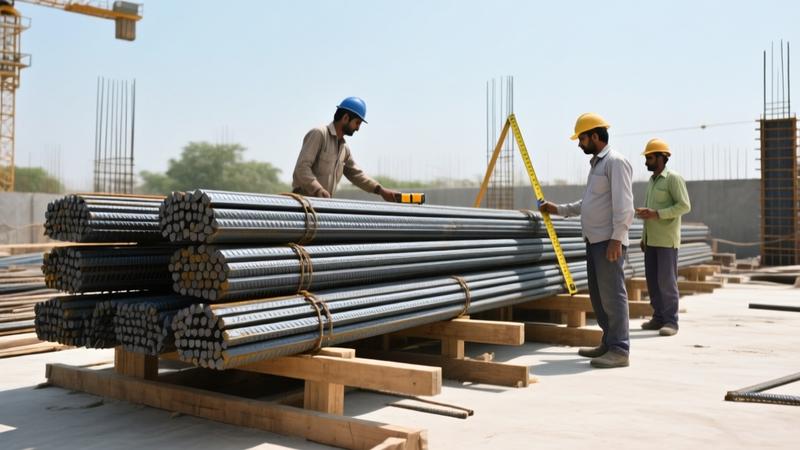
Introduction - why TMT bar quality matters for home safety
Thermo-Mechanically Treated (TMT) steel bars are the backbone of modern residential construction in India. They provide the tensile strength that concrete lacks, ensuring that walls, slabs, columns and footings can resist bending, cracking and seismic forces. A weak or sub-standard TMT bar can lead to premature cracking, reduced load-bearing capacity, and in extreme cases, structural collapse. For a homeowner, the consequences are not only financial but also affect the safety of families living in the house.
When you decide to build a new home or renovate an existing one, the first step is to calculate the amount of steel required for each structural element. Accurate calculations help you avoid over-ordering, which can inflate the project cost, and under-ordering, which can compromise structural integrity. For a detailed guide on calculating steel quantities, refer to our article How to Calculate Steel Requirement for House Construction. Once you know how much steel you need, the next critical task is to verify that the bars you receive meet the required quality standards.
In India, the Bureau of Indian Standards (BIS) mandates that all TMT bars used in structural work must conform to IS 1786 (2008) and carry the mandatory BIS mark. However, counterfeit bars, sub-standard manufacturing processes, and poor handling can still introduce defects. The good news is that homeowners can perform simple, low-cost tests at home to get a reliable indication of the bar's quality before it is laid. This article outlines five practical tests that anyone can perform with basic tools, along with guidance on interpreting the results.
What is TMT Steel and How It's Made (brief overview of hot rolling, quenching, tempering process)
TMT steel is produced through a three-stage process: hot rolling, quenching, and tempering. The process begins with a billet of hot-rolled steel, which is heated to a temperature of about 900°C to 950°C. The heated billet is then passed through a series of rollers that shape it into the desired bar size while still at a high temperature. This hot-rolling step aligns the grain structure and improves ductility.
Immediately after the final rolling, the bar is subjected to a rapid water quench. The outer surface of the bar cools quickly, forming a hardened martensitic skin with a hardness of around 400-500 HB. The rapid cooling also creates a steep temperature gradient between the outer surface and the core.
During the tempering stage, the bar is allowed to self-temper as the core temperature slowly rises, transferring heat to the hardened outer layer. This tempering process transforms the martensitic skin into a tempered martensite-bainite mixture, which provides a balance of high strength and good ductility. The resulting micro-structure gives TMT bars their characteristic "ribbed" surface for better bond with concrete, as well as the high yield strength (typically 415 MPa, 500 MPa, or 550 MPa) required by IS 1786.
The combination of these three stages - hot rolling, quenching, and tempering - creates a bar that is both strong and flexible, capable of absorbing energy during an earthquake. However, any deviation in temperature control, rolling speed, or quenching intensity can affect the final properties. That is why it is essential to verify the quality of the bars before they are used in construction.
Test 1: Bend Test - how to perform, what to look for (ductility check)
The bend test is the simplest and most direct way to assess the ductility of a TMT bar. A ductile bar will bend smoothly without cracking, indicating that the tempering process was successful. Here's how to conduct the test:
- Gather a small sample of the bar (about 150 mm in length). You can use a piece cut from a leftover length or a spare bar.
- Place the bar on a sturdy workbench and position a wooden block or a firm edge about 100 mm from one end.
- Using a hammer, apply a steady force on the free end of the bar, bending it over the block until a 90-degree angle is achieved.
- Observe the bend. A good quality TMT bar will show a smooth curvature with no visible cracks, splits, or sudden fractures.
- If the bar cracks or snaps before reaching the 90-degree angle, it indicates brittleness - a sign of poor tempering or sub-standard material.
When performing the bend test, make sure to wear safety gloves and goggles. The test is non-destructive for the sample bar, but it does destroy the portion being tested. For a typical 12 mm diameter bar, the bend test requires a force of roughly 800-1000 N. The key observation is the absence of any hairline cracks on the tensile side (the outer surface) of the bend. A clean bend assures you that the bar will perform well under load and during seismic events.
Test 2: Zinc Coating Test - acid test method for galvanized bars
Many TMT bars in the Indian market are hot-dip galvanized to improve corrosion resistance, especially in coastal or humid regions. A simple acid test can confirm the presence and uniformity of the zinc coating. Follow these steps:
- Prepare a 10% hydrochloric acid (HCl) solution. Dilute concentrated acid with distilled water in a 1:9 ratio (one part acid to nine parts water). Handle the acid with care, using gloves and a face shield.
- Clean a small section (about 20 mm) of the bar's surface with a dry cloth to remove any oil or dust.
- Place a drop of the acid solution on the cleaned area and observe the reaction.
- A good zinc coating will produce a steady fizzing or bubbling reaction, accompanied by a faint greenish color as zinc chloride forms. The reaction should last for at least 5-10 seconds.
- If there is little to no reaction, or if the reaction stops immediately, the zinc coating may be thin, uneven, or absent, indicating a poor galvanizing process.
After the test, wipe the area with a damp cloth and neutralize any remaining acid with a mild baking soda solution. Remember that the acid test is only applicable to galvanized bars. For plain (non-galvanized) TMT bars, skip this test and move on to the fracture test.
Test 3: Fracture Test - examining the broken surface for micro-structure
The fracture test provides insight into the internal micro-structure of the bar. When a bar is broken in a controlled manner, the surface can reveal whether the tempering process created the desired tempered martensite-bainite structure. Here's how to carry out the test:
- Select a short piece of the bar (around 100 mm) and place it on a flat surface.
- Using a heavy hammer or a concrete block, strike the bar sharply at the midpoint to break it. The impact should be strong enough to cause a clean break without excessive deformation.
- Inspect the fracture surface. A high-quality TMT bar will show a dull, matte appearance with fine, uniformly distributed grains. The surface should not be glossy or exhibit large, coarse crystals.
- Look for a "chevron" pattern or river lines that indicate ductile fracture. If the fracture surface is shiny, smooth, or shows large flat facets, it may suggest a brittle fracture, often due to improper tempering or the use of low-grade steel.
For a more detailed analysis, you can compare the observed fracture surface with images from standard IS 1786 reference charts, which illustrate typical ductile and brittle fracture patterns. While homeowners may not have a metallurgical microscope, even a simple visual inspection with a magnifying glass (10x) can reveal the necessary details.
Test 4: Weight and Dimension Check - using standard weight chart per IS 1786
IS 1786 provides a standard weight per meter for each nominal diameter of TMT bar. By measuring the actual weight and dimensions of a sample, you can verify whether the bar conforms to the standard density of steel (approximately 7850 kg/m³) and the claimed diameter.
Follow these steps:
- Measure the diameter of the bar using a calibrated vernier caliper or a steel ruler. Record the measurement in millimetres (mm). For example, a 12 mm bar should read between 11.9 mm and 12.1 mm.
- Weigh a known length of the bar (preferably 1 meter) on a digital weighing scale with an accuracy of at least 0.01 kg. Record the weight in kilograms (kg).
- Refer to the IS 1786 weight chart (see table below) and compare your measured weight with the standard value.
| Diameter (mm) | Standard Weight (kg/m) |
|---|---|
| 8 | 0.395 |
| 10 | 0.617 |
| 12 | 0.888 |
| 16 | 1.578 |
| 20 | 2.466 |
| 25 | 3.854 |
| 32 | 6.313 |
| 40 | 9.979 |
If the measured weight deviates by more than ±2% from the standard, it could indicate that the bar is either under-rolled (lighter) or contains impurities that affect density. Additionally, verify that the ribs (the raised patterns on the bar surface) are uniformly spaced and consistent with the standard rib geometry. Uneven ribs often point to poor rolling quality.
Accurate weight and dimension checks help you ensure that you are not overpaying for bars that are lighter than advertised. For instance, a 12 mm bar that weighs only 0.78 kg/m instead of 0.888 kg/m could be a sign of low-grade material, potentially costing you Rs. 300-500 per tonne in the long run.
Test 5: Magnetic Test - checking for non-magnetic impurities
High-quality TMT bars are primarily composed of ferrous steel, which is magnetic. However, the presence of non-magnetic impurities such as stainless steel cladding or excessive alloying elements can affect the bar's weldability and ductility. A simple magnetic test can help detect such anomalies.
- Obtain a strong neodymium magnet (available in most hardware stores).
- Place the magnet on the surface of the bar at several points along its length.
- If the bar is attracted strongly at every point, it indicates a homogeneous ferrous composition.
- If you notice weak attraction or areas where the magnet does not stick, it could be due to non-magnetic inclusions or localized alloying that reduces magnetic response.
While a mild reduction in magnetic attraction does not automatically mean the bar is unsafe, it warrants further investigation. Bars with significant non-magnetic zones may have been produced from mixed scrap or have undergone improper heat treatment. In such cases, consider rejecting the batch and requesting a certified sample from the supplier.
BIS Mark and Certification Verification - how to verify BIS license, check mark
The BIS (Bureau of Indian Standards) mark is a legal requirement for all TMT bars sold in India. The mark consists of the BIS logo, the brand name, the grade (e.g., 415, 500, 550), and a unique license number. Verifying this mark ensures that the bar has been tested for compliance with IS 1786.
Follow these steps to confirm the BIS certification:
- Inspect each bar for the stamped BIS mark. The mark should be clear, legible, and placed on the flat side of the bar.
- Note the license number printed on the mark (e.g., "License No. 12345").
- Visit the official BIS website (bis.gov.in) and navigate to the "Search for BIS Mark" section.
- Enter the license number and the manufacturer's name. The database will return the product details, including the grade, manufacturing plant, and validity period.
- If the license number is not found or the details do not match the bar, treat the product as potentially counterfeit.
In addition to the online verification, ask the supplier for a copy of the test report issued by an accredited lab (e.g., ISRM, SGS, or TUV). The report should include tensile strength, yield strength, elongation, and chemical composition. Cross-checking this report with the BIS database adds an extra layer of confidence.
Red Flags to Watch Out For When Buying TMT Bars - rust, uneven ribs, wrong weight, no BIS mark
Even with the five simple tests, some visual cues can instantly alert you to potential problems. Keep an eye out for the following red flags:
- Surface rust or corrosion: Freshly manufactured TMT bars should have a clean, bright surface. Any rust indicates exposure to moisture during storage or poor-quality galvanizing.
- Uneven or irregular ribs: The ribs should be uniform in height and spacing. Jagged or missing ribs reduce the bond strength with concrete.
- Incorrect weight: As discussed in the weight and dimension check, a deviation of more than ±2% from the standard weight per meter suggests sub-standard material.
- No BIS mark or illegible stamp: Absence of a clear BIS stamp is a major warning sign. Counterfeit bars often lack proper markings.
- Inconsistent colour or coating: For galvanized bars, the zinc coating should be uniform and silvery. Dark patches or uneven colour may indicate poor galvanizing.
- Excessive brittleness in bend test: If the bar cracks easily during the bend test, it is likely brittle and unsuitable for structural use.
- Magnetism irregularities: Weak magnetic response in some sections suggests impurity or mixed material composition.
When you encounter any of these issues, do not hesitate to reject the batch and request a new supply from a reputable manufacturer. Remember that the cost of a structural failure far outweighs the price difference between a genuine and a fake TMT bar.
FAQ
1. Can I rely solely on the BIS mark to ensure TMT bar quality?
No. While the BIS mark is mandatory and indicates that the bar has passed certain tests, counterfeit marks are common in the market. Always perform the five simple home tests and verify the license number on the BIS website to confirm authenticity.
2. Is the bend test destructive? Will it affect the structural integrity of the bar I use?
The bend test is performed on a small sample piece that is separate from the main construction stock. It does not affect the bars you will actually use. However, if you perform the test on a bar that you intend to use, it will be permanently deformed and should not be used for load-bearing elements.
3. How often should I test TMT bars during a large construction project?
It is advisable to test a random sample from each batch or delivery. For a typical residential project, testing at least 5% of the total quantity from each supplier's delivery is a good practice. This helps catch any variation in quality that may occur between batches.
4. Are there any specialized tools I need for these tests?
Most of the tests require only basic tools: a hammer, a ruler or caliper, a digital weighing scale, a strong magnet, and a small bottle of diluted hydrochloric acid. For the fracture test, a concrete block or heavy hammer is sufficient. If you want a more detailed analysis, you can consult a local testing lab, but the home tests provide a reliable first-hand assessment.
Conclusion
Ensuring the quality of TMT bars is a critical step that every homeowner should take before commencing construction. The five simple tests - bend, zinc coating, fracture, weight & dimension, and magnetic - can be performed with minimal equipment and give you a clear picture of the bar's integrity. Coupled with verification of the BIS mark and awareness of red flags, these checks empower you to make informed purchasing decisions, avoid costly rework, and safeguard the structural health of your home.
By applying these practical methods, you not only protect your investment but also contribute to higher construction standards across the industry. For further guidance on material quality, you may also find our article How to Check Cement Quality at Home useful. And when you are ready to choose a reliable supplier, consult our comprehensive comparison of top brands in Best TMT Bars in India 2026 - Top 10 Brand Comparison. Stay vigilant, test wisely, and build safely.