
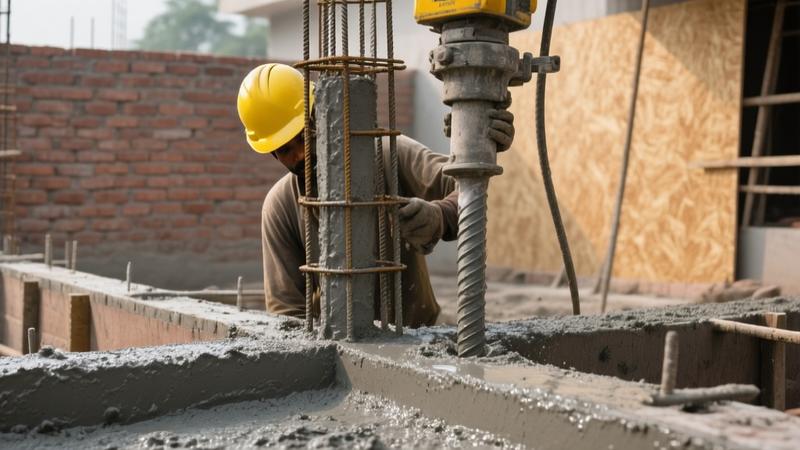
Why compaction matters in a Indian house
IS 456:2000 demands a minimum compressive strength of 20 MPa for RCC floors in residential buildings. That number is only achievable if the concrete is dense, without trapped air or honey-comb voids. Voids cut the cross-sectional area, so the stress on the surrounding concrete spikes, leading to early cracking. In a monsoon-prone zone, water seeps into those cavities, corrodes the reinforcement and the whole slab can start spalling within a year.
Void formation usually happens when the mix is too stiff, the placement is hurried, or the vibrator is omitted. Honey-combing looks like a network of dark spots on a cut surface; it indicates that the concrete didn't flow around the bars. The IS code explicitly mentions "proper compaction" in clause 23.2.4 - a failure here is a direct breach of the code and a legal risk for the contractor.
Good compaction also reduces shrinkage cracking. When air is expelled, the cement paste can cure uniformly, and the reinforcement gets the full bond strength. A well-compacted slab can carry 30-40 % more load than a poorly-compacted one of the same mix.
Related: Common Construction Mistakes to Avoid During House Building in India 2026
Vibrator types you'll meet on an Indian site
- Needle / poker vibrator - long slender rod, works from the top of the pour.
- Shutter (or internal) vibrator - placed inside the formwork before concrete arrives.
- Table vibrator - a flat plate that vibrates the entire slab surface; handy for flat roofs.
- Surface (or external) vibrator - pads that sit on the concrete surface, useful for large slabs.
| Vibrator | Typical Power (W) | Price (Rs.) | Best Use |
|---|---|---|---|
| Needle / poker | 300-800 | 5,000-12,000 | Beams, columns, footings |
| Shutter | 1,200-2,000 | 12,000-20,000 | Cast-in-place walls, deep footings |
| Table | 1,500-2,500 | 18,000-30,000 | One-storey slabs, flat roofs |
| Surface pad | 800-1,500 | 8,000-15,000 | Large ground-level slabs, precast panels |
Brands like Meco, Saurer and SFI are common in Delhi-NCR. A 25 mm poker from Meco costs around Rs. 6,500, while a 60 mm version from Saurer is Rs. 11,000. The price gap is mostly due to the heavier motor and a sturdier shaft, not some marketing hype.
Selecting the right needle / poker size
Think of the poker as a brush that pushes air out. A small brush works for thin elements, a big brush for thick ones. Here's the rule I follow on most houses:
- 25 mm - slabs up to 100 mm thick, plaster-grade concrete, or when the bar spacing is tight (e.g., 150 mm mesh).
- 40 mm - normal RCC beams (200-250 mm depth) and footings of 150-200 mm.
- 60 mm - deep footings, massive columns (>300 mm) and any element where the cover is >30 mm.
If you use a 25 mm poker in a 300 mm column, you'll spend forever trying to reach the centre. The concrete will set around the rod before the air escapes, leading to honey-comb. Conversely, a 60 mm poker in a thin slab will over-vibrate the surface, causing segregation and a weak top layer.
When to start vibrating and how long to stay
Start vibrating as soon as the concrete reaches the top of the formwork, not after it has settled. Waiting more than 30 seconds after the pour allows a skin to form, and the vibrator will just bounce on the surface without penetrating.
Insert the poker at a 45-degree angle, push it about 150-200 mm into the concrete, and hold for 5-15 seconds. The first 5 seconds create the bulk of air removal; the next few seconds smooth out the surface. If you hear a loud "rattle-rattle-rattle", you're still moving air. When the sound becomes a dull thump, stop - you're over-vibrating.
Spacing matters. The "30-50 cm rule" is a safe bet on Indian sites. Place each insertion point 30 cm apart for slabs under 150 mm, and stretch it to 50 cm for thicker beams. The radius of action of a 40 mm poker is roughly 25 cm, so overlapping circles ensures full coverage.
Never lift the poker too fast. Pull it out slowly, let the concrete flow back into the void left behind. A sudden yank opens a channel that later becomes a weak line.
Technique per structural member
Slabs (ground floor, roof)
Lay the concrete in layers of 100-150 mm, then vibrate each layer before adding the next. Use a table vibrator for the first 2-3 passes; it gives a uniform surface finish. Follow up with a 40 mm poker at 30 cm intervals to eliminate deeper voids. For a 12 m x 8 m slab, you'll need about 150-180 insertion points.
Beams
Beams are narrow, so the poker must be centred. Insert the rod at the centreline, push to the bottom, hold 8-12 seconds, then pull out slowly. Move along the length every 40 cm. If the beam has a stirrup cage, pause a second at each cage to let the vibration settle - otherwise the stirrups can shift.
Columns
Columns are the toughest because the steel density is high. Use a 60 mm poker for any column deeper than 250 mm. Insert the rod at the centre, vibrate for 12-15 seconds, then rotate 90 degrees and repeat. This double-direction method forces air out of the rebar cage. For a 300 mm x 300 mm column, a single insertion point every 30 cm along the height works.
Footings
Spread footings act like a thick slab. Use a 40 mm poker, insert at the centre, vibrate 10-12 seconds, then move in a spiral pattern outward. For strip footings, keep the spacing at 35 cm because the concrete tends to settle more in the middle.
Common mistakes you'll see on sites
- Over-vibration - concrete looks glossy, aggregates separate, surface becomes weak. Leads to early cracking under load.
- Under-vibration - honey-comb spots appear on cut sections, reduction of compressive strength by 5-10 %.
- Wrong poker size - using a 25 mm rod in a 300 mm column or a 60 mm rod in a 100 mm slab.
- Late start - waiting more than 30 seconds after pour, especially in hot weather, allows a skin to form.
- Fast pull-out - creates channels that later become leakage paths for water.
- Skipping corners and rebar-dense zones - air gets trapped in the "dead-ends".
One contractor I know still uses a single 25 mm poker for a 300 mm column. The result? Columns cracked at the 5th floor. That's the most common fraud in the trade - cutting equipment cost and passing the blame to "bad mix".
DIY vs hired vibrator - cost breakdown
If you own a small plot and want to do the slab yourself, a 40 mm poker can be bought for Rs. 8,000-10,000. Add a 5 A 230 V extension cable (Rs. 1,200) and you're set. A table vibrator rental in Jaipur runs Rs. 1,200 per day, plus a Rs. 500 security deposit.
Hiring a contractor with their own set of vibrators typically adds Rs. 30-40 per m3 to the concrete cost. For a 150 m3 slab, that's an extra Rs. 4,500-6,000 - a small price for a quality finish.
Manual rodding is an old-school method - a steel rod 2 m long, 12 mm diameter, swung manually. It works for thin plaster-grade concrete but is painfully slow for anything thicker than 100 mm. Expect a 30-40 % increase in labour time, and the compaction quality will never match a powered vibrator.
Questions to ask your contractor
- What poker size will you use for each element?
- When will you start vibrating after the pour?
- How long will each insertion point stay under vibration?
- Will you cover the corners and dense rebar zones?
- Do you have a table or surface vibrator for large slabs?
- Can you show a recent concrete cut to prove there's no honey-comb?
If the contractor hesitates or gives vague answers, walk away. A competent contractor knows these numbers by heart.
FAQ - your quick doubts cleared
Q: Does rain affect vibration?
A: Light drizzle doesn't matter, but heavy rain can create a water film on the surface, reducing the vibrators' grip. In monsoon season, use a shutter vibrator placed inside the formwork; it stays dry and works from within.
Q: What if the concrete is too stiff to vibrate?
A: Stiff concrete (slump < 30 mm) often means too much cement or low water-cement ratio. Either increase the water by 5 % (use a water-reducing admixture instead of plain water) or switch to a higher workability mix like M15 with a superplasticizer. Trying to vibrate a dead-set mix will just break the aggregate.
Q: Can I use a concrete mixer's built-in vibrator?
A: No. Mixer vibrators are designed for the drum, not for in-situ compaction. They lack the amplitude needed to push air out of a thick slab.
Q: How often should I test the compaction?
A: Take a core after 7 days from a representative spot. If the compressive strength is 10-15 % lower than the cube test, you have a compaction problem.
Final thought - what to do on your next pour
Buy a 40 mm poker, keep a 30-second timer handy, and mark insertion points on the formwork before the concrete arrives. That simple discipline will keep the slab from turning into a honey-comb mess, and you'll stay well within IS 456 limits without spending extra on remedial work.