
What is Ready-Mix Concrete (RMC)
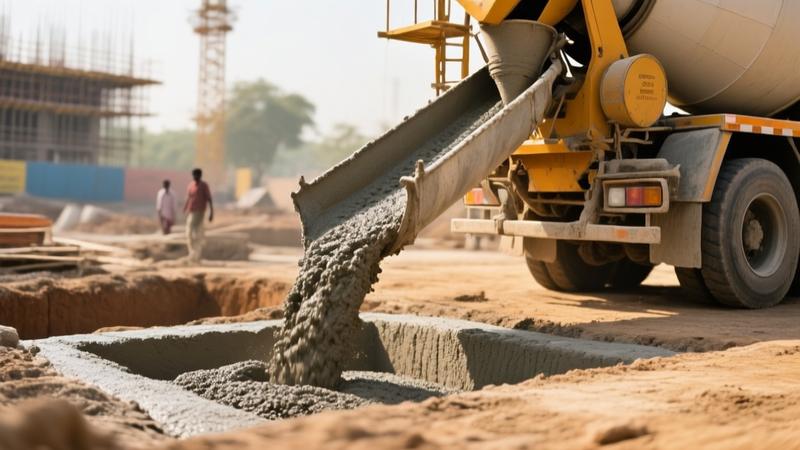
Ready-mix concrete is a factory-produced concrete that complies with IS 4926. The plant receives cement, fine and coarse aggregates, water and admixtures in measured proportions, mixes them in a high-speed drum, and performs a slump test before loading into a transit-mixer truck.
Batching is fully automated. A typical plant in Delhi-NCR can produce 60-80 cum per hour with a water-cement ratio (w/c) controlled to 0.45-0.50. The concrete leaves the plant at a temperature of 20-25°C, and the drum keeps it rotating at 15-20 rpm to prevent setting.
Admixtures are added at the plant itself. In summer (April-June) a retarder of 0.2-0.3% cement weight is common to offset temperature rise above 35°C. For low-slump work a super-plasticizer of 0.5-0.8% cement weight gives a slump of 75-100 mm without extra water.
Major cities host several plants: Mumbai (Bandra, Navi Mumbai), Bengaluru (Whitefield, Hosur), Pune (Haveli), Hyderabad (Gachibowli), Chennai (Siruseri), Kolkata (Salt Lake). A 1-cum RMC load from a plant near the site costs between Rs. 4,500-5,500 in Delhi-NCR, Rs. 4,200-5,200 in Mumbai, Rs. 4,000-5,000 in Bengaluru, and Rs. 3,800-4,800 in Tier-2 towns.
Pricing includes cement (Ultratech, ACC, Ambuja, Shree, Dalmia), aggregates, water, admixtures, loading, and delivery up to a 30-km radius. Anything beyond that attracts a per-km surcharge of Rs. 80-120.
What is Site Mix Concrete
Site mix concrete is mixed on the job-site by a foreman using bagged cement, river sand, crushed stone, and water. The usual nominal mix ratios are 1:1.5:3 for M20 and 1:2:4 for M15, but many small builders still use 1:2:4 for all works to simplify procurement.
Materials are stored in a temporary yard. Cement bags (50 kg) are opened, sand is dumped from a 25-cum bag, and coarse aggregate is poured from a 20-cum tipper. The foreman adds water by eye, often using a 5-L bucket, and then runs a 2-hp concrete mixer for 2-3 minutes.
Controlling w/c is a nightmare. In hot weather a foreman may add another 5-10 L of water to achieve a workable slump, pushing the w/c to 0.60-0.70 for a nominal M20 mix. The result is a weaker, more porous concrete.
Labor skill varies widely. A trained foreman can keep the slump within +/-15 mm of the target, but most small contractors rely on apprentices who guess the water amount. This is why site-mix strength often deviates by +/-15-20% from the design value.
Quality and Strength Comparison
Both RMC and site mix must meet IS 456 for structural concrete, but the path to compliance differs.
| Parameter | RMC (factory) | Site Mix |
| W/C Ratio | 0.45-0.50 (tight control) | 0.55-0.65 (often higher) |
| 7-day compressive strength | ~70% of 28-day value | ~55% of 28-day value |
| 14-day compressive strength | ~85% of 28-day value | ~70% of 28-day value |
| 28-day compressive strength | M20 = 21-23 MPa, M25 = 26-28 MPa | M20 = 18-20 MPa, M25 = 23-25 MPa |
| Slump retention (90 min) | 80-90 mm (with super-plasticizer) | 30-45 mm (water bleed) |
| Batch uniformity | +/-4% cement content | +/-10% cement content |
| Lab testing | Plant lab (cube 150 mm, IS 516) | Site cube test (often delayed) |
Admixtures give RMC an edge in early strength. A retarder + super-plasticizer combo can give a 7-day strength of 16 MPa for M20, whereas a site mix without admixture may still be at 12 MPa.
Uniformity matters for columns and beams. A 5% cement variation in a column can change its load-carrying capacity by 10-12%, which is why many engineers refuse site-mix for load-bearing members.
Cost Breakdown and Wastage
2026 price snapshot (per cubic metre):
- RMC: Rs. 4,500-5,500 (incl. Delivery, admixtures)
- Site mix cement (Ultratech 53 Grade): Rs. 350 per 50 kg bag → Rs. 7,000 per cum
- River sand (clean, 1-mm passing): Rs. 1,500 per cum
- Crushed stone 20-mm: Rs. 1,800 per cum
- Labor for mixing & placing: Rs. 300-350 per cum
- Equipment rental (2-hp mixer, 2-day): Rs. 2,500 total
Adding these gives a site-mix cost of roughly Rs. 11,500-12,500 per cum, almost double RMC. The large gap is due to cement price and labour.
Wastage is another killer. RMC trucks lose 2-3% of volume in transit (settling, over-filling). Site mix loses 5-7% because of spillage, over-watering, and rejected batches. For a 30-cum slab the extra waste can be 1-2 cum of concrete - a loss of Rs. 5,000-10,000.
Hidden costs appear when site mix fails strength. Re-pouring a footing because the cube test showed 18 MPa instead of 21 MPa can add Rs. 30,000-40,000 in demolition, new material, and delay penalties.
Logistics and Ordering
RMC suppliers ask for a minimum order of 4-6 cum. Anything less triggers a partial-load surcharge of Rs. 500-800 per cum. Booking is usually required 24-48 hours in advance; same-day delivery is possible only in metro cities with a plant within 20 km.
Transit time must not exceed 90 minutes. After that the slump drops by about 10 mm per 15 minutes, and the concrete may start setting. To avoid this, many contractors ask for a retarder dose of 0.2% when the expected travel time is 120 minutes.
Site access is critical. A 5-ton transit mixer needs a 3-m wide path and a turning radius of 6-7 m. If the site is in a narrow lane (common in old Delhi colonies), the supplier may charge an extra Rs. 1,200 for a mini-truck.
For high-rise pours (G+2 or more) a concrete pump truck is mandatory. Pump rates in Bengaluru average 8-10 cum per hour, costing Rs. 1,200-1,500 per hour. The pump hose length adds a pressure loss; beyond 60 m you need a higher-pressure pump, which adds Rs. 300 per hour.
Placement and Compaction
RMC is usually placed with a concrete pump. The pump delivers concrete directly to the formwork, reducing manual handling and segregation. For site mix, workers use shovels and wheelbarrows, which increases the risk of cold joints.
Vibration matters for both. A 10-kg internal vibrator inserted every 0.3 m in a slab gives a dense matrix. Over-vibration (more than 15 seconds per point) can cause segregation, especially in site mix with high water.
Placement must start within 30-45 minutes of arrival. If the concrete sits longer, the surface forms a crust, and the vibrator cannot penetrate, leading to honey-comb pores.
Rainy days need a plastic sheet over the fresh concrete. In summer (>38°C) the concrete should be chilled or a retarder used; otherwise the surface may set in 20-30 minutes.
Curing begins as soon as the surface is firm enough to support a thumb. A wet burlap cover for 7 days or a curing compound (2-3 L per cum) is standard. For site mix, the lower initial strength demands a longer wet cure - at least 10 days for columns.
Common Mistakes Indian Homeowners Make
- Skipping cube tests. Some owners trust the contractor's word and never see the 28-day strength result.
- Adding extra water on site to 'improve flow'. This destroys the w/c ratio and reduces strength by up to 15%.
- Using high-silt river sand. Silty sand lowers the effective cement content and raises water demand.
- Ignoring slump cone testing. Without a slump check you cannot know if the mix is too dry or too fluid.
- Delaying placement after delivery. A 1-hour delay can cut the 28-day strength by 2-3 MPa.
- Poor curing - no wet burlap, no curing compound, early removal of formwork.
- Ordering the wrong grade. Pouring M20 concrete for a beam that needs M25 is a recipe for cracks.
- Accepting a verbal mix design. Always ask for a written IS-4926 compliant mix sheet.
These slip-ups are why a third of structural failures in small houses trace back to low-quality concrete. The cure? Insist on documented slump, cube results, and a written mix design before the first pour.
When to Use RMC vs Site Mix - Decision Matrix
Below is a quick guide. Pick the column that matches your project.
| Criteria | RMC Recommended | Site Mix Acceptable |
| Poured volume per day | >10 cum | <10 cum |
| Structural members (beams, columns, slabs) | All | Only non-load-bearing (plaster, screed) |
| Budget sensitivity | Medium-high (cost offset by labour saving) | Very tight (accept lower strength) |
| Site accessibility | Good road width, loading bay | Narrow lanes, no truck entry |
| Weather | Hot summer - use retarder | Cool climate - easier control |
| Time pressure | Fast-track schedule | Relaxed timeline |
For a typical 1,200 sq ft G+1 house in Pune, the footings alone require 12-cum of M25 concrete. The safest bet is RMC - you get consistent strength, no surprise re-work, and labour for placing is minimal.
If you are building a small backyard patio in a village with no plant nearby, a site mix of M15 with local sand and stone is acceptable, provided you do a proper slump test and a 7-day cube test.
IS Code Reference
All numbers quoted follow the Indian Standards:
- IS 4926 - Specification for ready-mix concrete. Defines batch size, slump, w/c limits, and documentation.
- IS 456 - General design of concrete structures. Sets minimum grades (M20 for footings, M25 for slabs).
- IS 516 - Method for compressive strength testing of concrete cubes.
- IS 1199 - Procedure for slump test and workability measurement.
- IS 383 - Specification for coarse aggregate for concrete (size 10-20 mm).
Every RMC supplier must hand over a mix sheet that cites the plant's IS 4926 compliance, the grade, w/c, admixture dosage, and the date-time of mixing. For site mix you should prepare a similar sheet yourself and keep it on site for the engineer's inspection.
Decision Recommendation for the Typical Indian Homeowner
If your house plan is around 1,000-1,500 sq ft, has a reinforced concrete foundation, and you live in a metro or Tier-1 city, go for RMC. The extra Rs. 1,000-1,500 per cum is quickly recovered by saving labour, avoiding re-work, and ensuring the structure meets the designed load.
For a low-budget extension, a garden shed, or a non-structural slab in a remote village, a well-controlled site mix can do the job. Just keep a tight eye on water addition, do slump tests every batch, and run at least three 150 mm cubes for each 5 cum poured.
Bottom line: don't let cost alone decide. Strength, durability, and future resale value hinge on concrete quality. A Rs. 5,000-per-cum premium for RMC is a small insurance premium for a house that will stand 30-40 years without cracking.
Related: Concrete Cube Test and Compressive Strength Testing for House Construction 2026