
Why compressive strength matters for a house
Concrete that cannot take the load you designed it for will crack, sag or even collapse. In a typical 1,200 sq ft bungalow the footing may see 150 kN, the slab 45 kN per m^2 and a beam 70 kN. If the concrete's 28-day compressive strength is 20 MPa instead of the specified 25 MPa, the safety margin drops dramatically. For example, a 30 cm thick slab designed for 25 MPa will develop a flexural stress of 4.2 MPa under live load; at 20 MPa the same slab would be operating at 52 % of its ultimate flexural capacity, leaving little room for construction tolerances or future modifications.
Strong concrete = longer service life. It also means you can use less steel, saving Rs. 15-20 lakh on reinforcement for a 2-storey house. In a recent project in Pune, we reduced the top-rebars in a 5-meter span beam from 12 mm to 10 mm after confirming a 32 MPa cube result, cutting the steel bill by 12 % without compromising serviceability.
How the cube test is actually done on site
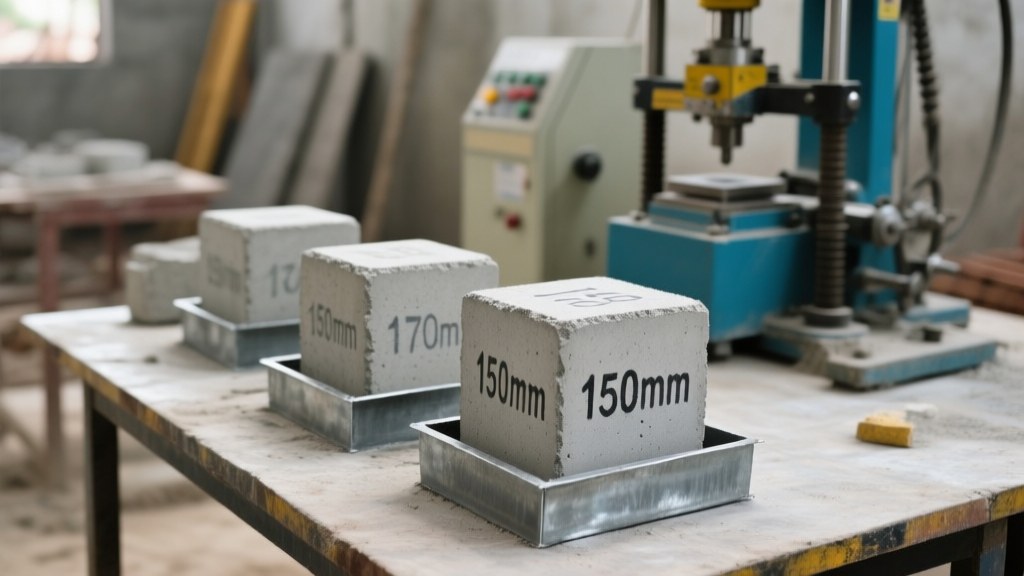
The contractor prepares three 150 mm × 150 mm × 150 mm steel-moulded cubes for every 1 cubic metre of concrete. After 24 hours the cubes are de-moulded, marked, and stored in a water-curing tank at 20 +/- 2 °C. The water level must be high enough to submerge the cubes completely; any exposure of the top surface to air reduces the 28-day strength by up to 6 %.
- Day 7: one cube is crushed in a calibrated hydraulic press. The reading is recorded as the 7-day strength. A typical 7-day value for M-20 concrete is 13-14 MPa; if you obtain less than 11 MPa, the mix is already under-designed.
- Day 28: the remaining two cubes are crushed. The average of the two gives the 28-day strength. For a high-early-strength admixture, you may see 28-day values 5-7 % higher than the nominal grade, which can be used to justify a reduction in column reinforcement.
- If the 28-day average is below the design value, the batch is rejected and a new mix is ordered. The contractor must also record the ambient temperature, slump, and any admixture dosage on the test log sheet - these data help trace the cause of a low result.
Most Indian labs charge Rs. 350 per cube for the 28-day test. Private labs in Delhi or Mumbai may ask Rs. 500-800, but they usually give faster turnaround (48 hours). Some large contractors negotiate a bulk rate of Rs. 250 per cube when they submit more than 100 cubes per month.
Target compressive strengths for different structural members
| Structural element | Typical design strength (MPa) | Recommended minimum (MPa) |
|---|---|---|
| Footing (soil bearing < 150 kPa) | 25-30 | 20 |
| Slab (residential live load 2 kN/m^2) | 20-25 | 18 |
| Beam (simply supported, span <= 4 m) | 25-30 | 22 |
| Column (axial load < 300 kN) | 30-35 | 25 |
If you are using UltraTech's M-25 grade cement with 20 mm river sand, you should see at least 25 MPa at 28 days for a solid footing. Anything less, and you are gambling with the foundation. In a recent 3-bedroom house in Bhopal, the footing cubes gave 22 MPa. The engineer ordered a 10 % increase in cement content and a super-plasticiser, which raised the subsequent batch to 27 MPa.
Common mistakes that kill strength - and how to avoid them
Cheap contractors cut corners. The worst offenders are:
- Using excess water to improve workability - each extra litre drops strength by about 5 %. For a 1 m^3 batch, adding 25 L of water instead of the recommended 180 L can reduce the 28-day strength from 25 MPa to 21 MPa.
- Skipping the curing tank and just sprinkling water once a day - the cube will lose 10-15 % of its strength. A field observation in Hyderabad showed that slabs cured by misting alone cracked after 6 months under thermal cycling.
- Mixing cement and aggregates on the ground instead of a mixer - leads to uneven distribution and weak spots. Hand-mixing a 2 m^3 batch resulted in a 28-day strength variation of 6 MPa between the first and third cube.
Don't be fooled by cheap labs that give you a half-baked result. A proper curing regime (see Concrete Curing Methods, Duration and Mistakes Indian Homeowners Make 2026) is the only way to trust the numbers. Also read Stirrups in Beams and Columns 2026 - Spacing, Size and Complete Guide to ensure the steel layout matches the concrete strength you achieve.
Cost of testing and who should do it
For a 2,000 sq ft house you will need roughly 15 cubic metres of concrete. That means 45 cubes, costing about Rs. 15,750 at a government-run lab. Private labs charge up to Rs. 36,000 for the same job but promise same-day reports. The additional cost may be justified if the project timeline is tight, but never compromise on the lab's accreditation (ISO 9001 or IS 516).
Hire a certified lab supervisor (often an M.Sc. Civil Engineer) to watch the mixing and moulding. Their fee is Rs. 2,000-3,000 per day, a small price compared to the risk of a foundation failure. The supervisor should also verify the slump (usually 70-100 mm for residential concrete) and record the temperature of the mixing water.
Putting the cube test into your construction plan
Schedule the first batch of cubes before the foundation pour. If the 7-day strength is already below 15 MPa, change the mix immediately - don't wait for the 28-day result. In a project in Surat, early detection of a 12 MPa 7-day cube prevented the use of a sub-standard batch that would have required a redesign of the ground floor columns.
Use the Concrete Mix Ratio Guide to pick the right grade. For most homes M-20 to M-25 works, but if your soil bearing capacity is under 100 kPa, step up to M-30. The Foundation Types: Which One Your Soil Needs article explains how to obtain a reliable bearing value from a geotechnical report.
My final advice: treat the cube test like a blood test for your house. It tells you whether the concrete is healthy. Skipping it or accepting a low number is the most common fraud in the trade. Get the test done, compare it with the table above, and demand a new mix if it falls short. Your house will thank you when the monsoon floods hit.
Field testing vs lab testing - which one is more reliable for homeowners
Many site engineers rely on on-site field tests such as the Schmidt hammer rebound test or the simple slump test because they are quick and cheap. However, field tests measure surface hardness or workability, not the ultimate compressive capacity of the hardened concrete. Lab-based cube testing, performed under controlled temperature and curing conditions, follows IS 516 and provides a direct measurement of compressive strength.
In practice, a homeowner who insists on a field test may be misled by a high rebound number that actually reflects surface smoothness rather than core strength. For a 25 MPa design, a rebound value of 40 can correspond to anywhere between 20 MPa and 30 MPa depending on aggregate type and surface condition. By contrast, a properly cured cube will give a result within +/- 2 % of the true compressive strength.
Below is a quick comparison that highlights the key differences:
| Aspect | Field testing (e.g., rebound hammer) | Lab cube testing (IS 516) |
|---|---|---|
| Parameter measured | Surface hardness / elastic rebound | Compressive strength under uniform load |
| Accuracy | +/- 10-15 % (highly dependent on operator) | +/- 2-3 % (standardised procedure) |
| Equipment cost | Rs. 2,500-4,000 for a basic hammer | Rs. 350-800 per cube (lab fees) |
| Time to result | Immediate (minutes) | 7 days for early reading, 28 days for design value |
| Suitability for critical members | Not recommended for footings or columns | Mandatory for footings, columns, and load-bearing beams |
For a homeowner, the safest route is to use both: a field test for quick on-site checks and a lab cube test for the final verification of structural elements.
Reading the cube test report - what each column means (IS 516 format)
The IS 516 cube test report is a tabular document that may look cryptic at first glance. Understanding each column helps you verify that the lab followed the correct procedure and that the numbers are reliable.
- Sample No. - Sequential identifier (e.g., C001, C002). Ensure the numbers match the cubes you marked on site.
- Age (days) - Usually 7 or 28. Some labs also give a 14-day result for early-strength mixes.
- Load (kN) - The maximum load applied to crush the cube. This is the raw figure before conversion.
- Compressive Strength (MPa) - Load divided by the cross-sectional area (0.15 m × 0.15 m = 0.0225 m^2). Verify the calculation: 500 kN ÷ 0.0225 m^2 = 22.2 MPa.
- Average Strength (MPa) - For 28-day tests, the average of the two cubes. If the average deviates more than 5 % from the individual values, the lab should note a possible anomaly.
- Temperature (°C) - Curing temperature. Deviations beyond 22 +/- 2 °C must be recorded because they affect strength development.
- Remarks - Any observations such as "water leakage in tank" or "mix contained super-plasticiser".
Sample entry:
Sample No. : C015
Age (days) : 28
Load (kN)  : 620
Compressive Strength (MPa) : 27.6
Average Strength (MPa)    : 27.4
Temperature (°C)           : 20
Remarks                     : No anomalies
Cross-check the "Load" column against the "Compressive Strength" column; any mismatch indicates a calculation error that could invalidate the report.
Non-destructive testing alternatives (rebound hammer, ultrasonic) when cubes are not taken
In some remote sites, taking cubes to a lab is logistically difficult. Non-destructive testing (NDT) offers a way to estimate concrete quality without breaking specimens. The two most common NDT methods in Indian residential construction are the Schmidt rebound hammer and ultrasonic pulse velocity (UPV).
- Rebound hammer - Measures surface hardness. Results are expressed as a rebound number (R). For normal weight concrete, R = 30 roughly corresponds to 25 MPa, but the correlation varies with aggregate type and surface finish. The method is inexpensive (Rs. 3,000-4,000 instrument) and gives immediate feedback, but it cannot detect internal flaws.
- Ultrasonic pulse velocity - Sends an ultrasonic pulse through the concrete and measures the travel time. Higher velocity indicates denser, stronger concrete. Typical values: 4.0-4.5 km/s for good quality concrete (>30 MPa), 3.0-3.5 km/s for marginal concrete (15-20 MPa). The equipment costs Rs. 12,000-20,000 and requires calibration against known strength samples.
Both methods have limitations. Moisture, temperature, and reinforcement bars affect the readings. Therefore, they are best used as supplemental checks rather than replacements for cube testing.
Comparison of the two NDT techniques:
| Method | Equipment cost (Rs.) | Typical accuracy | Depth of inspection | Influence of reinforcement |
|---|---|---|---|---|
| Rebound hammer | 3,000-4,000 | +/- 10 % (subject to calibration) | Surface 0-30 mm | Low - but steel can give higher rebound |
| Ultrasonic pulse velocity | 12,000-20,000 | +/- 5-7 % | Up to 150 mm (depends on transducer spacing) | Moderate - steel accelerates pulse |
If you cannot take cubes, schedule at least three NDT readings per structural member and compare them with the target strength chart. Document the exact locations and conditions; this record can be useful during future resale or insurance assessments.
What to do if cubes fail - retest, core test, structural audit checklist
A failed cube - meaning the 28-day average is below the specified grade - is a red flag. Do not assume the problem is isolated; concrete strength is a bulk property and a low result often indicates a systemic issue.
- Retest the batch - Immediately cast a new set of three cubes from the same mixer truck. If the second set meets the design strength, investigate the cause of the first batch (e.g., water addition, admixture dosage).
- Core test on hardened elements - Drill cores (diameter 100 mm, length 150 mm) from the poured element (footing, slab, or column) and send them to an accredited lab for compressive testing. The core strength is typically 80-85 % of the cube strength; use the conversion factor recommended in IS 2386-2.
- Structural audit checklist - Before proceeding with further construction, complete the following:
- Verify mix design calculations (cement content, water-cement ratio, aggregate grading).
- Check water temperature and mixing water quality (no chlorides above 300 ppm).
- Confirm that the batching plant is calibrated; request a recent calibration certificate.
- Review curing records - ensure continuous water curing for at least 7 days.
- Inspect reinforcement placement for proper cover; inadequate cover can cause premature corrosion, affecting long-term strength.
- Document all findings and obtain a signed statement from the contractor acknowledging the corrective actions.
- Engage a third-party consultant - If the failure persists after corrective measures, hire an independent structural consultant (M.Sc. Civil, IS 800 certified) to assess the risk of proceeding with the current mix. The consultant may recommend a higher-grade cement or the inclusion of silica fume to boost strength.
Remember, a single low-strength cube does not automatically mean the entire structure is unsafe, but it does warrant a thorough investigation. Ignoring it can lead to costly repairs or, in worst cases, structural failure during extreme events such as earthquakes or heavy monsoon loads.
Putting everything together - a practical checklist for the homeowner
- Before ground breaking, obtain a signed mix design from the contractor that references IS 10262-2019.
- Arrange for a certified lab to receive the first three cubes within 2 hours of mixing.
- Inspect the curing tank - water temperature should be 20 +/- 2 °C, and the tank must be covered to prevent evaporation.
- Review the 7-day strength report. If below 15 MPa for M-20 concrete, halt further pours until a new mix is approved.
- After 28 days, compare the average strength with the design table. Record the full IS 516 report and keep it in your project folder.
- If you cannot get cubes, schedule at least three rebound hammer readings per major member and an ultrasonic test on the slab surface. Document the raw numbers and the conversion used.
- In case of failure, follow the retest-core-audit protocol described above before proceeding.
- Finally, retain all test reports, mixing logs, and supervisor certificates for at least 5 years - they are valuable during resale or insurance claims.
By treating concrete testing as a non-negotiable part of the construction schedule, you protect your investment and ensure that the house will stand the test of time, whether the monsoon rains or the next generation of occupants come along.