
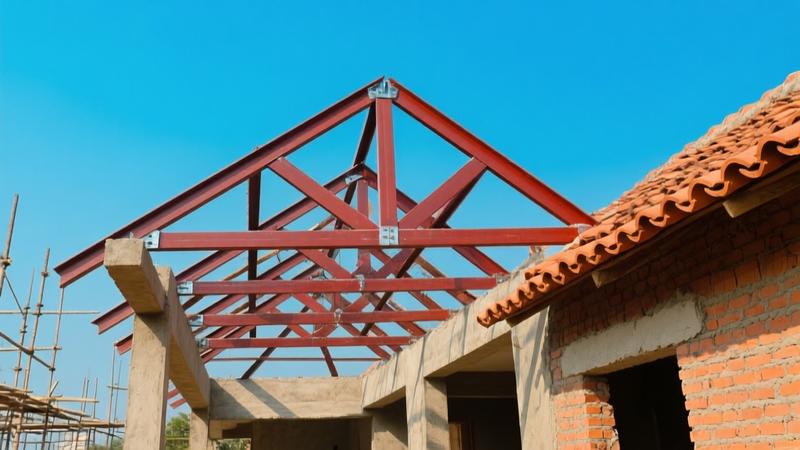
1. Cost per square foot - how the numbers break down
Below are realistic numbers for Bangalore (steel Rs 55/kg) and Delhi (steel Rs 48/kg). I took an average steel price of Rs 52/kg, cement bag Rs 400, 20 mm aggregate Rs 1,200 per cu m and labour Rs 350 per man-day. All figures are inclusive of typical profit margins for a small contractor.
| Built-up area | Item | Truss roof (Rs./sq ft) | RCC slab (Rs./sq ft) |
|---|---|---|---|
| 1,000 sq ft | Steel (truss) | Rs 45 | Rs 30 |
| Steel (RCC) | - | Rs 30 | |
| Cement (bags) | Rs 12 | Rs 20 | |
| Aggregate | Rs 8 | Rs 15 | |
| Brick / block (for parapet) | Rs 5 | Rs 5 | |
| Labour | Rs 20 | Rs 35 | |
| Formwork / sheet metal | Rs 10 | Rs 12 | |
| Total approx. Rs 100 per sq ft for truss, Rs 137 per sq ft for RCC | |||
| 1,500 sq ft | Steel (truss) | Rs 45 | Rs 30 |
| Steel (RCC) | - | Rs 30 | |
| Cement (bags) | Rs 12 | Rs 20 | |
| Aggregate | Rs 8 | Rs 15 | |
| Brick / block | Rs 5 | Rs 5 | |
| Labour | Rs 20 | Rs 35 | |
| Formwork / sheet metal | Rs 10 | Rs 12 | |
| Total approx. Rs 100 per sq ft for truss, Rs 137 per sq ft for RCC | |||
| 2,000 sq ft | Steel (truss) | Rs 45 | Rs 30 |
| Steel (RCC) | - | Rs 30 | |
| Cement (bags) | Rs 12 | Rs 20 | |
| Aggregate | Rs 8 | Rs 15 | |
| Brick / block | Rs 5 | Rs 5 | |
| Labour | Rs 20 | Rs 35 | |
| Formwork / sheet metal | Rs 10 | Rs 12 | |
| Total approx. Rs 100 per sq ft for truss, Rs 137 per sq ft for RCC | |||
The per-sq-ft cost stays almost flat because most items scale linearly. The big difference is steel consumption and labour intensity.
2. How far can you span without intermediate support?
| Clear span (ft) | Maximum span with standard steel truss | Maximum span with RCC slab (125 mm thick) |
|---|---|---|
| 12-16 | 12-16 (single bay) | 12-16 (single beam) |
| 16-20 | 16-20 (double bay, 6 mm T-section) | 16-20 (beam 200x300 mm, 1.5 m spacing) |
| 20-24 | 20-24 (tri-angular truss, 8 mm T-section) | 20-24 (beam 250x300 mm, 1.2 m spacing) |
| 24-30 | 24-30 (prefab tubular truss, 10 mm T-section) | 24-30 (beam 300x350 mm, 1 m spacing) |
| 30-36 | 30-36 (RCC frame truss or heavy tubular, 12 mm T-section) | 30-36 (requires deep beam 350x400 mm, 0.9 m spacing) |
Trusses win as you go beyond 24 ft because steel carries tension better than a concrete slab. For a 30-ft span a typical RCC slab would need a massive beam that eats up floor area.
3. Which house size prefers which system?
- Small homes < 1,200 sq ft - truss roof is cheaper, lighter and quicker. You rarely need a deep beam, so the cost gap widens to Rs 30-40 per sq ft.
- Medium 1,200-1,800 sq ft - a mix works. If you have a long rectangle (e.g., 30 ft width) go truss; if the plan is compact (20 ft width) RCC is fine.
- Large > 1,800 sq ft - RCC becomes competitive because the slab can double as a service floor, you can embed ducts, and the extra steel cost is offset by lower labour on large spans.
4. Climate and monsoon - what to watch out for
Concrete stores heat. A 125 mm RCC slab can raise indoor temperature by 3-4 °C compared to a ventilated truss with metal sheet. If you live in Hyderabad or Pune, a reflective coating (white aluminium paint) on the sheet metal costs about Rs 30 per sq ft and cuts the heat gain by half.
Trusses need proper waterproofing. The joints between sheet metal and purlins must be sealed with bitumen or EPDM membrane - roughly Rs 15 per sq ft. Missing this seal is the most common cause of leaks during monsoon. RCC joints are easier; just follow good practice for construction joints - see our Monsoon Construction Guide 2026 for details.
Insulation: 25 mm polystyrene under a metal sheet costs Rs 35 per sq ft, while a 50 mm concrete plaster with vermiculite under a RCC slab is about Rs 45 per sq ft. Choose based on budget and desired R-value.
5. Material usage at a glance
| System | Steel (kg per sq ft) | Concrete grade | Formwork |
|---|---|---|---|
| Truss roof (angle iron) | 5-6 | - | Light gauge steel or plywood, Rs 2 per sq ft |
| Truss roof (tubular) | 5-6 | - | Plywood 12 mm, Rs 2.5 per sq ft |
| RCC slab | 3-4 | C25 (25 MPa) | Plywood 15 mm, Rs 3 per sq ft |
Less steel means lighter foundations. If your plot has weak soil, a truss roof can save you from deep footings.
6. Common truss types you'll see on site
- Angle-iron truss - hot-rolled 150 mm x 75 mm angles, cheap, good for spans up to 20 ft.
- Tubular steel truss - 48 mm diameter hollow sections, prefabricated, ideal for 24-30 ft spans.
- Prefabricated galvanized truss - factory-made, comes with pre-drilled holes for purlins, reduces erection time.
- RCC frame truss - concrete ribs with steel reinforcement, used when you want a solid look and extra fire resistance.
7. Beam sizes and slab thickness for RCC
A 125 mm slab is standard for residential roofs. Beams are sized by span:
- 12-20 ft span - 200 mm x 300 mm beam, spaced 1.5 m.
- 20-24 ft span - 250 mm x 300 mm beam, spaced 1.2 m.
- 24-30 ft span - 300 mm x 350 mm beam, spaced 1 m.
- 30-36 ft span - 350 mm x 400 mm deep beam, spacing 0.9 m.
All beams use 12 mm dia TMT bars at 150 mm centre, stirrups 8 mm @ 150 mm.
8. Construction time - the real schedule
Truss roof: steel members arrive, erect in 2-3 days, sheet metal fixed another day, insulation and waterproofing another day. Total 4-5 days from start to weather-proof roof.
RCC slab: formwork 2-3 days, concrete pour, 7-10 days curing before waterproofing. Expect 10-14 days for a complete roof ready for interior work.
9. Durability - how long will it last?
- RCC slab - 80-100 years if good cover (25 mm) and proper curing. No major maintenance until you want a new finish.
- Truss roof - 40-60 years. Steel will rust if paint fails; repaint every 8-10 years. Sheet metal lasts 25-30 years before replacement.
10. When each system is mandatory
- Truss needed for terrace garden, solar PV mounting, or when you plan a future mezzanine. The light weight lets you add a garden without over-loading the foundation.
- RCC required for multi-storey extensions, integrated services (plumbing, wiring) that run in the slab, or when you intend to add another floor later.
11. Common mistakes that bite you later
- Poor welds on angle-iron - leads to sudden collapse.
- Undersized members - truss sagging, cracking.
- Missing diagonal bracing - lateral instability.
- No anti-rust paint on steel - rust spots, corrosion.
- Skipping waterproofing membrane on truss - leaks during monsoon.
- Using cheap corrugated sheet without proper fixing - tile cracking.
12. Future proofing - think beyond today
- Plan for a false ceiling: leave 150 mm clearance in the truss design, or embed recessed channels in the RCC slab.
- Waterproofing layers: for RCC use a 2-coat polymer membrane (Rs 25 per sq ft) plus a screed; for truss use bitumen sheet + waterproof paint.
- If you may add a floor, keep the roof beam size at least 250 mm deep - it will act as the footing for the next level.
13. Regional preferences - what neighbours do
South Indian states (Karnataka, Tamil Nadu, Kerala) lean 70-80 % RCC because of heavy rains and the habit of using concrete for thermal mass. In the North (Punjab, Haryana, UP) the split is about 60-40 favouring trusses, especially in flat roof villages where steel is cheap.
14. Bottom line for a typical 1,500 sq ft house
If your plot has decent soil, you want a quick roof and plan a terrace garden, go with a tubular steel truss and reflective sheet. Expect Rs 100 per sq ft total, 5-day erection, and a 40-year lifespan with repainting.
If you are thinking of adding a second floor later, need heavy service ducts, or live in a hot, humid zone where thermal mass is a plus, choose an RCC slab. It costs about Rs 137 per sq ft, takes two weeks, but will last a century and support future expansion.
My advice: for most 1,500 sq ft homes in Bangalore or Delhi, the truss roof gives the best value-to-speed ratio. Keep a reserve of Rs 5-10 lakh for waterproofing and periodic repaint.
Related: Monsoon Construction Guide 2026
Related: Common Construction Mistakes to Avoid During House Building in India 2026
Related: How to Add a Floor to Existing House 2026
Frequently asked questions on truss vs RCC roof
Can a truss roof be converted to RCC slab later?
Technically yes, but it is rarely worth it. The trusses have to come down, the purlins and roofing sheet are wasted, and you still have to pour a fresh slab with new columns. Budget 1.8 to 2 times the original RCC slab cost to do the conversion, versus building the slab in the first place.
Is RCC slab more waterproof than a tiled truss roof?
A properly waterproofed RCC terrace is more reliable in the long run because there are no joints for water to enter. A tiled truss roof relies on the underlay membrane and tile overlap, both of which degrade over 20-25 years. For monsoon-heavy regions (Mumbai, Konkan, Kerala coast), RCC slab with bitumen membrane plus liquid coating is the safer bet.
What is the best roof slope for a truss with tiles?
For Mangalore tiles, 22 to 30 degrees works. Below 22 degrees water seeps through tile overlaps during heavy rain. Above 30 degrees the tiles need mechanical fixing (screws or clips), and the truss steel cost goes up because of the steeper geometry.
How much does anti-rust treatment add to truss cost?
Red oxide primer plus one enamel coat runs about Rs. 18-25 per sq ft of steel surface. Hot-dip galvanising is Rs. 45-60 per kg of steel, more durable but used mostly for prefabricated trusses. For site-fabricated angle iron trusses, primer plus enamel is the standard.