
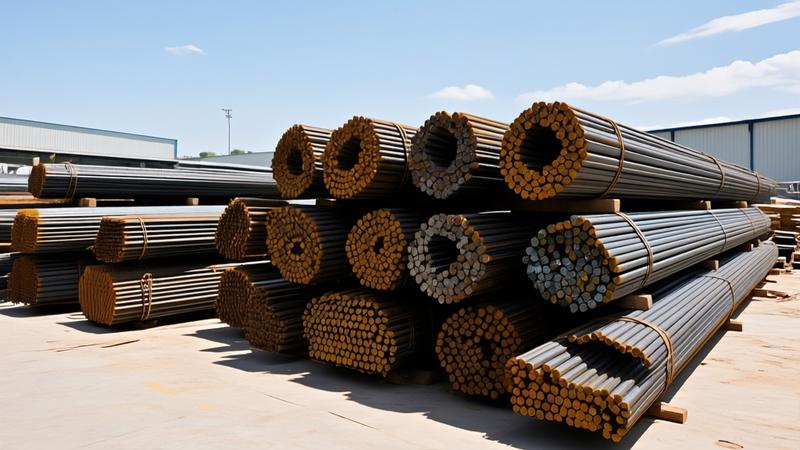
Soot to MM Conversion Chart for Steel Bars - Complete Reference 2026
In Indian construction the term soot (also written as sut or suti) is still widely used to describe the diameter of TMT steel bars. Most homeowners, small contractors and local masons understand soot because it has been part of the trade language for decades. However the official specifications and most suppliers quote bar sizes in millimetres (mm). This guide bridges the gap by providing a clear conversion, weight data, ordering tips and real-world examples so you can buy the right steel without confusion.
Soot measurement is essentially a shorthand for a predefined bar diameter. One soot corresponds to a specific millimetre size, and the relationship is fixed across the industry. The system originated when steel bars were produced in limited standard sizes and the local market needed a quick way to communicate them. Today, even though manufacturers label bars in mm, many purchase orders, invoices and verbal agreements still use soot.
Historically the soot system was introduced during the early days of reinforced concrete in India, when imported steel rods were marked with simple numeric codes. The codes evolved into the present eight-step scale ranging from 1 soot (8 mm) to 8 soot (32 mm). Rural and semi-urban markets adopted the scale because it matched the dimensions of the most common construction elements such as columns, beams and slab reinforcement.
Why does soot persist despite the modern metric system? The answer lies in habit, ease of communication and the fact that many local suppliers still price their stock per soot. When a mason asks for "3 soot bars", the supplier instantly knows the size, weight per metre and typical bundle weight. Understanding both notations prevents costly mistakes and ensures your steel order matches the structural design.
Understanding Soot (Sut/Suti) in Indian Construction
The word "soot" is derived from the Hindi word "sut" meaning "thread". In practice, it is a numeric label that represents a specific bar diameter. The most common sizes you will encounter are 8 mm, 10 mm, 12 mm, 16 mm, 20 mm, 25 mm, 28 mm and 32 mm, each linked to a soot number from 1 to 8. The conversion is fixed and does not change with the brand of steel, which makes it a reliable reference for both buyers and suppliers.
Regional usage varies slightly, but the eight-step scale is accepted nationwide. In North India the term "sut" is more common, while in South India "suti" is used interchangeably. Regardless of the local dialect, the underlying dimensions remain the same, so a 4-soot bar in Delhi is exactly the same as a 4-soot bar in Chennai.
When you request a bar by soot, the supplier will usually quote the price per kilogram and the standard bundle length. The bundle length is typically 10 m per bar, and a bundle contains ten bars, giving a total length of 100 m. Knowing the bundle composition helps you calculate the total weight and cost before the steel arrives on site.
It is important to differentiate between soot and millimetre specifications because structural calculations are based on the actual diameter in mm. A design engineer will specify 12 mm bars, which corresponds to 3 soot, but if you mistakenly order 4 soot (16 mm) you will increase weight, cost and concrete cover requirements. The tables below remove that ambiguity.
Conversion from Soot to Millimetre
| Soot (Sut/Suti) | Diameter (mm) |
|---|---|
| 1 | 8 |
| 2 | 10 |
| 3 | 12 |
| 4 | 16 |
| 5 | 20 |
| 6 | 25 |
| 7 | 28 |
| 8 | 32 |
The conversion is linear in the sense that each increase in soot adds a specific increment in diameter. From 1 soot to 2 soot the diameter jumps by 2 mm, while from 4 soot to 5 soot the increase is 4 mm. This pattern reflects the historical availability of bar sizes and the engineering requirements for larger structural elements.
For quick reference, you can use the following mental shortcut: multiply the soot number by 4 and add 4 to get the approximate diameter in mm for soot numbers 1 through 4 (e.g., 3 soot -> 3x4+4 = 16 mm, which is close to the actual 12 mm). For higher soot numbers the increment grows, so it is safer to consult the chart above.
Example: If a structural drawing calls for 20 mm bars, you can simply request "5 soot" from the supplier. The supplier will then provide 20 mm TMT bars, and you can verify the size by measuring the bar diameter with a caliper. This back-and-forth communication is common on site and saves time compared to writing "20 mm" on every purchase order.
Related: How to calculate steel weight for a house
Weight per Metre for Each Size
| Soot | Diameter (mm) | Weight (kg per metre) |
|---|---|---|
| 1 | 8 | 0.395 |
| 2 | 10 | 0.617 |
| 3 | 12 | 0.888 |
| 4 | 16 | 1.578 |
| 5 | 20 | 2.466 |
| 6 | 25 | 3.853 |
| 7 | 28 | 4.832 |
| 8 | 32 | 6.313 |
The weight values are calculated using the standard formula Weight (kg/m) = (Diameter² x 0.006165). This formula assumes the steel density is 7850 kg/m³, which is the typical density for TMT bars. The resulting weights are widely accepted by steel manufacturers and are printed on product catalogues.
Understanding weight per metre is essential for estimating the total steel requirement of a project. If you know the length of each bar you need, simply multiply the length by the corresponding weight per metre to obtain the total kilograms. This method works for both individual bars and for bulk calculations involving many members.
Weight also directly affects transport and handling costs. A 100 m bundle of 16 mm bars weighs nearly 158 kg, which may require a small truck for delivery. By contrast, a 100 m bundle of 8 mm bars weighs only about 40 kg and can be carried manually on a small trolley. Planning bundle sizes based on weight helps avoid unexpected logistics charges.
When you compare steel prices, remember that the quoted price is usually per kilogram. Therefore a heavier bar will cost more per metre even if the price per kilogram is the same. This is why many contractors prefer to calculate cost based on total kilograms rather than the number of bars.
How to Calculate Steel Requirement for a Project
The calculation process can be broken into three simple steps: (1) list all structural members, (2) determine the length of each member in metres, and (3) multiply the length by the weight per metre from the table above. The sum of all individual weights gives the total steel requirement in kilograms, which can then be converted to metric tonnes for ordering.
Step 1 - List members: Identify columns, beams, slabs, footings and any special reinforcement such as stirrups. For each member note the required bar diameter (soot or mm) as specified by the structural engineer. It is common to have multiple diameters in a single member - for example a beam may use 12 mm main bars and 8 mm distribution bars.
Step 2 - Determine length: Measure the clear length of each bar, adding extra length for hooks, bends and wastage. A typical rule of thumb is to add 5 % to the calculated length for cutting and fitting. For example, a 3 m column bar becomes 3.15 m after adding 5 %.
Step 3 - Multiply and sum: Use the weight per metre table to find the weight for each bar size. Multiply the adjusted length by the weight per metre, then add the results for all bars. The final figure is the total steel weight needed for the entire structure.
Example: A single 3 m column using 16 mm bars (4 soot) would require 3.15 m x 1.578 kg/m = 4.97 kg per bar. If the column uses four such bars, the total for the column is 4 x 4.97 kg = 19.9 kg. By repeating this process for all columns, beams, and slabs you obtain the complete steel estimate.
Related: Common construction errors and how to avoid them
Bundle Weights and Ordering Practicalities
Suppliers typically sell TMT bars in bundles that consist of ten bars, each 10 m long. This results in a total length of 100 m per bundle, and the weight of each bundle can be calculated by multiplying the weight per metre by 100. Knowing the bundle weight helps you decide how many bundles to order and how many trips the delivery truck will need.
| Soot | Diameter (mm) | Weight per 100 m Bundle (kg) |
|---|---|---|
| 1 | 8 | 39.5 |
| 2 | 10 | 61.7 |
| 3 | 12 | 88.8 |
| 4 | 16 | 157.8 |
| 5 | 20 | 246.6 |
| 6 | 25 | 385.3 |
| 7 | 28 | 483.2 |
| 8 | 32 | 631.3 |
When placing an order, specify both the soot number and the number of bundles you need. For example, "4 soot, 5 bundles" tells the supplier you require five bundles of 16 mm bars, totaling 5 x 157.8 kg = 789 kg of steel. It is advisable to request a weight tolerance of ±2 % on the delivery note, as minor variations can occur due to manufacturing tolerances.
Transport considerations also depend on bundle weight. A standard small truck can carry up to 2 tonnes, which means you can load up to three bundles of 6 soot (25 mm) in a single trip. Planning the number of trips in advance prevents delays on the construction site and helps you negotiate better freight rates.
Common Mistakes When Ordering by Soot vs Millimetre
- Assuming 1 soot always equals 8 mm without checking the local conversion chart.
- Ordering the wrong diameter because the design calls for a specific mm size but the purchase order mentions a different soot number.
- Neglecting to add wastage allowance, leading to shortage of steel on site.
- Confusing bundle length (10 m per bar) with total bundle length, causing over-ordering.
- Not verifying the weight per metre, which can result in cost overruns when heavier bars are delivered.
Each of these mistakes can have a financial impact. For instance, ordering 4 soot (16 mm) when the design requires 3 soot (12 mm) can increase the steel weight by about 78 % for the same length, inflating material costs significantly. Similarly, forgetting to include a 5 % wastage factor may cause you to run short during construction, forcing you to place an urgent extra order at higher prices.
Another frequent error is to treat the bundle as a single unit of 10 m total length. In reality, a bundle contains ten bars of 10 m each, so the total length is 100 m. Misinterpreting this can lead to ordering only a tenth of the required steel, especially on larger projects where dozens of bundles are needed.
Finally, always cross-check the supplier's invoice. The price is usually shown per kilogram, but the total weight may be listed in kilograms or tonnes. Converting the numbers yourself helps you catch any rounding errors or hidden surcharges before payment.
Practical Example: Reinforcement for a 1200 Sq Ft House
A typical 1200 sq ft (111 sqm) single-storey house has a slab thickness of 150 mm, four columns, three beams and a strip footing. Using common reinforcement guidelines, we can estimate the steel requirement as follows.
Foundation and Strip Footing: Assume a 0.3 m wide strip footing running around the perimeter (40 m total length). Provide 12 mm bars at 200 mm centre spacing. Number of bars = 40 m / 0.2 m = 200 bars; each bar length = 0.3 m. Total length = 200 x 0.3 m = 60 m. Weight = 60 m x 0.888 kg/m = 53.3 kg.
Columns: Four columns of 0.3 m x 0.3 m cross-section, height 3 m. Use four 16 mm bars per column. Adjusted length per bar = 3 m x 1.05 = 3.15 m. Total length per column = 4 x 3.15 m = 12.6 m. For four columns, total length = 50.4 m. Weight = 50.4 m x 1.578 kg/m = 79.5 kg.
Beams: Three beams each 0.3 m x 0.5 m, length 10 m. Main reinforcement: two 12 mm bars per beam, length = 10 m x 1.05 = 10.5 m each. Total main length = 3 beams x 2 bars x 10.5 m = 63 m. Weight = 63 m x 0.888 kg/m = 55.9 kg. Distribution reinforcement: four 8 mm bars per beam, same adjusted length. Total distribution length = 3 x 4 x 10.5 m = 126 m. Weight = 126 m x 0.395 kg/m = 49.8 kg.
Slab: Area = 111 sqm, thickness = 0.15 m, volume = 16.7 cubic m. Main reinforcement: 12 mm bars at 200 mm spacing in both directions. Number of bars per direction = 10 m / 0.2 m = 50; total bars = 100; length per bar = 10 m. Total main length = 100 x 10 m = 1000 m. Weight = 1000 m x 0.888 kg/m = 888 kg. Distribution reinforcement: 8 mm bars at 150 mm spacing. Number of bars per direction = 10 m / 0.15 m â 67; total bars = 134; length per bar = 10 m. Total distribution length = 1340 m. Weight = 1340 m x 0.395 kg/m = 529.3 kg.
Summing all components gives a total steel weight of approximately 1,594 kg (1.6 tonnes). This figure is a realistic estimate for a modest 1200 sq ft house built with standard reinforcement practices.
Pricing and Cost Estimation
The market price of TMT steel in 2026 varies with bar diameter, grade and location. Below is a typical price range per kilogram for common diameters:
- 8 mm (1 soot): Rs. 45-55 per kg
- 10 mm (2 soot): Rs. 50-60 per kg
- 12 mm (3 soot): Rs. 55-65 per kg
- 16 mm (4 soot): Rs. 70-85 per kg
- 20 mm (5 soot): Rs. 90-110 per kg
- 25 mm (6 soot): Rs. 110-130 per kg
- 28 mm (7 soot): Rs. 130-150 per kg
- 32 mm (8 soot): Rs. 150-180 per kg
Using the weight breakdown from the practical example, we can estimate the material cost. For 12 mm bars (main slab and beams) the total weight is 888 kg + 55.9 kg = 943.9 kg. At an average price of Rs. 60 per kg, the cost is about Rs. 56,600. For 8 mm bars (distribution reinforcement) the weight is 529.3 kg + 49.8 kg = 579.1 kg. At Rs. 50 per kg, the cost is about Rs. 28,950. For 16 mm column bars the weight is 79.5 kg, at Rs. 80 per kg the cost is Rs. 6,360. Adding a small allowance for wastage (5 %) brings the total steel cost to roughly Rs. 95,000 for the entire house.
When you convert the total weight to bundles, the example requires approximately 9 bundles of 12 mm (each 88.8 kg), 6 bundles of 8 mm (each 39.5 kg) and 1 bundle of 16 mm (157.8 kg). Discussing bundle numbers with the supplier helps you verify that the total weight matches the calculated requirement and reduces the chance of over- or under-ordering.
Related: How to calculate steel weight for a house
Tips for Homeowners, Contractors and Builders
- Always cross-check soot against millimetre size. Write both notations on the purchase order to avoid miscommunication.
- Include a 5-10 % wastage allowance. Extra steel is needed for cutting, bending and unexpected changes in design.
- Verify bundle weight on delivery. Ask for a weigh-bridge slip or ask the supplier to confirm the total kilograms delivered.
- Plan delivery in phases. Ordering all steel at once can lead to storage issues on site; stagger deliveries according to construction schedule.
- Negotiate price per kilogram, not per bundle. This prevents hidden markup if the bundle contains lighter or heavier bars than expected.
- Use the weight per metre table for quick calculations. A calculator or spreadsheet can speed up the process for large projects.
By following these best practices you can keep your steel procurement transparent, cost-effective and aligned with the structural design. Remember that steel is a critical safety component; any compromise on size or quantity can affect the durability of the building.
Conclusion
Understanding the soot (sut/suti) system and its conversion to millimetre sizes is essential for anyone involved in Indian construction. The conversion chart, weight per metre tables and bundle information provided in this guide give you all the data needed to order the correct quantity of TMT steel. Accurate calculations, proper wastage allowances and careful verification of bundles will protect you from costly mistakes and ensure structural integrity.
Whether you are a first-time homeowner, a seasoned contractor or a builder managing multiple sites, using the soot-to-mm reference will make your steel procurement smoother and more transparent. Keep this guide handy during the planning stage, share it with your supplier and always double-check the final delivery against the numbers presented here.